| Continued from Previous Page. From Wyoming Tales and Trails This Page: The Star Valley, Afton, Estelle Reel. |
 |
|
| Continued from Previous Page. From Wyoming Tales and Trails This Page: The Star Valley, Afton, Estelle Reel. |
|
|
|
|
About This Site |
|
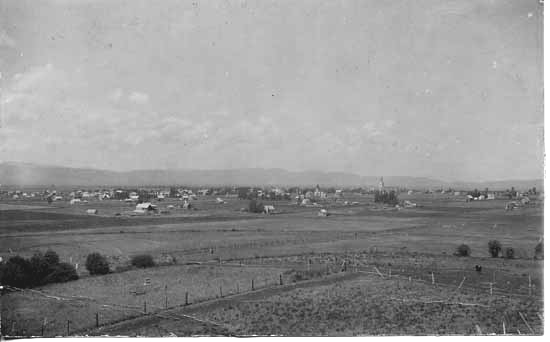
To the right of center, behind the clump of trees may be seen the spire of the Mormon Tabernacle. See next photo. Afton, like most towns in the Star Valley was founded by Mormons in 1885. The Star Valley lies to the northwest of Kemmerer and is separated from the rest of Lincoln County, and, indeed, the rest of the State by the Salt River Range. Although the area received its first settlers in 1859 when some English Mormons were employed to work on the Lander Cutoff which passed through the area, the primary growth began about 1880 when Moses Thatcher and Charles C. Rich, both members of the Quorum of the Twelve in the LDS Church, dedicated the valley for Mormon settlement. Thatcher and William B. Preston had first visited the what was then known as the Salt River Valley in the fall of 1877. Thatcher was active in establishing Mormon colonies including some in Mexico. He was later removed from the Quorum of the Twelve.
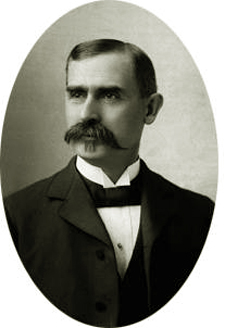 . . . .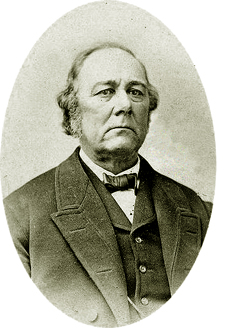 Left, Moses Thatcher; Right, Charles C. Rich
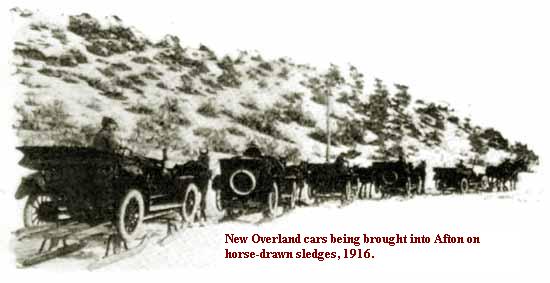
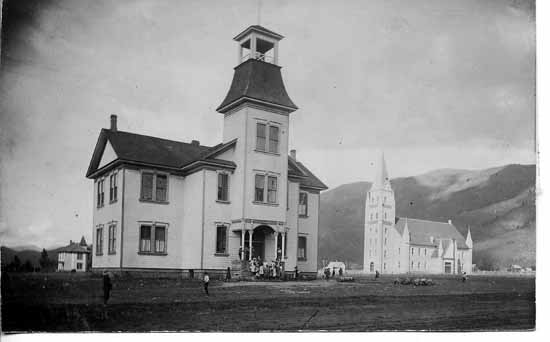 Afton School (left) and Mormon Tabernacle (right), 1911 The isolation of the valley made it a refuge for those who continued to practice polygamy. Access to the valley was by a spring wagon stage from Montpellier. In the winter the trek cold be brutal with three to fifteen foot snow drifts. Tipovers, breakdowns and swollen streams in the springtime could make things interesting. In some cases, the light spring wagons, because of the danger of being swept away crossing streams, were not up to the journey. In such instances, at Thomas' Fork Jack Merrill, the owner of the stageline, would substitute a Bain wagon for the portion of the trip down Crow Creek to Afton. Bain wagons were basically heavy springless farm wagons drawn by four horses. L. R. Martineau described the 30 miles down Crow Creek in the wagon as having "churned" the seven passengers "almost to a pulp." Deseret Evening News, May 17, 1904. Indeed, even as late as 1916 public transportation into or out of the valley was by stage, then operated by Kib Cook. The stage left Afton at 7:00 a.m. on Sundays and Wednesdays and returned the next day. If enough passengers to fill a load could be obtained a trip was also made on Fridays. If one missed the stage, the only other way out of town was over a treacherous road constructed by convict labor to Cokeville where one might catch a train. Fare on the stage one way in 1916 was $3.00 equal to $63.69 in 2012. In winter even in 1916 the town was physically cut off from the outside world. In January 1916, Lynch & Wells, the Willys-Overland dealer advertised that in spring it was bringing in a caload of new Model 83 Overlands, fitted with "high tension magneto ignition." Price for the cars f. o. b. factory were $695. The advertisement advised buyers not to "be satisfied with anything but high tension magneto ignition." Spring came and in due course, the new 1916 Overlands arrived in Montpellier. The dealeship had to bring the cars into Afton on horse-drawn sledges.
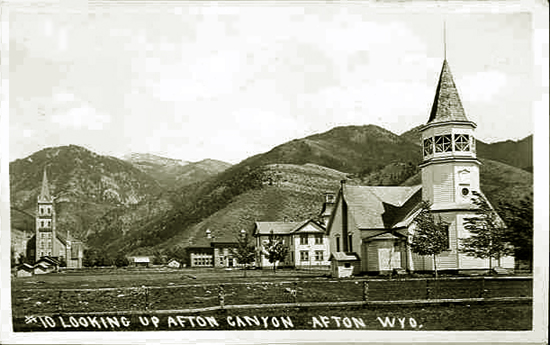 Afton, Wyoming, looking "up-canyon," approx. 1911, As indicated, the isolation of the area caused the valley to become attractive to those continuing to practice polygamy. Commencing in the 1870's and early 1880's, the Federal Government began criminal prosecution of members of the Church who practiced a teaching that promoted multiple wives. The law, itself, regulating the marital relationship had been passed in 1862 and signed by President Lincoln. The law, however, was generally ignored. The teaching found its origin with Joseph Smith in 1831 when he inquired of God why Abraham, Isaac, and Jacob, as also Moses, David and Solomon, were permitted to have multiple wives. The Lord replied that He had directed it: Abraham received concubines, and they bore him children; and it was accounted unto him for righteousness, because they were given unto him, and he abode in my law; as Isaac also and Jacob did none other things than that which they were commanded; and because they did none other things than that which they were commanded, they have entered into their exaltation, according to the promises, and sit upon thrones, and are not angels but are gods. Section 132, Doctrine and Covenants, July 12, 1843, Nauvoo, Illinois. The teaching, however, was not revealed to the Quorum of the Twelve until 1841 when Smith married Louisa Beaman. God's revalation was placed in writing in 1843 and made public in 1852.
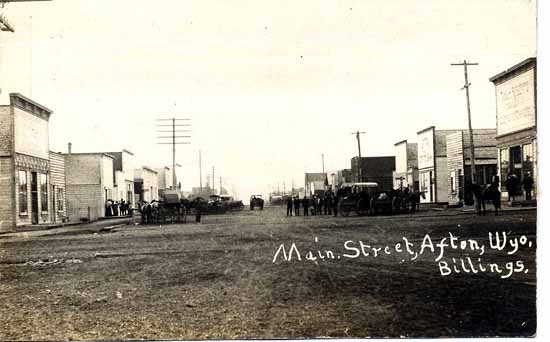 Main Street, Afton, approx. 1910 In 1875, Brigham Young's personal secretary was tried for violation of the Territorial Laws relating to plural marriages. He was found guilty and sentenced to two years in the Territorial Penitentiary. The case was appealed to the Territorial Supreme Court and then to the United States Supreme Court. After disposing of some procedural and evidentiary questions, the Court traced the history of the consitutional amendment guaranteeing freedom of religion and then concluded: By the statute of 1 James I. (c. 11), the offence, if committed in England or Wales, was made punishable in the civil courts, and the penalty was death. As this statute was limited in its operation to England and Wales, it was at a very early period re-enacted, generally with some modifications, in all the colonies. In connection with the case we are now considering, it is a significant fact that on the 8th of December, 1788, after the passage of the act establishing religious freedom, and after the convention of Virginia had recommended as an amendment to the Constitution of the United States the declaration in a bill of rights that 'all men have an equal, natural, and unalienable right to the free exercise of religion, according to the dictates of conscience,' the legislature of that State substantially enacted the statute of James I., death penalty included, because, as recited in the preamble, 'it hath been doubted whether bigamy or poligamy be punishable by the laws of this Commonwealth.' 12 Hening's Stat. 691. From that day to this we think it may safely be said there never has been a time in any State of the Union when polygamy has not been an offence against society, cognizable by the civil courts and punishable with more or less severity. In the face of all this evidence, it is impossible to believe that the constitutional guaranty of religious freedom was intended to prohibit legislation in respect to this most important feature of social life.Reynolds v. United States, 98 U.S. 145 (1878) [Writer's comment: It is hard to imagine what could be "punishable with more * * * severity" than death, unless it be hanging, drawing, and quartering, a punishment usually reserved for treason against the Crown. But Utah only made the offense punishable by five years in the Territorial Penitentiary.]
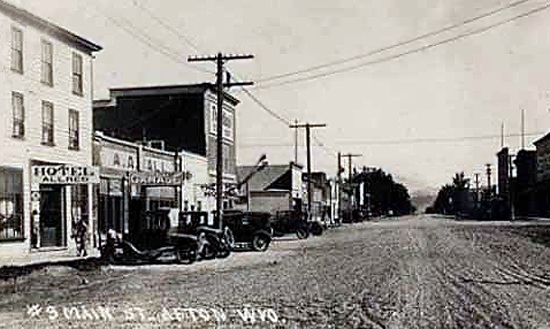 Main Street, Afton, Wyoming, aprox. 1920, Allred Hotel on left. The law remained, however, difficult of enforcement until 1882 when Congress enacted the Edmunds-Tucker Act. The act eliminated the need to prove an actual marriage ceremony and and permitted the Goverment to seize church buildings. Enforcement was stepped up in Utah and Idaho. In Idaho, United States Marshal Fred Dubois, after whom Dubois, Wyoming, is named, embarked on a cruisade against practitioners of multiple marriage. Many Mormons with multiple wives fled Utah and Idaho to Canada and Mexico. Others sought refuge in the secluded Star Valley of Wyoming. One of the first towns founded was Freedom settled in 1879. Freedom had the advantage that the main street was split by the Territorial Line with Idaho. Thus, to escape an Idaho marshal it was only necessary to cross the street. By 1886, enforcement of the law was having a critical impact upon the Church. Utah Territorial Governor Caleb W. West noted, as an example, in a proclamation that the chief officers of the Church, the First Presidency, were in hiding. Other prominent members, apostles, bishops, and teachers were confined in the Penitentiary. As a result, "Great expense is necessarily incurred, and our courts [are] continually burdened with the trial of offenses against the law." The problem, however, began to resolve itself in 1890 when God instructed Church President Woodward that the Church should obey the law of the land. Accordingly, a manifesto was issued by the Church that plural marriages were no longer sanctioned. Nevertheless, many refused to accept the manifesto and the population of the Star Valley continued to grow. The population was attracted by a Wyoming "live and let live" attitude. Next page: Afton continued, Miss Estelle Reel, conflict between cattlemen and sheep companies. |