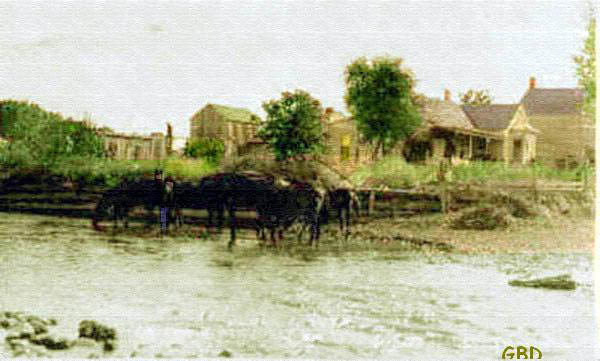
Watering Horses at Beulah, approx. 1910. Artwork by
G. B. Dobson
Across the Black Hills between 1880 and 1920, small towns arose and subsequently faded. Those towns included
Aladdin, Williams, Farrall, Hay Creek, Deep Creek, Croton and Lightning Flat. Such is Beulah the oldest town in Crook County.
The town is About 16 miles north of Sundance at the confluence of Sand Creek and Redwater Creek.
For several decades up until 2012, Beulah had a population of 33. The town celebrated its population by beginning
various functions at precisely thirty-three minutes past the hour. The Fourth of July parade would start at
3:33 p.m. Even though the town has a population of 33, the Fourth of July Parade is a Big Thing. The 1997 Parade had some 193 entries.
It took an hour for the parade to pass through the two-block long City Center.
The fire works for the Fourth of July and the additional fireworkds celebrating the annual return of the Harleys
to Beulah would start at 10:33 p.m. [Writer's note: Just as the buzzards annually return to
Hinkley and the swallows to Capistrano,the Harleys return to Beulah the first full week following the first weekend of
August each year.]
A local saloon is named Saloon 333. Saloons to a great extent, as discussed below, contributed to the
town's early growth and its continued existence during the dry times.
In 2012 disaster struck the little town.
The United States Bureau of Census reported that the population had almost doubled to 73. The Wyoming Depratment of
Transportation replaced the signs at the entrances to the town which formerly posted the population as
33 with new signs proclaiming the growth to a population of 73. The local residents looked about and failed to
see the proclaimed surge. The difficulty lay in the fact that the town was not incorporated. Historically, the town consisted of the six blocks drawn
by the town's first settler, Alex Moorcroft. But the town not being incorporated, the bounaries were not in so far as the
Federal Government was concerned were legal boudaries. In its bureaucratic wisdon, the census area for Beulah was expanded.
It has been said that not a sparrow could flutter to the ground in the entire British Empire without
Queen Victoria knowing it. While it may or may not be true that the Governor of Wyoming has the knowledge attributed to
Queen Victoria, he quickly learned of the battle with the Federal Government. A whisper in the ear of the Wyoming Department of
Transportation by Governor Matt Mead quickly restored the signs to "Pop. 33". Thus, in so far as
Wyoming is concerned the population of Beulah is 33. Bureaucrats in Washing believe the population of the Beulah "Census Designated Place" is
currently [2015] 137 including nine American Indians and one "other."
As noted, the first settler was Alexander Moorcroft (1845-1895), a Civil War Veteran, Co. G, 30th New Jersey Volunteers, Infantry.
At the time, Moorcroft laid out the town the population was 15.
As noted on the next page, the Town of Moorcroft was possibly named named after him.
Local legend has it that the town of Beulah was named after Beulah Sylvester, a school teacher in Exira, Iowa.
Others have speculated that the name comes from Isaiah 62:4. Perhaps also the name alludes to
lines in Chapter 11, "The Heavenly City" in John Bunyan's The Pilgrim's Progress in which the land of Beulah is described as a land
bordering on Heaven:
In this country the sun shineth night and day; wherefore this was beyond the Valley of the
Shadow of Death, and also out of the reach of Giant Despair, neither could they from this
place so much as see Doubting Castle. Here they were within sight of the city they were
going to, also here met them some of the inhabitants thereof; for in this land the
Shining Ones commonly walked, because it was upon the borders of heaven.
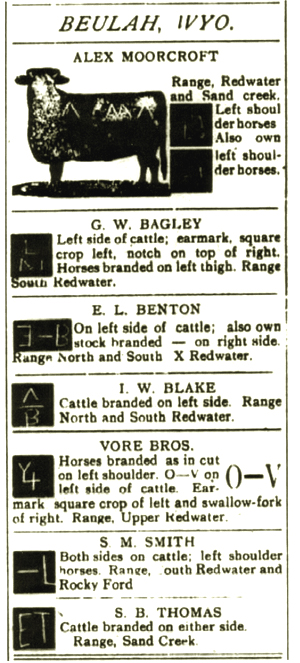 Brands of farmers and
stockmen from Beulah, 1892 Brands of farmers and
stockmen from Beulah, 1892
It may be speculated, however, that most likely the name comes from a sermon preached by the Reverend Dr. Richard W. Hamilton (1794-1847), see
Sermon IX, Sermons by Richard W. Hamilton, LLD, 2nd ed. Hamilton, Adams Co. London, 1864. Dr. Hamilton's description was
later repeated in William Nichols' Concordance to the Bible, the Bible Explainer, Halifax, 1870:
But a "better country" than this, earth did not contain. It was "a delightsome," and
"a pleasant land;" "a goodly heritage of the hosts of nations." It was variegated and
intersected with all the elements of sublimity and beauty, with whatever was bold and
gentle. It was prolific without a miracle, and the subject of a periodical one. It was
a wealthy place. Aromatic herbs covered its hills, and the fairest flowers decked its
glens. The rose was in Sharon, and the lily in the valleys. The voice of the turtle was
heard in the land. There roamed the vine, and there clustered the date, and there hung the
pomegranate. The cedar towered on the mountains, and the myrtle skirted their sides. No
human hand could raise the clusters of Eschol . The south wind passing over the gardens,
caused the spices thereof to flow out. The seasons revolved in their variety, but with a
blended sweetness. There was the upland breeze, in which the fir could wave its arms, and
the softer air in which the olive unfolded its blossoms. The sun smote not by day, nor the
moon by night. The birds sang among the branches. The dew lay thick on Ilermon. There was
balm in Gilead. The lign-aloe drooped from the river-bank. Kedron and Jordan poured forth
their streams. The rain also filled the pools. Lakes glistened in the landscape, and cooled
the drought. Beautiful, for situation, was mount Zion. The cattle browsed on a thousand hills.
The excellency of Carmel, and the glory of Lebanon, set their pinnacles against the deep azure of Canaan's sky. The year was crowned with goodness. The Lord God cared for that land, and his eyes were always upon it. At the stated periods fell the early and the latter rain. The pastures were clothed with flocks. The ploughman overtook the reaper, and the treader of grapes him that
sowed seed. The barns were filled with plenty, and the presses burst out with new wine. The
little hills rejoiced on every side. Precious fruits were brought forth by the sun, and
precious things were put forth by the moon. The earliest pass, the valley of Achor, was a
door of hope. The vineyards distilled the pure blood of the grape. The fountain of Jacob was
upon a land of corn and wine. The inhabitants were filled with the finest of the wheat.
It flowed with milk and honey. Its heavens dropped fatness. It was surrounded with munitions
of rock. The deep, couching beneath, spread its sure defence. The land might be called Beulah.
The distant glimpse of its prospect refreshed the dying eye of Moses; and of all thine earthly
territory, is emphatically thy land, O Immanuel!
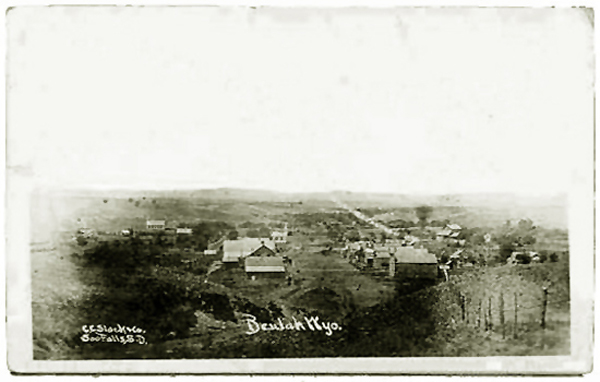
Beulah, 1913, Photo by Charles C. Slack
Alexander Moorcroft, born in Ireland, settled in the area in 1876 during the height of the Indian Wars. Indeed,
on several occasions Moorcroft had to defend his little compound from Indian attack. The most famous of the attacks was
on a wagon train heading west from Spearfish. The wagon train had to take refuge and circle the wagons on Moorcroft's farm.
Rifle pits were constructed around the wagons where Moorcroft and the party fought off
about 60 Indians for two days until rescuers could arrive from Spearfish. The actual location of the fight was about 150 yards from the present center of town.
Moorcroft developed about 320 acres and a herd of 35 horses and 150 head of cattle. By the time of
the 1880 Census, the total population of the area had grown to 11.
The town finally began to grow when in 1881 the government let a contract for mail
service from Spearfish to Sundance and Buffalo. This necessitated the establishment of
a stage station. Allegedly, the postoffice was in a corner of the saloon. Additionally, some prospectors came into the area.
By 1883, there were three ranches along Redwater Creek.
The American & Cleveland Tin Mining Co. proposed to construct a tin mine and associated smelting plant.
By 1890, The Ellsbury Bros. advertised their facility as having groceries, privisons, dry goods, hotel and
feed stable, blacksmith, Carriage and repair shop. The Ellsworth Bros. also developed a ranch to the West of
Beulah at Farrall. In addition to the Ellsworth Bros. hotel, there were two other hotels,
the East Side Hotel and the West Side Hotel.
By 1890, the town also had an additonal feed stable,two saloons, a 35 barrels a day grist mill on Sand Creek, a barbershop and
a physician, but no lawyers. The presence of only one physician and the omission of a lawyer
was regarded by the [Sundance] Wyoming Weekly Republican, June 18, 1890, as
"sufficient proof of her high physical, mental and moral standard."
Dependency upon liquor is not necessarily healthy.On May 28, 1896, Amos Robinson who previously constructed
the Wyoming Mercantile in Aladdin, opened a new saloon in Beulah. At the time, Francis E. "Ed" Ross with Charles Graham operated a competing
saloon. Less than a month after Robinson opened his new saloon, on the evening of June 21, Ross came into the Robinson
establishment, interfered with a card game and generally raised cain and left. Shortly thereafter
Robinson emerged from his place of business. The rukus continued and Ross shot Robinson dead. Ross defended on the basis of
"self-defense." He was convicted of second degree murder. He appealed and lost. The point made by the
Wyoming Supreme Court is that one may not goad someone into pulling their weapon and then claim
self-defense. See Ross v. State, 8 Wyo. 351 (1899).
The grist mill was constructed by Herman H. Reinecke and John J. Fox.
Fox was the miller.
The mill on Sand Creek utilized a three-foot high dam and a Victor Turbine water wheel. The mill cost $8,500 to construct. Reinecke sold his interest to
Albert W. Holcomb. In 1892, Mrs. Fox forecosed on Holcomb's interest. Holcomb became increasingly delusional and in 1897 was "removed" to the
State Hospital in Evanston. The nature of his delusion was that he had a large amount of money in the east.
By 1891, the town had a newspaper, the
Beulah Globe-News. The town was on a roll.
In the 1890's, other homesteaders and stockgrowers moved along the
Redwater for which Beulah served as a source of supplies. As indicated by the brands to the
right, settler included, in addition to Alex Moorcroft,
George W. Bagley, E. L. Benton, Isaac W. Blake, Silas Lincoln, Wiliam W. Williams, and the Vore Broters. Later,
the Vore Ranch would play a significant part in the archeological history of Wyoming.
By 1901, the town had a Modern Woodmen of America Lodge. In 1908, the Right Reverend James J. Keane dedicated the new
Roman Catholic Church of St. John. By 1910, the town had grown to a population of 311. By 1916, the town had a "Rochdale" store.
A Rochdale store was a co-operative store in which sales were for cash. The customers bought shares in the store and the profits were
distributed to the shareholders proportionately to the amount of the purchases. In 1918, the post office moved into the store.
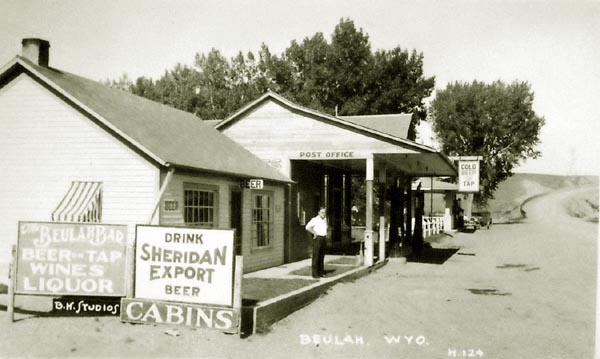
Beulah, 1930's.
The reason for the rapid growth can be attributed to the the town being a conventient watering hole for both man and horse.
It is located only about one mile
from the Dakota line. By 1887, there was talk of statehood for what was to become North and South Dakota. A battle royal spread across
Dakota Territory between "dries" and "wets" as to whether the new states would be wet or dry. At first,
it was "local option," South Dakota became dry until about 1891. The principle Anheuser Busch distributor in western Dakota
Territory, John Treber moved his operation from Deadwood to Beulah. By 1890 there were some four saloons in
Beulah,
But the seeds of decline in the town had already been sown. As discussed on later pages,
by 1890, the Burlington System began pushing its railroad from Newcastle northward to Upton and Gillette. As it did so, the
necessity of using freighters and stages for goods and freight declined. By 1890, J. J.
McCullough's Buffalo & Burlington Stage & Express Co. began serving Merino (present-day Upton) rather than making connections to
Spearfish. With the construction of the railroad into Aladdin, more traffic was diverted from Beulah.
As previously discussed, a drought hit the area. Dry Farming no longer worked. Prohibition came making the booze equally available in both
Wyoming and the Dakotas.
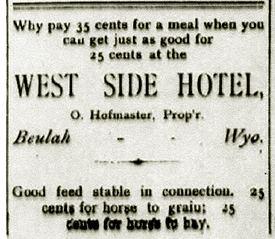 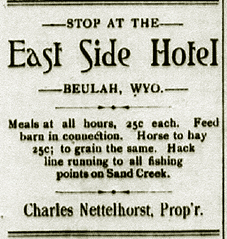
Competing advertisements for Beulah's West Side Hotel and East Side Hotel, 1896.
By 1921, the population of Beulah had declined to about 100. In late July, newspapers across the country reported that the entire
town had been "practically wiped out" by a four-foot wall of water and flash flood that roared down Sand Creek. Wires were down and details were not
available. Emergency help, the papers reported, was being sent from Chadron. The flood would not have been the first.
In 1895, a flood had washed out wagon bridges leading to the little town. After the telephone wires were restored the details emerged.
The flood had swept in the early morning hours through a canyon in which tourists were camping. Two of the campers in the darkness headed into the
wrong direction into the flood and drowned.
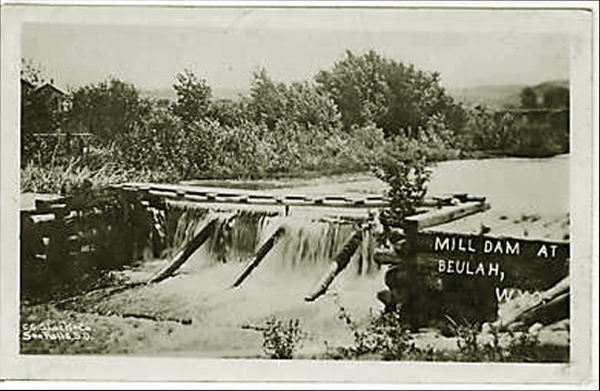
Beulah Mill Dam, approx. 1913. Photo by Charles C. Slack.
The water powered grist mill continued in operation until World War II. It had been acquired by
the D. J. Toomey Produce Co. of Spearfish. Toomey also had a flour mill in Sundance. In 1919, the Sundance flour mill
was updated with its original 45 hp steam engine being replaced by a gasoline engine. The Beulah mill has now been made into a
vacation or meeting rental property appealing to persons who like trout fishing.
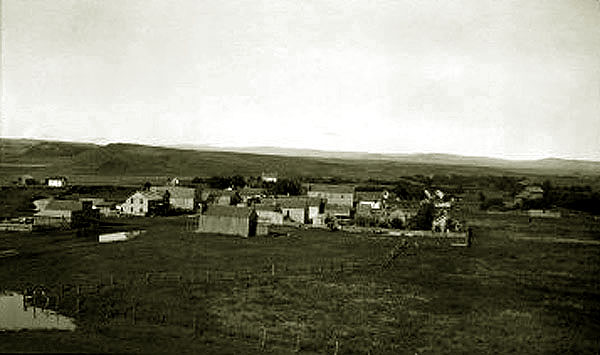
Beulah, approx. 1913.
Music this Page, courtesy Horse Creek Cowboy:
BEULAH LAND
Music by John R. Sweney
Lyrics by Edgar P. Sites
Verse 1
I’ve reached the land of corn and wine,
And all its riches freely mine;
Here shines undimmed one blissful day,
For all my night has passed away.
Refrain
O Beulah Land, sweet Beulah Land,
As on thy highest mount I stand,
I look away across the sea,
Where mansions are prepared for me,
And view the shining glory shore,
My Heav’n, my home forever more!
Verse 2
My Savior comes and walks with me,
And sweet communion here have we;
He gently leads me by His hand,
For this is Heaven’s border land.
Verse 3
A sweet perfume upon the breeze,
Is borne from ever vernal trees,
And flowers, that ne’er fading grow
Where streams of life forever flow.
Verse 4
The zephyrs seem to float to me,
Sweet sounds to Heaven’s melody,
As angels with the white robed throng
Join in the sweet redemption song.
Next Page: Beulah Continued
|