| Photos From Wyoming Tales and Trails This Page: Pitchfork Ranch, C. J. Belden and the Development of his photography. |
 |
|
| Photos From Wyoming Tales and Trails This Page: Pitchfork Ranch, C. J. Belden and the Development of his photography. |
|
|
|
|
About This Site |
|
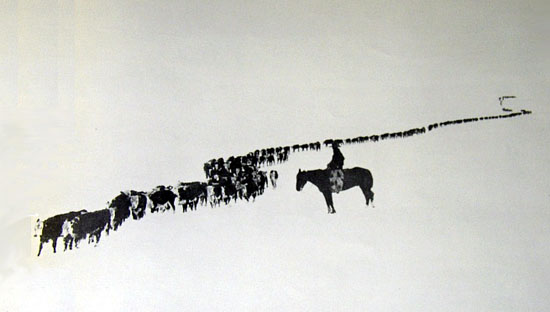 Winter Cattle Drive on the Pitchfork, photo by Charles J. Belden In the 1930's and 40's The Pitchfork, in part due to the promotion and photographs of Charles J. Belden (1886-1966), Phelps' son-in-law, became famous as a dude ranch, hosting, among others, Amelia Earhart and Will Rogers.
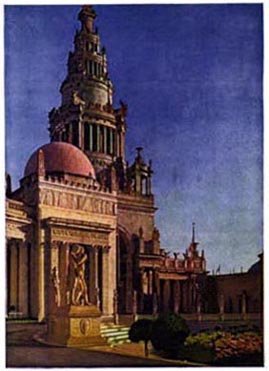
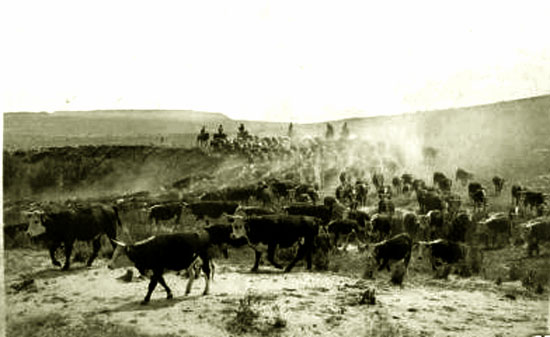 Trail Herd on the Pitchfork, photo by Charles J. Belden In 1912, Belden married Eugene's sister Frances. He began early experimentation with color photography. Several of his color photographs were published as part of a book on the 1915 Pan-American Exposition. He also published an article on a Libyan oasis and the houses of Siwa which were constructed of a mixture of rock salt and mud. A journey through the Sierra Nevada by automobile was featured in Scribner's, "Motoring in the High Sierras." as wwll as an article in Outing Magazine, "Motoring Among the Mountains." In the article he tells his readers "With a reasonably complete equipment for the emergencies and a level head, no one of either sex need fear the demands and problems of a motor tour among the peaks." We find out, however, that part of the reasonably complete equipment is "a good block and tackle." Indeed, in his journey through the Sierras he not only had to use the block and tackle, but had to remove boards from the railroad's snow sheds to put beneath the car's wheels.
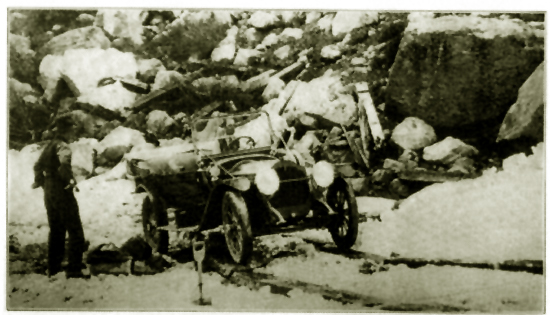 Car stuck in Donner Pass, photo by Charles J. Belden, 1915.
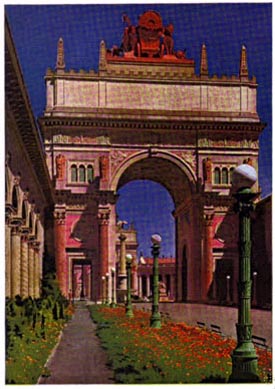 . . . . 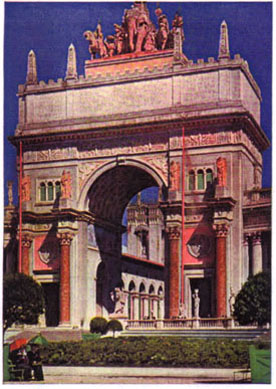 Left, Western Entrance, Court of the Universe Right,"Through the Eastern Arch"
Autochromes were invented by Auguste and Louis Lumi�re in 1904 and came on the market in 1907. The use of the autochrome process was very expensive, using specially prepared glass plates. The plates were coated with translucent potato granules dyed in the three primary colors. The plates cost some twelve-times the cost of black and white plates. It may be that Belden's interest in the autochrome process was sparked at M.I.T. where a demonstration of the new process was given in 1908 by a representative of the Lumi�re Brothers. Next page: Belden photography continued. |


 . .
. .