|
|
|
About This Site |
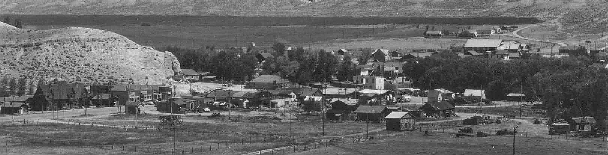 Dubois, Wyo., 1940's Click here for close-up As noted with regard to the discussion of Lander, several of the early mountain man rendevous were conducted in the area. Some question exists as to the exact location of several of the rendevous. Hiram Chittenden, History of the American Fur Trade, discussed with regard to Yellowstone, contended that the rendevous of 1830 was conducted near South Pass or Lander. On the other hand, Charles Giffin Coutant, in his 1899 History of Wyoming, contends that it was conducted at the head of the Wind River near Dubois. The expedition, led by William Sublette, consisted of 81 men on mules, 10 wagons drawn by 5 mules each, and 2 carts. It took from April 10 until July 16 to get from St. Louis to the Wind River Basin, making 15 to 25 miles a day. Additionally there is evidence that Andrew Henry and William Ashley's company had its winter camp in the area in 1823-24 as did Jedediah Smith in 1829.
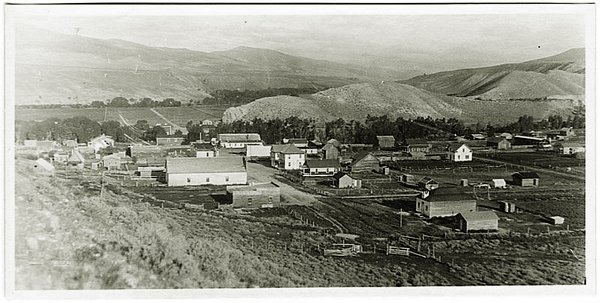 Dubois, Approx. 1913 The area around present-day Dubois was first settled in the 1870's by stockgrowers and tie hacks. An early settler in the area was Oran M "Old Man" Clark who homesteaded ten miles west of the present site of Dubois. clark, also known as "Wind River Clark" established a placer mine on the north side of Warm Spring Creek near the DuNoir Tie Camp. He also raised money by collecting bounties on coyotes and wolves. The general area of Dubois was originally known as "Never Sweat," named after an early camp,located on the Wind River. The area was also on the military road through To from Fort Washakie to Fort Yellowstone. The road, however, was not suitable for ordinary travel. As late as 1913, the Commander of Fort Yellowstone described the road between Moran Junction and Dubois:
The bridges and culverts need repairing, and, in addition, if the road is to be made passable for automobiles the location must be changed in places in order to reduce the grades, and many small streams that are now forded by teams must be provided with bridges. I am informed that this part of the road is in very poor shape; that the grades in many places are excessive�20 to 40 per cent and even as high as 45 per cent in a few places. The Development of Dubois as a town owes itself to things: the efforts of Eugene Amoretti, Jr., an early guide and then banker and 3ntrepreneur; and the establisment of the Welty Store. When it came time for the establishment of a post office, officials in Washington determined that the name "Never Sweat" would not do; it should be named for Idaho United States Senator Fred Thomas Dubois (1851-1930), a member of the Senate Postal Committee.
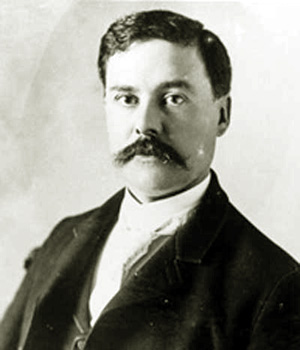 . . . . . .
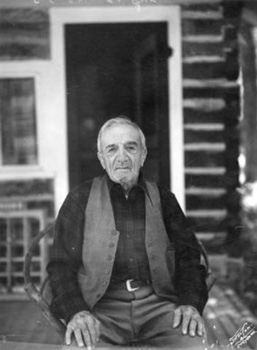 Left, Fred T. Dubois; Right, Eugene Amoretti In August 6, 1889, a post office was duly established. Charles C. Smith was named as postmaster.
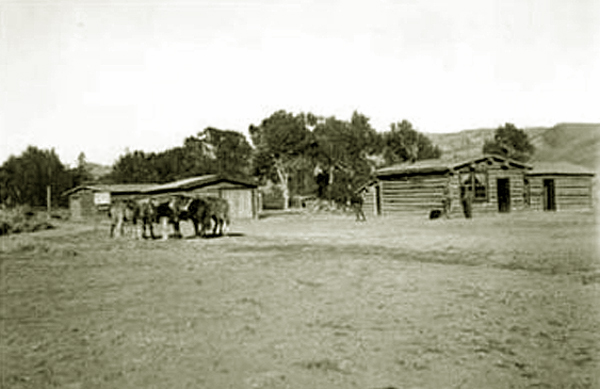
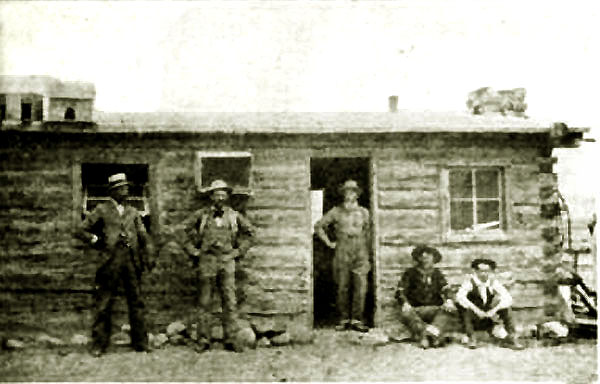 First Post Office Dubois, Wyoming, approx. 1890 The individuals in the photo have been identified as Eugene Amoretti on the left and supposedly Butch Cassidy seated left of door. The structure has also been identified as a cabin on Amoretti's ranch on Horse Creek. Horse Creek rises near Raggedtop Mountain and flows to the east of Ramshorn Peak. It is one of some twenty-eight streams in Wyoming bearing the same name. Further to the south rising in the Wyoming Range is another stream of the same name which flows into the Green River near Daniel. Having more significance in the history of the state is the stream meandering eastward out of the Laramie Range and giving rise to the town of Horse Creek north of Cheyenne. Ramshorn Peak, a volcanic plug the top of which was carved by ancient glaciers into a "Matterhorn" shape, and lended its name to Ramshorn Avene and to two hotels in Dubois.
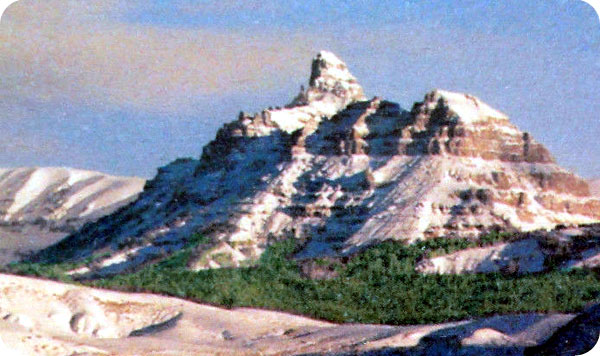 Ramshorn Peak In 1896, Postmaster Smith resigned and Alice A. Welty, the wife of Dr. Francis H. Welty (1846-1910), as appointed as Postmaster. Dr. Welty was the post physician at Fort Washakie and later served as Dubois's firt mayor when the town was incorporated in . Mrs. Welty's post office was established in a store established by her son, Frank A. Welty, Sr. Frank had worked as a government surveyor and also for a while had worked in the J. K. Moore's store in Ft. Washakie. Indeed, he later recalled that one of the customers coming into Moore's store was Butch Cassidy to whom Frank sold to cigar. In the mid-1890's Frank homesteaded in an area near on Horse Creek to the north of the present site of Dubois. His mother also claimed homestead. His mother, Alice, proved up her homestead in 1901 and Frank proved up his claim in 1901. Frank constructed a store on the homestead. In 1897, George Y. Hays and Hewitt M "Huey" Yeomans constructed a store on the present site of Dubois.
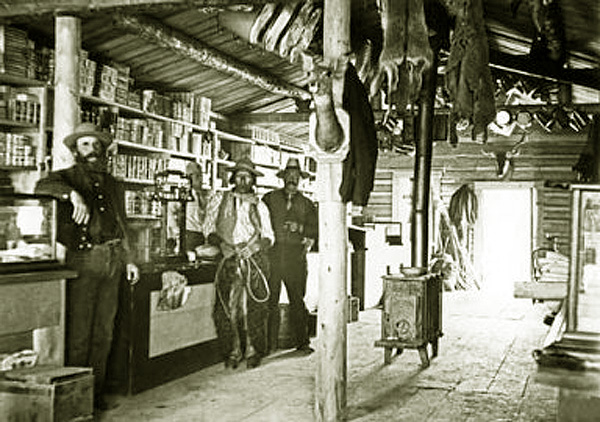 Interior General Store, Dubois, undated. The following year, Frank bought out Hays and Yeoman's, dismantled the store on his homestead and moved it to the Hays-Yeoman establishment near the confluence of Wind River and Horse Creek and rebuilt it as a rear extension to the store. Thus began a series of extension and additions to the store over more than 100 years. The town developed around the location of Welty's Store.
 Blacksmith Shop and Saloon, Dubois, undated.
Next Page: Dubois continued, Welty's Store. |