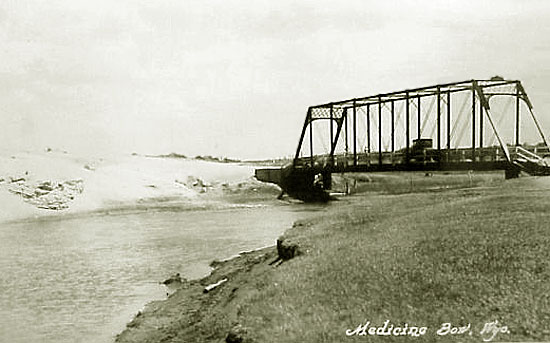
Lincoln Highway Bridge across the Medicine Bow, approx. 1920.
To the west of Como Bluff the Lincoln Highway crossed the Medicine Bow just to the east of the town of the
same name. The Stansbury expedition passed through the area in 1850. The area was on the original route for
the Overland Stage, but due to Indian attacks the line was moved further south nearer to the
present day town of Elk Mountain.
The Union Pacific reached Medicine Bow in 1868, when the town consisted of little more
than a store and saloon.
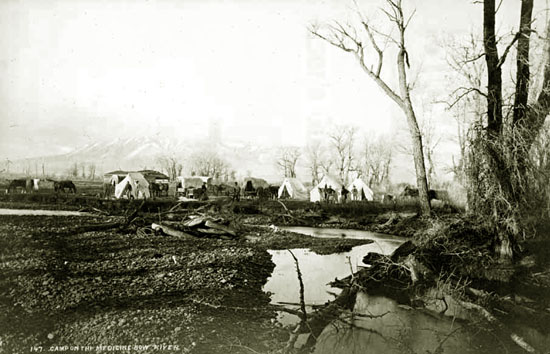
Camp Along Medicine Bow River, Hayden Expedition 1871, photo by Wm. H. Jackson
In the background is Elk Mountain, originally called "Medicine
Butte." Compare with
the next scene from the 1930's along the Lincoln Highway. As indicated by the photo,
the Hayden Expedition camped along side the River in 1871.
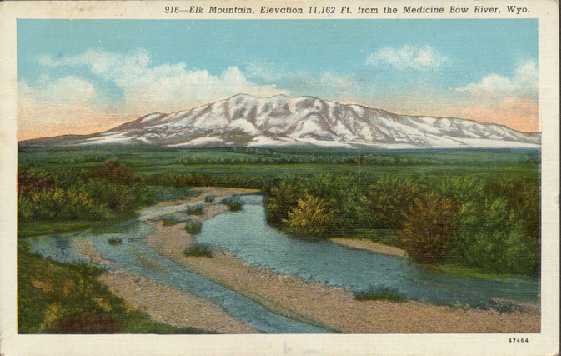
Elk Mountain in distance, Medicine Bow River in
foreground
As previously discussed, one of the proposed routes for the Lincoln Highway was through Elk Mountain City rather than through
Medicine Bow. The town of Elk Mountain was laid out in 1906 by lumberman Andrew Olson. By 1915 the town had a hotel,
the Elk Mountain Mercantile owned by Olson, a sawmill, electice light plant and a telephone
exchange.. Additionally, by 1916, had daily autostage service from
Hanna.

Elk Mountain City, 1910.
In 1912 and 1913, a furious battle raged over the route to be taken by the Lincoln Highway. The Elk Mountain
Boosters Club began a campaign of publicity in the newspapers, particularly the Tribune. In May 1912, Elk Mountain blasted the
Medicine Bow route as "disgracing our county by sending people passing through it in automobiles over
the very worst section of the county and the logest route. One could not even get a decent drink of water from Medicine Bow to
Fort Steele over the Carbon route, a distance of 65 miles." In contrast to the Medicine Bow route, the town bragged that its
route "has inumerable springs and streams of nice, clear, cool, good water.
In July a full half page on the first page of the Tribune extolled the
virtues of Elk Mountain. An August 1 dispatch from Elk Mountain reported that "pathfinders" from Omaha had been
feted at the Grand View Hotel and that
Elk Mountain had been selected as the route for the new highway. The Booster Club would, according to the dispatch,
immediately, log and mark the route from Laramie to Rawlins. We now know that Elk Mountain spoke too soon.
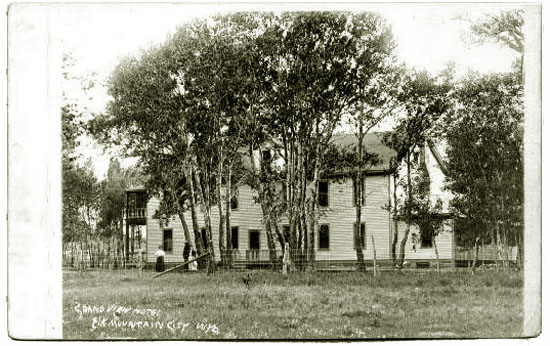
Grand View Hotel, Elk Mountain, 1910.
The Grand View Hotel was constructed in 1905 by John S. Evans and operated by his wife.
Nearby was a dance hall, later expanded and renamed as the Garden Spot
Pavilion. Between 1948 and 1949, the Garden Spot attracted major artists including Les Brown,
Lawrence Welk, and Bob Wills and the Texas Playboys. It is now on the National Register.
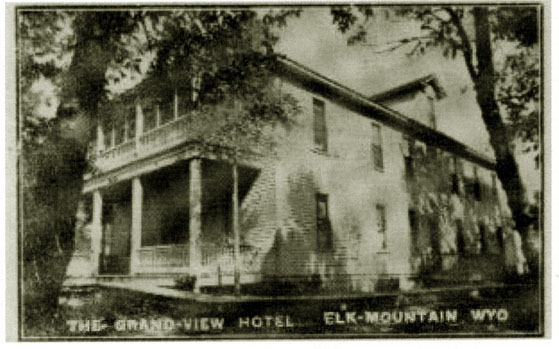
Grand View Hotel, Elk Mountain, 1916.
At 3:00 p.m. the pathfinders left the Grand View in four cars for Rawlins. They were accompanied by
another six cars from Saratoga. Shortly thereafter, in Rattlesnake Pass the party encountered a
cloudburst. The chauffeur of the lead car stood on a small bridgte to test its strength. A wall of the
nice, clear, cool, good water carried man and bridge away. He was rescued two hundred yards down the stream. With ropes and tackles the
party finally succeeded in crossing the stream and arrived at Rawlins at midnight." The battle continued. It was untrue, Elk Mountain Boosters argued, that
one had to go through thirty-four gates on their route. The number had been reduced to eighteen.
On November 25, 1913, a small item appeared in the Tribune. The highway was to go through
Medicine Bow. Elk Mountain continued the fight. In the July 21, 1914, Tribune a dispatch from Elk
Mountain reported: