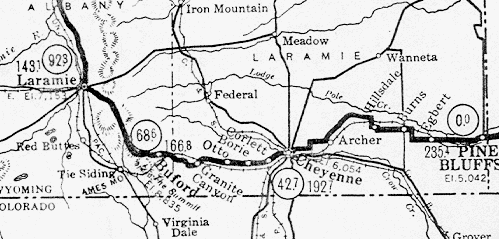
Lincoln Highway Map, Pine Bluffs to Laramie
Although, publicly funded roads in the
west date back to the construction of the Lander Cutoff in 1859 and the construction of
the so-called "Steam Wagon Road" in 1862 from Nebraska City to Ft. Kearny, no real effort at
the construction of decent roads occurred until after the institution of rural free delivery. The Steam Wagon Road
was constructed to provide for a road for a 20-ton, $9,000 steam-powered behemoth which was proposed
to pull freighters, in lieu of oxen, from Nebraska to Denver. Unfortunately, the tractor and its
crew of three only made it seven miles before it broke down. Due to the Civil War,
replacement parts were not available, and freighters continued to use oxen.
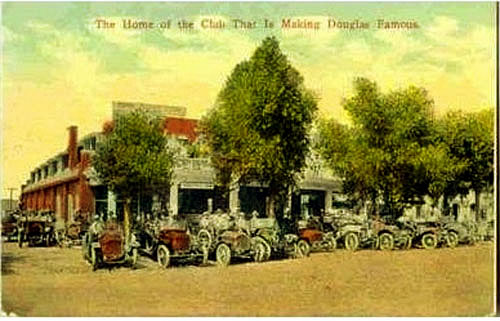
Meeting of Good Roads Club, Douglas, 1908
The Good Roads Association arose out of
a bicycle group, The League of American Wheelmen formed in 1880. It had as a slogan,
"Lifting Our People Out of the Mud." The 1908 State Fair in Douglas featured an automobile
parade.
As early as 1903, efforts were made to traverse the country by motor vehicle. That year four separate
individuals made the crossing fron San Francisco to New York. The first, George A. Wyman, traveled alone by motorcycle
The second, Vermont physician Horatio Nelson Jackson, made the trip in response to a $50.00 bet in a used
Winton. Dr. Jackson was accompanied by
mechanic Sewall Crocker and a dog named Bud who hitched the ride in Idaho.
There being no windshield on the Winton, all three, including Bud, wore goggles.
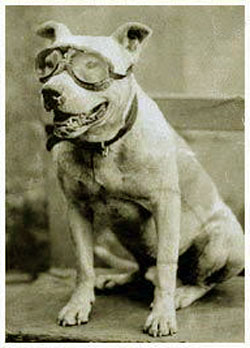
Bud
The third was E. T. "Tom" Fetch, accompanied by magazine writer
Marius C. Krarup, in a factory sponsored twelve horsepower Packard Model F. The last was Lester L. Whitman and
Eugene I. Hammond in a factory sponsored 4.5-horsepower curved dash
Oldsmobile. Road conditions
were terrible. Dr. Jackson reported that on one day they traveled only six miles and had to use a block
and tackle 17 times. On one occasion they went 16 hours without seeing another human being. Additionally, the
Winton suffered from repeated breakdowns The vehicle threw a rod twice, once in Rawlins and a second time in
Pine Bluffs. Each time
there were delays while parts were shipped by railroad from the Winton factory. The final breakdown
occurred when Dr. Jackson reached Vermont and was putting the car in his garage. The chain
drive broke. Indeed,
Winton unreliablity was responsible for the founding of the Packard Motor Car Company. James
Ward Packard, an electrical equipment manufacturer, had purchased a new Winton and attempted to
drive it home 60 miles. It broke down and the vehicle had to be towed. When Packard suggested
to Alexander Winton changes that would make the car more reliable, Winton dismissed Packard out of
hand with a comment that if Packard though he could make a better car, he should do so. James Ward
Packard did. By 1920 Winton was out of business. Shortly after
his return to Vermont, Dr. Jackson received a speeding ticket in Shelburne for
violating a six mile per hour speed limit. In 1916, Dr. Jackson vied with three others for the
National Progressive Party nomination for Governor of Vermont. Each candidate received
precisely 25% of the vote. Only four votes in the Progressive nomination were cast.
Fetch's Packard was more reliable, but was delayed in that the factory advertising department envisioned
the car being photographed against a backdrop of the Utah Canyonlands and the Colorado Rockies. Thus,
the Packard was slowed down by the crossing of passes of over 9,000 feet in elevation.
In 1904, Whitman reversed the journey and went from New York to
San Francisco in an aircooled Franklin. In 1905, James W. Abbott of the office of Public roads, then a
part of the United States Department of Agriculture, organized an automobile race from New York to Portland, Oregon, for
the opening of the Lewis and Clark Expositon. The prize was to be $1,000.00. Tlhere were, however, only two entries,
both Oldsmobiles. One driven by Dwight B. Huss, an employee of Oldsmobile, accompanied by mechanic and relief driver Milford Wigel, in a vehicle
known as "Old Scout" The other vehicle, "Old Steady," was driven by Percy Freeman Megargel accompanied by Barton Stanchfield.
Huss was an experienced driver, having driven automobiles since 1902, including taking an
Oldsmobile to England in 1903 where the vehicle received an award for reliability.
Abbott arranged for stocks of gasoline and dry cell batteries to be available along the route. Gasoline was available otherwise only in
small quantities in drugstores for use in drycleaning. The dry cells were necessary because the Oldsmobiles were not
equipped with magnetos.
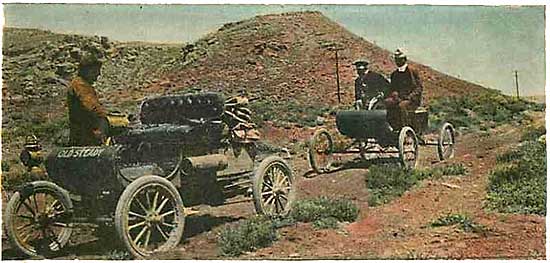
Old Steady and Old Scout in Wyoming, 1905.
By the time the cars reached Cheyenne they were eleven days behind the projected schedule. Across Wyoming, the cars followed the
old Oregon Trail crossing the continental divide at South Pass. In Wyoming the roads were less than
idealic. Huss later wrote of one day in which he had driven 18 hours, forded five streams and made a total of
eleven miles. In addition to the mud, Huss ran into snow. In Oregon he took a toll road in the Cascades. The toll
attendant did not know how much to charge, since the tolls were based on the number of animals. It was finally
decided that the toll would be collected on the basis of the seven horsepower of the Oldsmobile.
One hour before the opening of the Exposition, Huss pulled up before the administration building having made the
journey in 44 days. Mergargel arrived a day later.
In August Mergargel accompanied by David F. Fassett decided on a round trip from New York to the Pacific Coast in a 16 horsepower Reo. The return trip
to New York from San Francisco was considerably slower. They left the City by the Bay on November 21, 1905 and finally arrived in New York over six months
later on June 9, 1906. The total round trip took 294 days.
By 1905, the need in Wyoming for improved roads suitable for motor cars was perceived. In that
year the Good Roads Association, at the invitation of Gov. B. B. Brooks,
met in Rawlins. The following year, Payson W. Spaulding, the owner of the first motor car in Evanston, drove from
Evanston to Cheyenne in order to prove that such a drive was possible.
Just as in the instance of the Railroad, various organizations vied for competing routes for a transcontinental
highway. Some contended for a southern route across New Mexico and Arizona to end in San Diego. Others vied for
a route following the old Oregon Trail through Wyoming and ending in San Francisco or for a
northerly route through Montana and ending in Seattle. In 1911, British travel writer, Thomas W. Wilby (1867-1923) and
his wife drove in a chauffeur-driven Ohio touring car from New York to San Francisco. The car was
nicknamed the "Mud Hen." Their route
took them along the future route of the Lincoln Highway. They then went down to San Diego and
returned to New York via Phoenix and Santa Fe accomplishing the round trip in only 105 days. Thus,
Agnes Wilby became the first woman to make a round trip from coast to coast by automobile. The following
year, Wilby became the first to cross Canada, sea to sea, by automobile.
In 1913, the Lincoln Highway
Association was formed under the auspices of Carl G. Fisher (1874-1939),
of the Prest-O-Lite Company and later developer of Miami Beach, Henry C. Ostermann a promoter
for the Buffalo Bill Wild West Show, and Henry B. Joy, president of the Packard
Motor Car Company.
On October 31, 1913, the Lincoln Highway, later U.S. Highway 30, was officially designated by Gov. J. M. Carey.
The designation of the highway was celebrated by a bonfire in from of the
Plains Hotel in Cheyenne. Other bonfires were lit in Elk Mountain and
Rock Springs, the later fueled by sage brush. In Laramie the Superintendent of Schools
addressed a high school assembly. The highway ran from the Nebraska
border near Pine Bluffs, to Cheyenne, Ozone, Buford Station, Sherman Hill, Laramie, Bozler, Rock River, Como, Medicine Bow, Parco,
Rawlins, Rock Springs, Green River and Evanston. Colorado, being by-passed, was miffed. Later,
Colorado posted deceptive signs in Big Springs, Nebraska pointing to an alternative route by way of Denver and
then up to Cheyenne. The Lincoln Highway Association warned drivers not to be deceived by signs in Big Springs. Years later,
along the East Coast similar signs urged motorists to take U.S. 1, U.S. 301, or U.S. 17, each claiming to
be the shortest route to Florida. This led to a suggestion that U.S. 1 should be advertised as "the route of the Second Yankee Invasion."
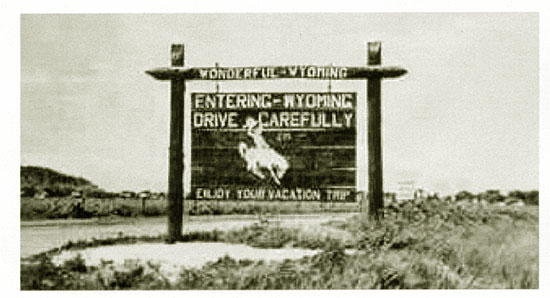
Welcoming sign on Nebraska line, near Pine Bluffs, 1930's
At one time, a truck stop marked the state line with a tall tower on which were the vertical words
"STATE LINE." The tower came down in 1996.
The Lincoln Highway was not a nationally funded highway, but, instead, was a collection of
locally funded and maintained roads put together as a single route marked by the Lincoln Highway Association. State construction started about
1920.
 Lincoln Highway Logo
The result was that originally the
codition of the highway ranged from being a fair set of ruts to absolutely abysmal,
nowhere coming close to the description given by Laramie Studebaker dealer Elmer Lovejoy in his 1914 Guide.
Lovejoy claimed that one could cross the state in 26 hours with the vehicle singing a "sweet song and the
wheels whir as they roll over the hard surface of well-marked trail." Although by 1916 the road had improved, in areas it remained
a mite bit rough. Nevertheless, in 1916 Amanda Preuss was able to cross the continent 11 days, 5 hours, and 45 minutes, beating the
prior record of Cannonball Baker. Near Rock Springs, the highway followed an old railroad embankment on which the only improvement was the
removal of the ties, leaving regular indentations where the ties had previously been. Amanda Preuss managed to damage
the brakes on her Oldsmobile roadster on such an embankment and had to pause at the Oldsmobile dealer in
Cheyenne. But the indentations in the roadbed were not the only cause of damage to her vehicle.
Just to the east of Egbert, the front of her vehicle was indented. She described the incident:
Running along at aout 45 miles an hour I saw standing loose in the
road ahead of me a beautiful bay horse. Immediately I slowed down to
about 25 miles an hour and sounded my horn. By this
time I was close upon it, and as it did not move, I swerved sharply to the left to pass around it.
Unfortunately, as I swung, the horse decided to swing also, and leaped squarely in front of my machine.
I hit it with a crash, bowling it over, and,
before it had a chance to recover, I rolled upon it with the front wheels of my car. There I hung, with the
neighing, kicking horse beneath me.
I would never have been able to get off the horse, had it not been for a couple of
men working on the road who came to my assisance. Our
combined efforts, however, finally managed to
extricate the car.
To put the horse out of its misery, it had to be shot by the workmen. Miss Preuss reported
the incident to the police in Pine Bluffs. As a result of
the collision, the radiator of the car sprang a leak. Another Oldsmobile owner gave up his radiator so that she could continue.
Nevertheless, in Nebraska she was again stopped until she
posted $150.00 to cover the cost of the horse.
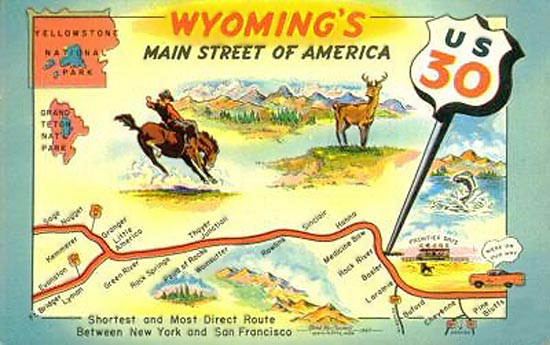
Postcard for U.S. 30, 1960's.
Music this page: "In my Merry Oldsmobile."
Next Page, Lincoln Highway continued, Pine Bluffs, Egbert and Burns.
|