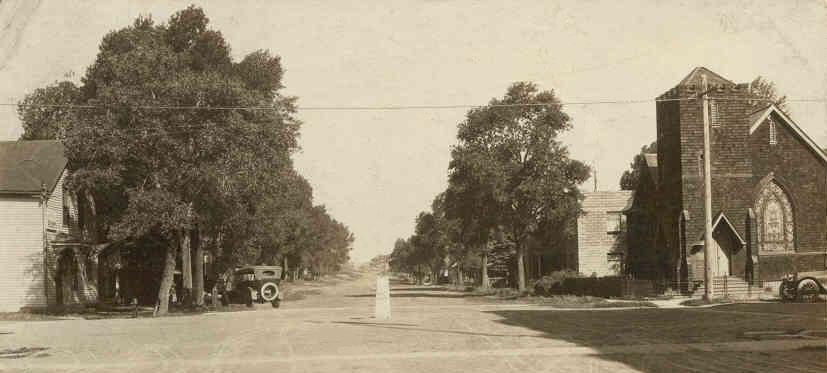
Evanston, Wyoming, approx. 1920
Evanston, named after Union Pacific
Division Engineer James A. Evans (1830-1887), was founded in November 1868, when the first
graders for the Union Pacific arrived in the area. For discussion of Evans, see
Sherman. Originally, the division point was to be
Wahsatch to the west of Evanston. Wahsatch, however, had a shortgage of water. Thus the
division point was moved and Evanston's future was assured.
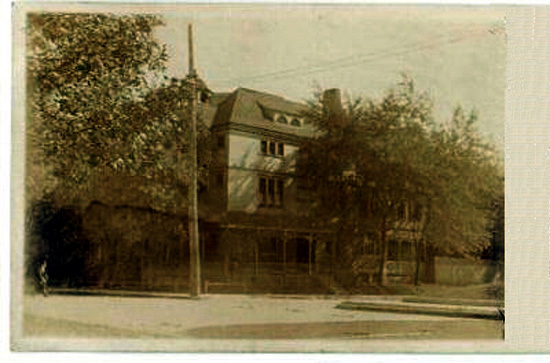
Union Pacific Hotel, Evanston.
As a division point, the railroad constructed a hotel and eating house, The Mountain
Trout House operated by the Kitchen
Brothers of Omaha. Under its black manager, Howard W. Crossley, the hotel received good
reviews by early travelers for the attentativeness of its Chinese waiters and the quality of the
featured dish in the dining room, mountain trout. The main portion of the hotel burned in
1899. In Nebraska, Crossley is remembered as the first black to qualify for jury duty.
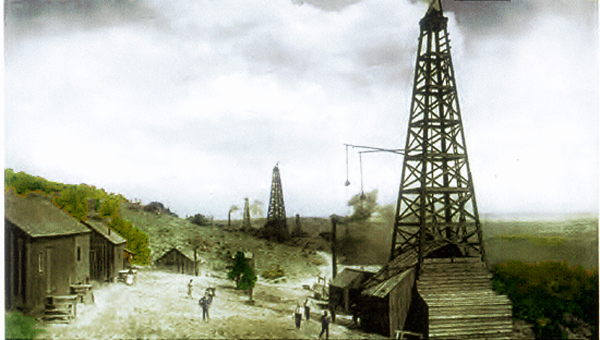
Spring Valley oil field, Unita County, Wyoming, 1907.
The early growth of Evanston was based on the presence of the Railroad, timber, and coal. It has been known since the time of the Bonneville Expedition that there is
oil in the area of present-day Evanston and Uinta County. The Spring Valley Oil Field is located to the east of
Evanston. The "oil boom," however, started in 1900 when the Union Pacific drilled
for water and struck oil. At one time there were, as a result, 31 oil companies in the
area. Additionally, the area was able to provide railroad ties to the Railroad. Three companies provided
ties: Evanston Lumber Company, Coe & Carter, and Burns & Bennett.
Oil springs were discovered at an early time both at Hilliard and at Fossil in present-day
Lincoln County. With the Railroad, various industries in addition to petroleum developed. This included including
lumber, coal, ice, and petroleum, developed. The need for
railroad ties created a lumber industry in the area. An outgrowth of the
lumber industry was the development of charcoal production.
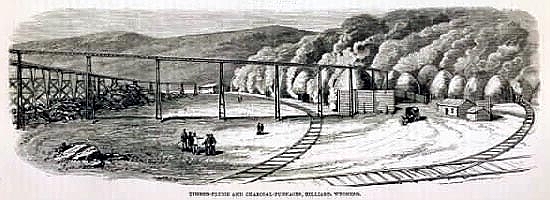
Timber Flume and Charcoal Kilns, Hilliard, Wyo., 1885
Hilliard was located about 15 miles south of Evanston. The timber was brought to
Hilliard on a log flume owned by the Hilliard Flume and Timber Company from the Uinta Mountains to the south.
One branch of the flume, some thirty miles long started at Gold Hill and proceeded along
Hayden's Fork to Hilliard. Another branch started at the headwaters of Black's Fork. The timber would be cut into railroad ties or converted to charcoal for
use in smelters near Salt Lake City. At one time Uinta County had about forty
charcoal kilns. Of those kilns the only remnants are three kilms and the ruins of
a fourth on private property at Piedmont, also a ghost town. It is estimated that
by 1873 the area produced in excess of 100,000 bushels of charcoal per month.
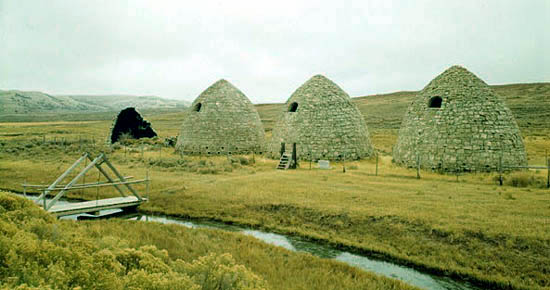
Remains of Charcoal Kilns, Piedmont, photo courtesy
Library of Congress
Piedmont, southeast of Evanston, was settled about 1867 as a tie camp to provide
railroad ties for the Union Pacific. The first two families to permanently settle in the area were
those of Moses Byrne (1820-1904) from Cheshire, England, and Charles Guild
(1826-1908) from Dundee,
Scotland. Byrne constructed the charcoal kilns in the above photo and
Guild established one of the first ranches in the Territory. The Guild Ranch is still in existence.
Originally, the area was named "Byrne," but due to confusion with Byron Station was renamed Piedmont. Both
Byrne's wife, Anne Beus, and Guild's wife, Marie Madeleine Cardon, were from
Torino in the Piedmont area of northern Italy.
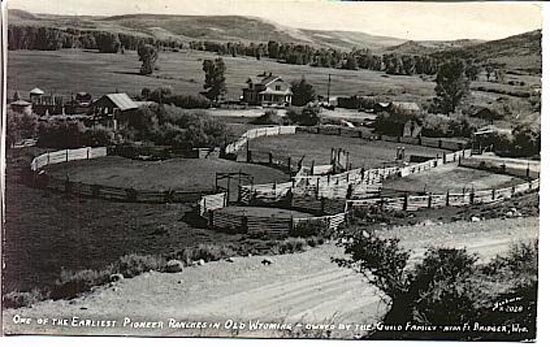
Guild Ranch, 1930's.
In 1900, the Union Pacific track was relocated and by the 1950's the town had become a ghost town.
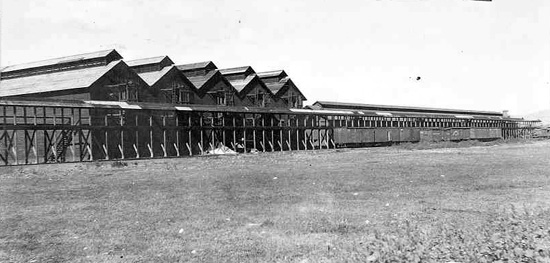
Ice Houses, Evanston, undated.
With the completion of the Pacific Railroad, fresh
produce could be shipped eastward from California. Additionally, meat required refrigeration. This
need gave rise to the use of "reefer" cars equipped with ice bunkers to cool the
cars. To provide ice, in 1887, the Union Pacific constructed extensive ice houses and ponds.
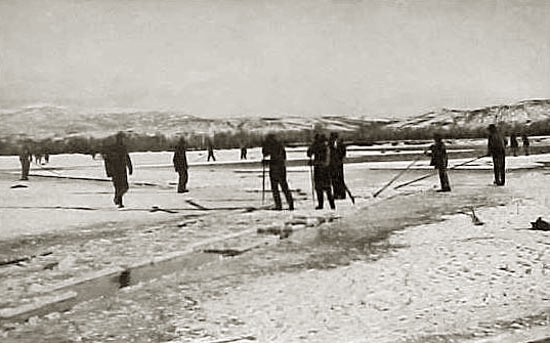
Cutting on the Bear Ponds, Evanston, undated.
The ponds, known as the "Bear Ponds," received water by diversion from the Bear River. In order
to provide clean ice, the ponds were kept free from snow in the winter. The ice when it
attained the proper thickness would be cut into 22-inch "cakes," which would be stored in the
ice houses using sawdust as insulation. Some of the sawdust would be obtained from Jesse L. Atkinson's nearby lumber mill.
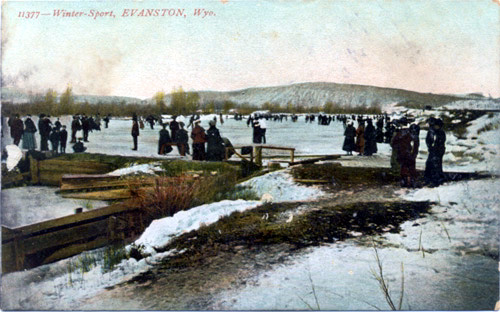
Ice Skating on the Bear Ponds, Evanston, approx 1910. Postcard by W. W. Davis.
In 1906, the Southern Pacifc and the Union Pacific formed the Pacific Fruit Co. which purchased, among
others, the Evanston Ice facilities. The facilities closed in 1921 with the
construction of a mechanical ice plant in Ogden, Utah. The ice houses were razed in the 1930's. The ponds
remain and are used for fish and in the winter for ice skating.
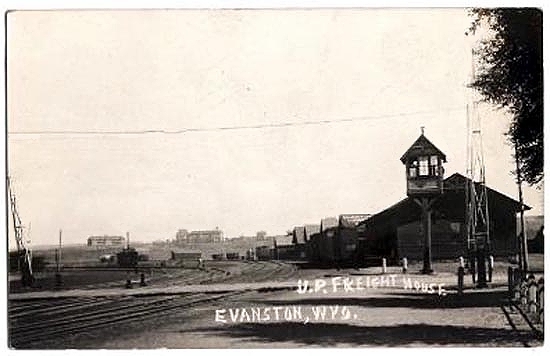
Union Pacific Freight House, Evanston
Next page: Evanston continued.
|