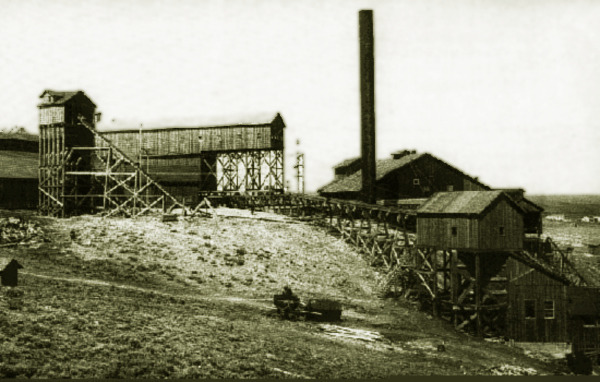
Rudefeha Mine, Battle, Wyoming, 1902, photo by J. E. Stimson.
As a part of promotional material used to sell stock,
a series of photographs of the Rudefeha Mine and the Encampment Smelter were taken by
Cheyenne photographer J. E. Stimson. For information as to J. E. Stimson see Cheyenne.
The Rudefeha Mine, 14 miles from Encampment, was established by J. M. Rusmsey, Robert Deal, George Ferris and Ed Haggarty
and named after the investors. The deposit was discovered by Ed Haggarty (1866-1944), an English-born sheep
herder.
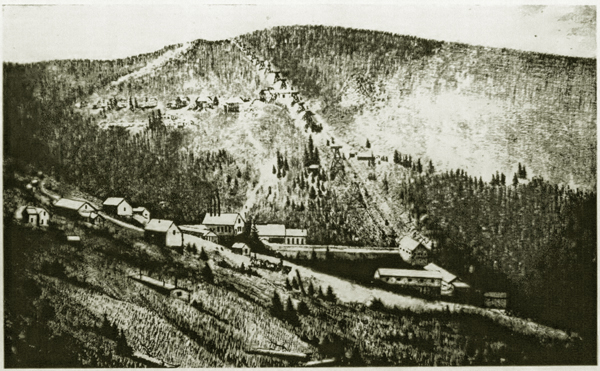
Rudefeha Mine, Battle, Wyoming. Engraving of pencil sketch by
Merritt D. Houghton, 1903.
Following the discovery of the claim, the investors brought in one of Colorado's foremost mining engineers, William Weston,
to examine the claim. Weston was a consulting mining engineer to David H. Moffat and the mining and exploring
engineer for Moffat's Denver, Northwestern and Pacific Railway Company. By the time of
Weston's visit, the initial facilities consisting of a log stable, eating house, and bunk house had been constructed. By the winter of
1889, 250 tons of ore had been shipped to Rawlins by wagon over a snow road using nine teams of four hourses each, "nine fours."
With the completion of the tramway to Encampment, 350 tons of ore could be shipped in a single twenty-four hour period.
The tramway was the world's second longest aerial tramway, photos of tramway in Encampment on a
preceding page. The tramway utilized 270 towers with the highest span above
ground at 900 feet. The tramway utilized three transfer stations in which the ore was transferred from one section of the
tramway to the next. This was done by dumping the ore into a bin from which the ore would then
be transferred to the next section. In crossing the divide, the tramway at one point was 10,690 feet above
sea level. The longest span between towers was 2,270 feet across Cow Creek Ca��n.
Prior to the construction of the tramway, ore was taken from the mine to the smelter by wagon. The wagon road was
some 26 miles long while the tramway, being direct, was only 17 miles long. Before completion of the
tramway, it cost the mine operators $14.00 a ton to transport the ore. By 1904 with completion of
the tramway, the cost was only 17 cents a ton.
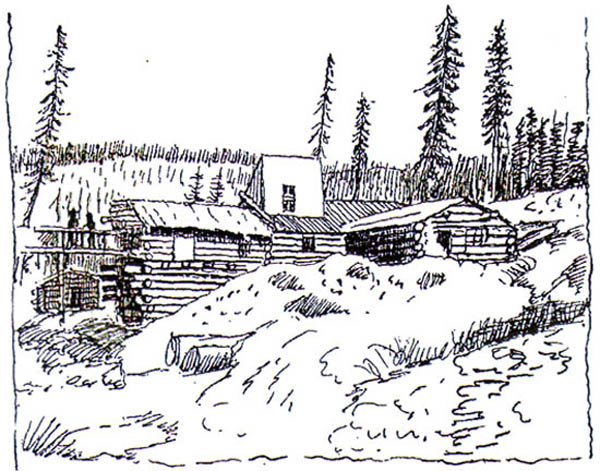
Original Rudefeha Mine, Battle, Wyoming, 1898. drawing by Arthur Lakes, courtesy of
Beth Simmons.
by 1904, the mine was electrically illuminated. The site, being isolated, had its own hospital,
a boarding house, workshops for timbering and
blacksmithing.
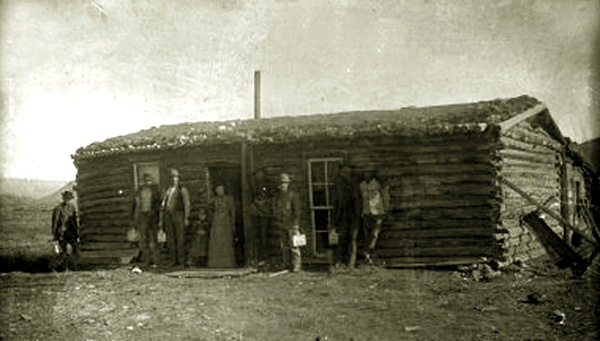
Original boarding house for Rudefeha Mine.
the log boarding house
was later replaced with a two-story boarding house. The Dillon Doublejack reported in
December 1902:
The Rudefeha mine and bunk house is completed, and is
pronounced to be one of the most convenient structures of the kind in
these mountains. It is 19x100 feet and two stories high. Here
100 men can eat and 80 sleep with comfort. It has a cozy reception room in
front, and next behind it is the dining room and then
the kitchen, which is said to be the best appointed culinary
"shop" in a mining camp in Wyoming.
In the mine, trams were moved by a pneumatic locomotive powered by a
500 psi three-stage air compressor. Coal for the electic generating plant was brought in by wagon from a coal mine about three miles away.
Coal required for the smelter was then sent by the aerial tramway to Encampment.
The Ferris-Haggerty Company sold the mine to the Penn-Wyoming Copper Co. about
1902.
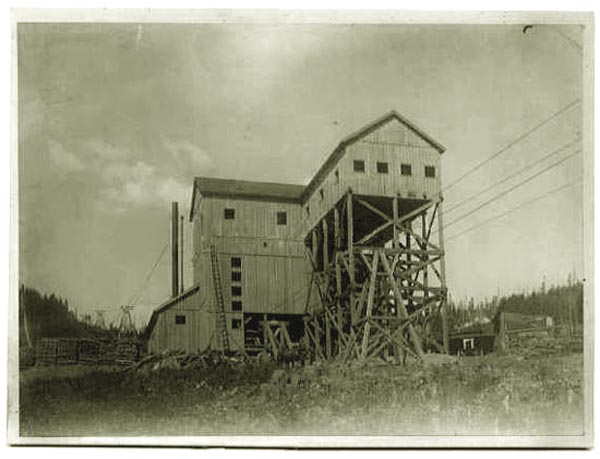
Rudefeha Cable and transfer house
Note, the aerial tramway comes in at a higher level to the rear of the cable house. A second
tramway emerges toward the viewer at a lower level. This permits the ore to be transferred from
one section of the tramway to the next. The transfer operation was fully automatic.
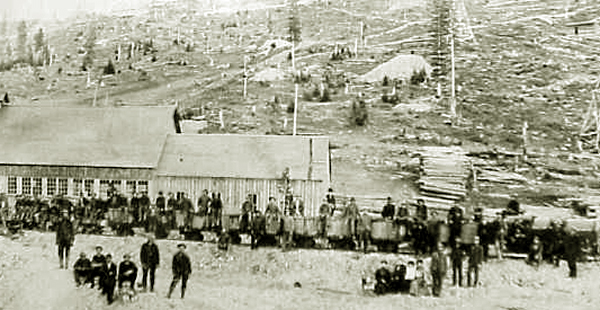
Rudefeha Mine, Battle, Wyoming, prior to 1908
Battle was named as
a result of a battle fought between 500 Sioux, Arapaho and Cheyenne and 23 Rocky Mountain Fur
Company trappers.
During the period from 1900 to about 1908, promotion of new mines and stock speculation was rampant. Other companies prospecting the
area included the Haggerty-Jordan Copper Mining Co. of which Ed Haggerty was
vice-president. It had an interest in the Nellie B. Victor, Granite and Fair
View Mines. Others companies included the Hercules Mining Co., the Northwestern
Copper Mining Co., the Verde Copper Mining & Milling Co., Wyona Iron & Copper Co.,
Beulah Copper Co., Blanche Copper Mining Co., Carbon County Gold Mining & Milling Co.,
El Rey Gold & Copper Co., and the Kearns Consolidated Copper Co. By 1901, The The Battle Lake Miner listed in excess of
140 mines working in the area.
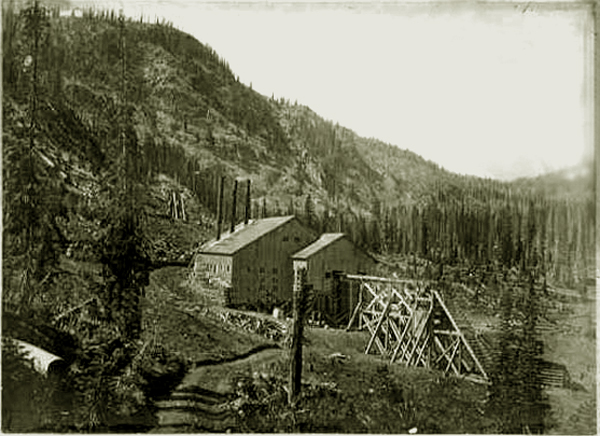
Mine near Encampment, undated
Penn-Wyoming also bought the Rambler. By 1907, the company had acquired as subsidiaries the
Encampment Tramway Co., the Encampment Pipe Line Ditch Co., the Encampment Water Works Co.,
the Encampment Land & Town Lot Co., the Saratoga & Encampment Railroad Co., the Carbondale Coal Co.,
the Emerson Electric Light Co., and the North American Mercantile Co.
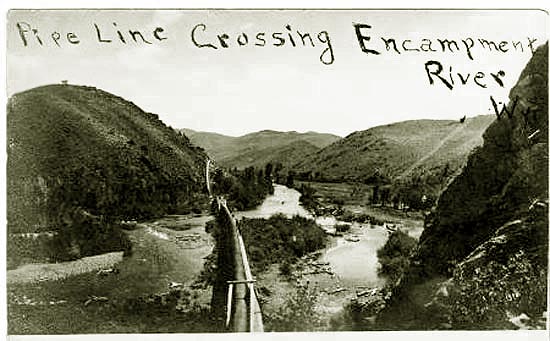
Encampment Pipeline.
The pipeline to Encampment, as was
the tramway, was regarded as a wonder of the age. The pipeline, made of wood, took water from the south
fork of the Grand Encampment River four miles to the smelter at Encampment. There, the water drove 5 turbine wheels, 2 connected to the shafting and
drive for the concentrating machinery, the other three providing electric power.
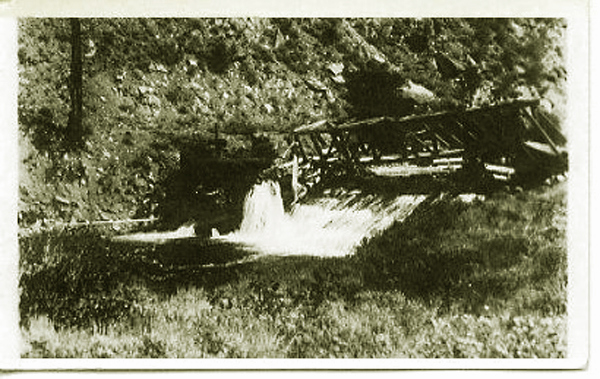
Ruins of dam for electric generating plant for Penn-Wyoming Company, 1920's.
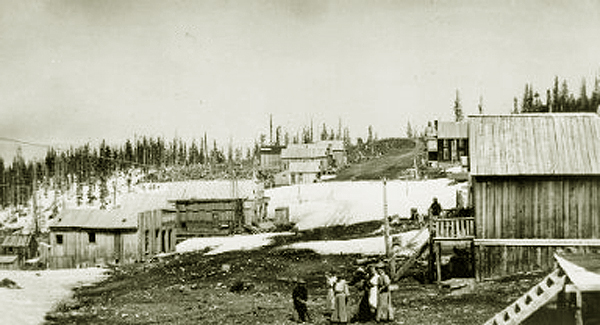
Battle, 1904
The initial difficulty with mining in Battle was access. The Town was located on the Continental Divide almost 10,000 feet in elevation.
Normal travel in the winter within the townsite was on skis or snowshoes. Until construction of the smelter in Encampment, ore was hauled to
Fort Steele 70 miles away by wagon. And even afterwards until construction of the tramway, ore had to be hauled by wagon to Encampment. Snows remained
on the ground until June. An early visitor Thomas Tonge recounted his visit to the town in
June 1900. In June, the only means of reaching the town was by Wagons and sleighs
"in the night time when the surface of the snow had frozen sufficiently hard to bear horses and sleigh." 20
Mines and Minerals, August 1900, p. 29.
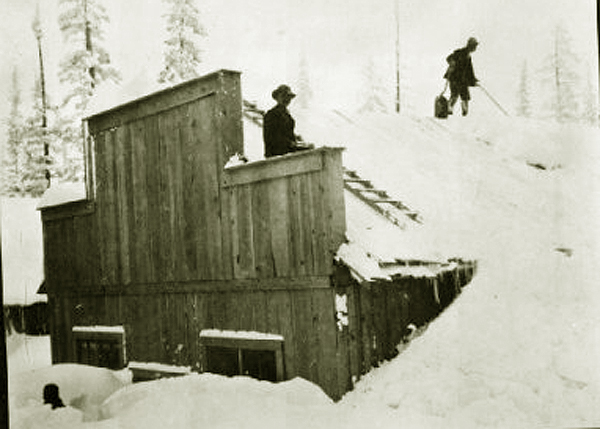
Shovelling snow off roof of building, Battle approx. 1902.
On January 19, 1902, the telephone line from Battle to the Mines west of Battle went down. The telephone lineman, C. G. Comen, set out on snowshoes along with
Assistant Engineer Peter Le Mieux, set out on snow shoes to repair the line. Le Mieux accompanied Comen since he was more familiar with the location of theline.
when no word. They made it to Dillon where they had lunch. They then headed back
toward the mine. When no word was received from them, their wives beame concerned, but they were reassured that they were alright, they having called in after repairding
the line. When they still failed to appea, there was greater concern and search parties set out from
Battle, Rambler and Dillon. Near the Head-of-Cow-Creek the snowshoe tracks were discovered leading to an area where they
were covered by an avelanche. The bodies were recovered. Comen was still wearing his climbing and repair gear. The same snow storm also
collapsed the roof of the old Ferris-Haggerty shaft house. Even today, State Highway 70 is closed in the wnter.
In April 1904, the editor of the Dillon Double Jack complained that the mail had to be carried in from
Battle on snowshoes, leaving all out-of-town newspapers behind. Simply put, the town was out of touch with the world insofar as
news was concerned.
The wagon road to the Battle Lake Mining District had been constructed by George Doane. With, however the mining frenzy,
the Battle Lake area had three "hotels, a rooming house, and three stage lines which provided service to
Encampment, Saratoga, Wolcott, and Fort Steele. Down the hill to the west just above Battle Lake, was the town of Rambler. The road westward
to the Little Snake Valley was a bit rough. The Right Reverend Anson R. Graves noted in his
autobiography, that the it was the "Rockiest Road in the Country." Graves, Anson R.: "The Farmer Boy Who Became a Bishop," the New Werner Company, Akron, Ohio, 1911, p.
166.
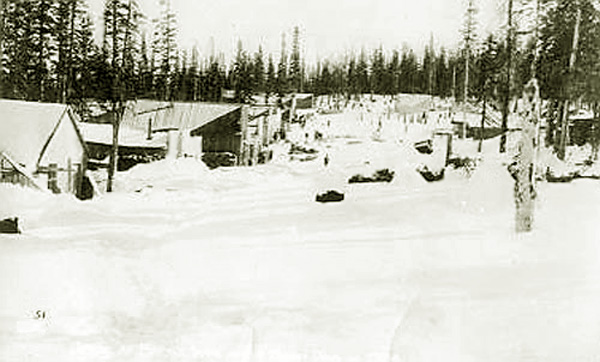
Battle, 1904
In the immediate vicinity of the Rudefeha bars and saloons were not available. Such facilities were available in the next town, Dillon, about 7 1/2 miles away to the west. Dillon had a number of saloons including Alex La Marsh's, Gooch & cluff's, the Miner's Exchange, and
Doyle & Co. The town also had a Knights of Pythias Lodge. But if Battle was difficult to get to in te
Winter, Dillon was worse. In the winter, mail had to be carried in by a mailman on snowshoes. The regular advertised schedule for
the Scribner Stage Line from Dillon to Wolcott showed departure from Dillon at 7:00 a.m. and arrival at
Wolcott at 5:00 p.m. the next day.
Next page, Battle, Dillon, Rudefeha Mine continued, Rambler, Lost Cabin Mine.
|