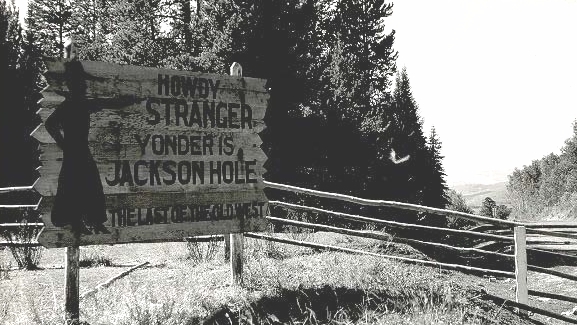
Welcoming Sign, 1930's
Jackson, until
comparatively recently, has remained a small isolated town, primarily devoted to
agriculture. In recent years a major change has overtaken the town and the valley.
The following three photos taken from the same location illustrate the comparitively modest grwoth of the town over almost fifty years.
Similar series of photos taken from other locations are on subsequent pages.
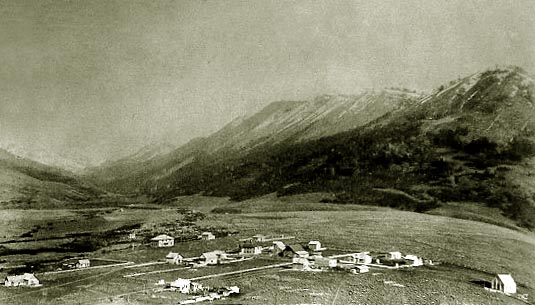
Jackson looking Southeast, 1907
The two-story building is the "Clubhouse" constructed about 1897 and still in existence on the eastside of the
Square.

Jackson, looking southeast.
Photo by William P. Sanborn, 1940.
The roof of the Clubhouse is in the center of the photo. On the right of the photo appears the Wort Hotel has been constructed.
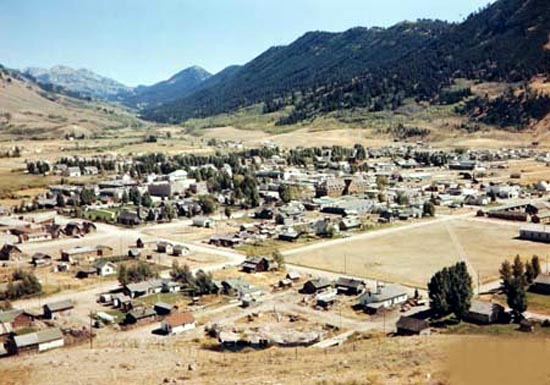
Jackson, looking southeast, approx. 1950.
Trees planted in the Square now obstruct views of some of the buildings.
The isolation of Jackson Hole was noted by Owen Wister who summered in the Hole near Moose.
Wister in his novel The Virginian wrote:
Somewhere at the eastern base of the Tetons did those hoofprints disappear
into a mountain sanctuary where many crooked paths have led. He that took
another man's possessions, or he that took another man's life, could always
run here if the law or popular justice were too hot at his heels. Steep
ranges and forests walled him in from the world on all four sides, almost
without a break; and every entrance lay through intricate solitudes. Snake
River came into the place through canyons and mournful pines and marshes,
to the north, and went out at the south between formidable chasms. Every
tributary to this stream rose among high peaks and ridges, and descended
into the valley by well-nigh impenetrable courses: Pacific Creek from Two
Ocean Pass, Buffalo Fork from no pass at all, Black Rock from the
To-wo-ge-tee Pass--all these, and many more, were the waters of loneliness,
among whose thousand hiding-places it was easy to be lost. Down in the
bottom was a spread of level land, broad and beautiful, with the blue and
silver Tetons rising from its chain of lakes to the west, and other heights
presiding over its other sides. And up and down and in and out of this
hollow square of mountains, where waters plentifully flowed, and game and
nature' pasture abounded, there skulked a nomadic and distrustful population.
This in due time built cabins, took wives, begot children, and came to
speak of itself as "The honest settlers of Jackson's Hole." It is a
commodious title, and doubtless to-day more accurate than it was once.
Many call Jackson "Jackson Hole." The "Hole" is a valley
lying to the north of the town. The town is not "Jackson Hole." The area was settled in the
1890's and is named after a partner in the Ashley Fur Company, David Jackson. The isolation of the valley as observed by
Wister may have been accurate. In 1895, the Indian Agent at Fort Hall wrote his superior
in Washington City of the reputation of Jackson's Hole, "There are a few good citizens ranching in the Jackson Hole country, the majority
of the citizens being men 'who have left their country for their country's good,'
the Jackson Hole country being recognized in this country as the place of refuge for
outlaws of every description from Wyoming, Idaho, and adjacent States."
Because of its isolation, Teton County, of which Jackson is the county seat, was
formed out of Lincoln County in 1921. Notwithstanding
that the area embraced by the new county failed to meet either population or valuation requirements
for the formation of a county, it was organized on January 1, 1923. Part of the delay may have been as a result of having to overcome
a legal challenge in court. It would be another seven years before the new county
had a proper courthouse. Undoubtedly the expense of running the county and the sparcity of tax collections may have contributed to the delay.
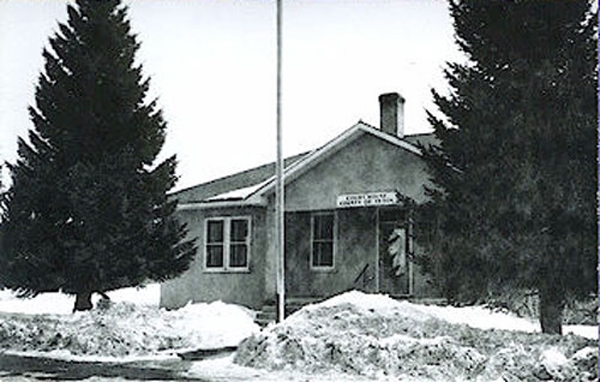
Teton County Courthouse, approx. 1940
Jackson was designated
as the County seat but it was not until 1930 that the above depicted budilding at 160 S. Cache became the
courthouse.
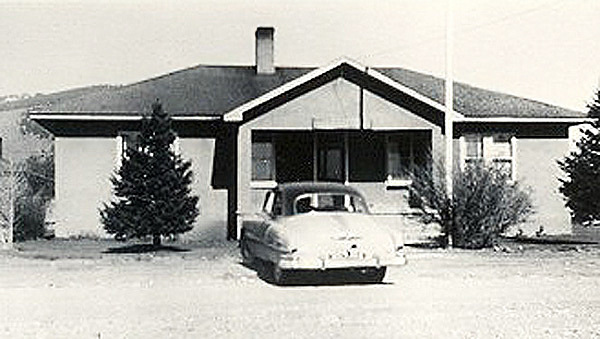
Teton County Courthouse, approx. 1950
The county finally moved to a new much bigger and glorious courthouse at 180 S. King in 1968. The old courthouse is now privately owned.
The reason for the formation of the County was explained by Chief Justice Potter in
State ex rel. Budge v. Snyder, 31 Wyo. 333, 225 P. 1102 (1924), an appeal challenging the
formation of the County:
The fact is, as we judicially know, that the territory within the
boundaries of Teton County is surrounded on all sides by high mountain
ranges, without railroad communication with the county seat of the parent
county, except by wagon road over a mountain pass about 28 miles to a
railroad station in Idaho more than 100 miles from said county seat.
Indeed, there was not then and is not now any railroad within said
boundaries. And for many months during each year it was very difficult,
and at times practically impossible, for the people of that area to reach
the county seat of the county to which they then belonged, and the expense
was usually too great for a trip upon ordinary business.
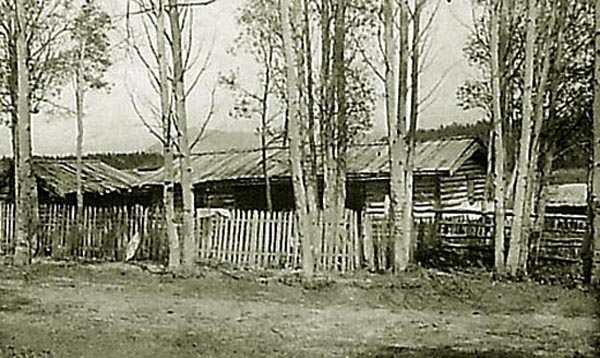
Stage Station, Teton Pass, approx. 1900.
In actuality, the round trip in the 1920s to the Lincoln County seat of Kemmerer took three days. And not withstanding
the wagon road alluded to by Justice Potter, it was not a fully satisfactory means of access even from
Idaho. Even supporters of Jackson such as S.N. Leek noted some difficulties.
In a 1903 letter to the editor of the Sportsman's Magazine of the West, Vol 2, p. 331, Leek noted:
I am receiving a great many inquiries from sportsmen in your locality as
to how best to get into this section. In answer I beg to say that the
best route for tourists or hunters to reach the Jackson Hole country
is rail to St. Anthony, Idaho, then by wagon road to and through Teton
Basin, Idaho, then up Trail Creek through Teton Pass into Jackson Hole, Wyo.
The base of the mountains near the Pass has an elevation of about 6,300
feet, the summit of the pass is 8,300 feet; making a climb and descent
of about 2,000 feet, which on the west or Idaho side, is strung out about
ten miles but on the east side the climb or decsent must be made in about
three miles. Near the summit on the east side is a pile of "chunks" that
excite no small speculation in the minds of travelers as to how they came
there; they have been used to block the wheels of the wagons, so as to give
the horses a rest in making the ascent. Farther down, near the foot of the
steepest part of the hill, a great many logs and tree tops will be seen
piled near the road; these have been used as drags to hold the wagons back
in going down hill and have been cut near the summit till the opening thus
cleared can be seen from my place ten miles away. It is usually July
first before travel can go over Teton Pass without negotiating a long
distance on snow. By the middle of that month the roads may be said to be
fairly open and travel is good.
Others noted signs that travellers to Jackson may have experienced some unhappiness. An anomomous contributor to
Outing Magazine, calling him or herself "Teddy, October 1906, observed:
[T]he road down the side is lined with defamatory notices
left by suffering pilgrims whose wagons have been wrecked on
its rocks and ruts.
Teddy's own wagon had to be abandoned and Teddy's party proceeded on by pack train.
Charles Haven Ladd Johnston in his 1913 "Famous Frontiersmen and Heroes pf the Border," L.C. Page & Company, p. 342 wrote:
To cross into the valley of Jackson's Hole requires one's utmost exertions, for one must climb up the Teton Pass in order to get over the mountains
which surround this paradise of fish and game. For a man and a
horse to pass up and across is easy work, but we were unfortunate
enough to have a wagon with us. As we neared the bottom of the trail,
which led almost perpendicularly up in the air, we saw a broken vehicle
of a pioneer.
"The Top of Teton Pass, or Bust," some one had written on a board and placed upon the battered spokes.
It had " Busted."
Now climbing, pushing, blowing, we yoked four horses to our wagon
and
gradually worked it to the summit of the Pass. It was July,
but snow was on the ridges, and the air was like Labrador as
it swept across the hemlock-covered mountains. When once on top of the
Pass, what a view! We gazed down into a peaceful little vale with log
houses and thatched roofs, fields of green grass with stacks of yellow
hay, and bluish gray rivers curving gracefully across the plain.
Hereford cattle, with their brown bodies and white faces, grazed
contentedly upon the wide sweep of natural grass, and the barking of dogs
sounded indistinctly from the barnyard of a new-made home.
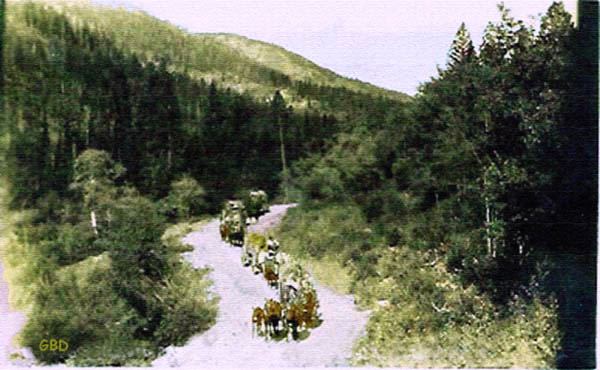
Freight wagons negotiating Teton Pass .
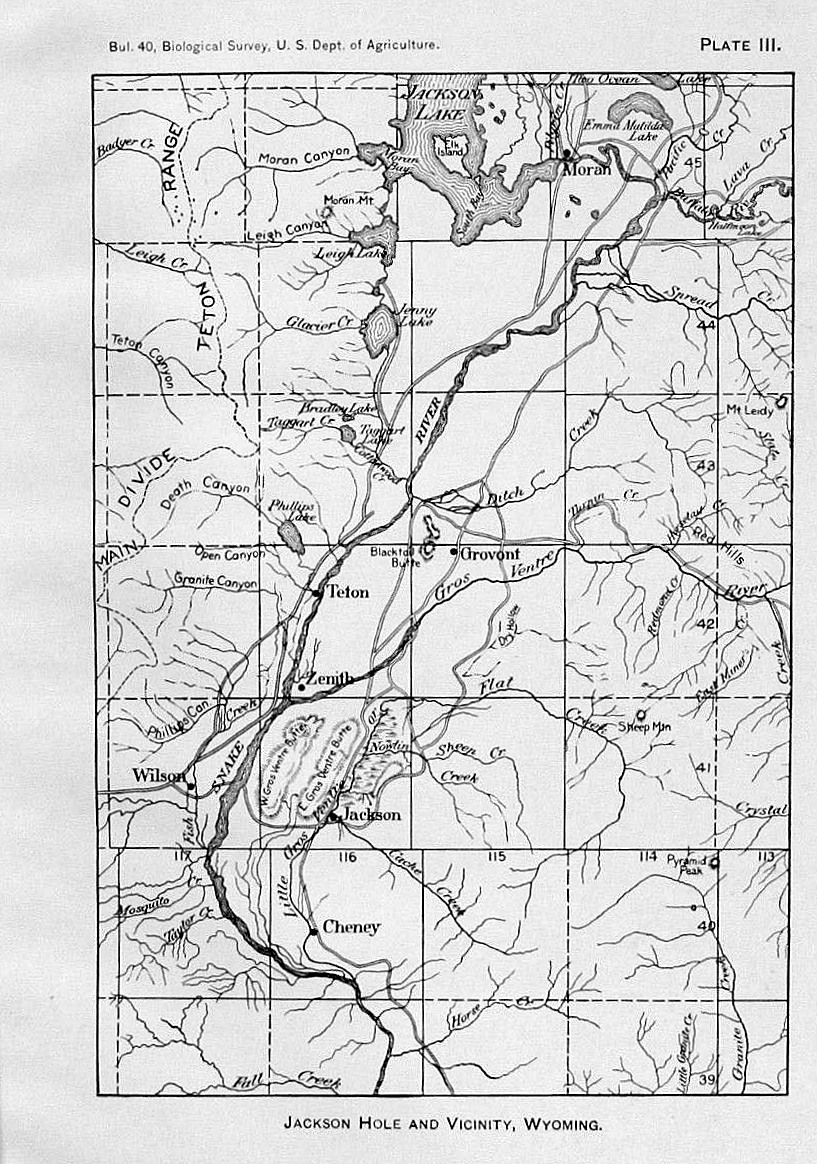
Map of Jackson Hole, 1911.
Background music this page:
When Its Springtime in the Rockies
The twilight shadows deepen into night, dear
The city lights are gleaming o'er the snow
I sit alone beside the cheery fire dear
I'm dreaming dreams from out the long ago
I fancy it is springtime in the mountain
The flowers with their colors are aflame
And ev'ry day I hear you softly saying
"I'll wait until the springtime comes again"
When it's springtime in the rockies
I am coming back to you
Little sweetheart of the mountains
With your bonny eyes of blue
Once again I'll say "I love you"
While the birds sing all the day
When it's springtime in the rockies
In the rockies, far away
When it's springtime in the rockies
I am coming back to you
Little sweetheart of the mountains
With your bonny eyes of blue
Once again I'll say "I love you"
While the birds sing all the day
When it's springtime in the rockies
In the rockies, far away
I've kept your image guarded in my heart, dear
I've kept my love for you, as pure as dew
I'm longing for the time when I shall come, dear
Back to that dear, old western home and you
I fancy it is springtime in the mountains
The maple leaves in first sky-green appear
I hear you softly say, my queen of Maytime
"This springtime you have come to meet me here"
When it's springtime in the rockies
I am coming back to you
Little sweetheart of the mountains
With your bonny eyes of blue
Once again I'll say "I love you"
While the birds sing all the day
When it's springtime in the rockies
In the rockies, far away
Next Page: Teton and Hoback Passes continued.
|