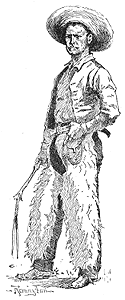
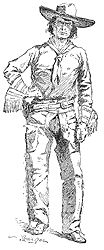
"First Call for Breakfast in Wyoming"
The above photo was featured on the cover of a Life magazine.
The photo on the preceeding page of the cowboy gazing at the airplane in the sky is evocative of the theme found in
Belden's work of the West of the 1920's and 30's as a place caught between the old and the new, a theme repeated in the
next three photos, the first of an airplane with Pitchfork and Z Bar T brands upon its cowling, the second
which suggests that round-ups were assisted by aviation, and the thrid of the
old sheepherder in the sheep wagon with a new Atwater Kent radio and a Scientific American
magazine
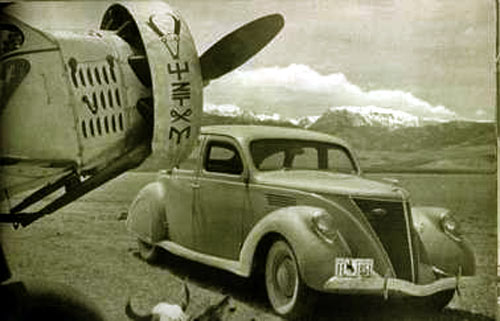
Airplane and Lincoln Zephyr.
The photos are often replete with juxtaposition of symbols. In the above photo not only are there
symbols of the old such as the cattlebrands but of the new in the form of the airplane. Note the antelope skull
next to the airplane tire. The McCracken Collection of the Buffalo Bill Historial Center holds another
version of the same scene in which Belden's tame cayote is seated between the car and the
airplane.
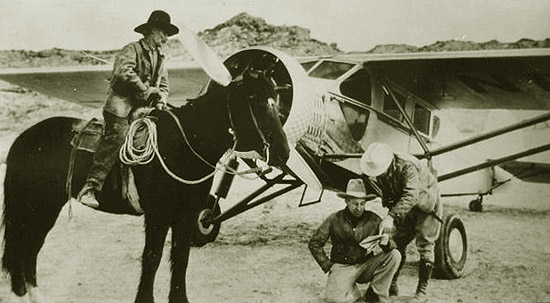
"Cowpilots," Cody pilot, Bill Monday squatting.
Bill Monday started flying in the 1920's with a card signed by Orville Wright. During World War II, he was a test pilot for
Lockheed. After the war, although he was still in his forties, Monday retired from aviation and
operated a sand and gravel business in California.
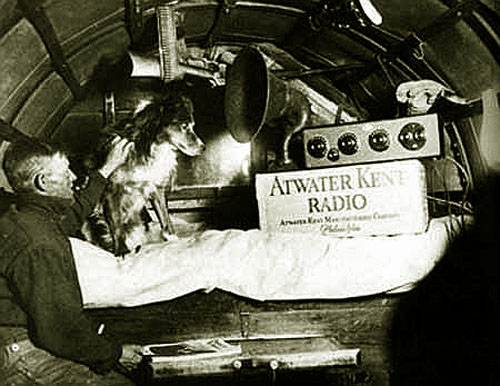
Burt Tennyson in sheep wagon with his dog.
The question brought to mind, however, is where in a sheep wagon is there
electricity to power the radio. The radio is actually battery powered, but certainly it would
require an external antenna to bring in the signal of KFBB in Great Falls over two-hundred
miles away. And with the radio, shipping box, and external loud speaker, all on the bunk, where is
the poor sheepherder to sleep? The first radio station in Wyoming, KDFN (now KTWO) did not go
on the air until 1930. The photo is a part of a
series of photos, with Tennyson lying on the bunk with his head on the left end of bunk, then with Tennyson with
his head on right end, and Tennyson holding the Scientific American with the viewer having a clear view of the cover. In another shot,
the Scientific American was replaced with a New York Times.
The point is that although Belden's photos are regarded as illustrative of everyday
life on the range, they were very carefully posed right down to the Scientific American. with multiple shots made of the
same scene.
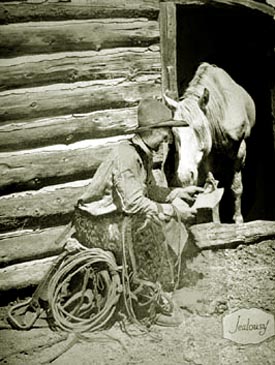 . . . . . .
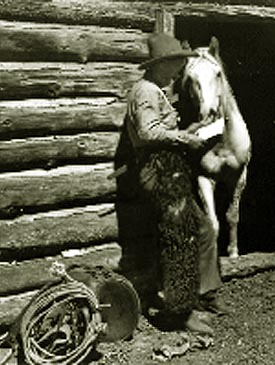
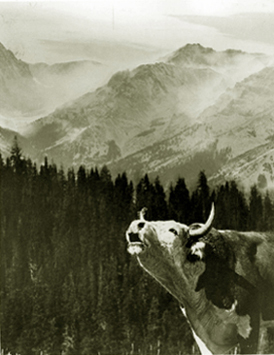
"Jelousy."
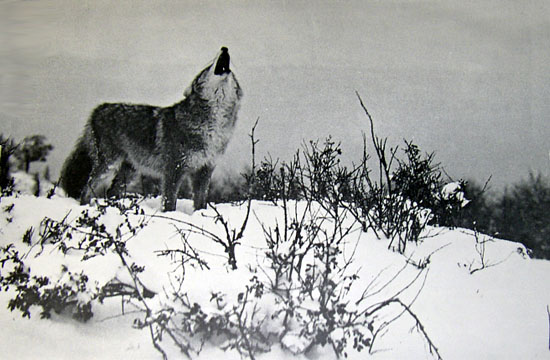
Howling Coyote.
Even the above photo is posed. The coyote was tame and trained to howl upon command, much like
the writer's own Siberian husky who would "sing" upon request. Belden repeated themes as indicated
by the next photo on the left.
 . . . . . .
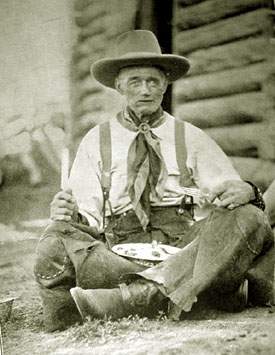
Left, "Cattle Call," 1937; Right, "Veteran of the Range," 1930.
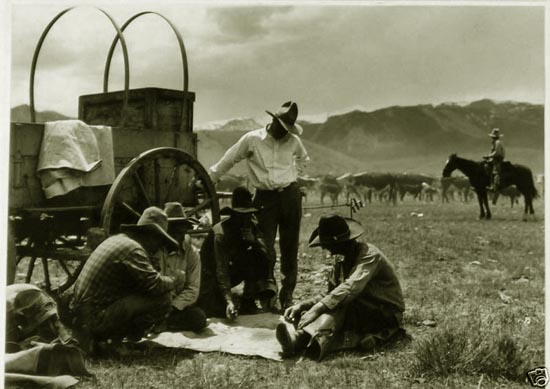
A game at the mess wagon. Jack Rhodes, St., Hughie Windsor, Curly Hollingsworth, Mark Windsor, Durch Kreal.
The wagon, identified from another photo, is a Z Bar T wagon. Resting on a rack in the background is a
Pitchfork branding iron. The "Pitchfork" had multiple brands: The Pitchfork, the Z Bar T, the Pallette, and the 91.
The latter was named for the year of its founding. The Windsors were from Montana.
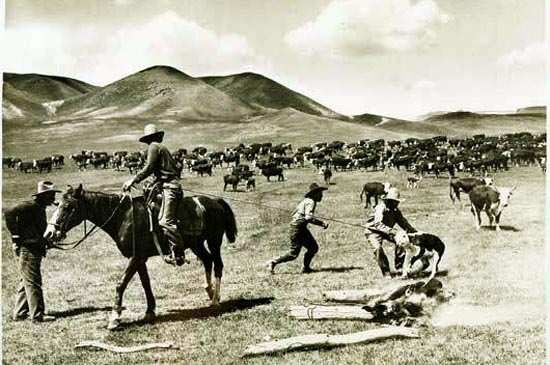
Branding on the Pitchfork, near Meeteetse.
Compare background and piece of wood with the next photo.
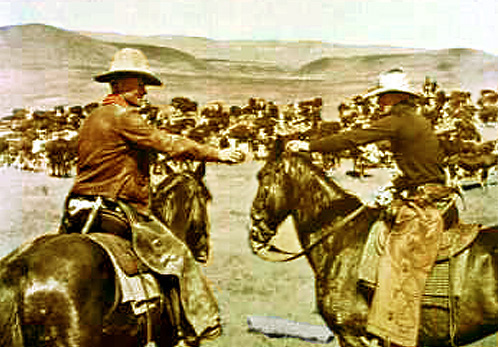
Friends
Next page: Meeteetse continued, more Belden photos.
|