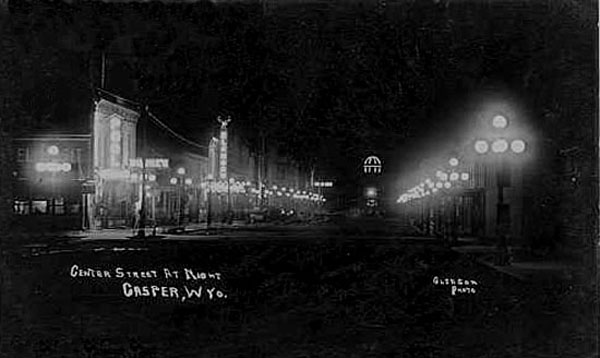
Night time view, Center Street looking north, approx. 1912. Photo by
Olin S. "O.S." Gleason.
The sign with the antlers at the top on the left is the Elkhorn Saloon. To its left is the Rhinocerous
Restaurant discussed on a subsequent page.
The photographer, O. S. Gleason (1879-1968) some of whose photographs are featured on this and
other pages, was born in Vermont and moved with his parents to Nebraska. In 1909, he and his
wife moved to Saratoga, Wyoming where he set up a short-lived photography business. In June 1910, he purchased
E. P. Holmberg's photography studio at 119 3rd Ave., Casper. In Casper in addition to a normal
photography business, he documented the growth of the oil industry in Salt Creek and the Big Muddy. About
1920, he left Casper and set up a photography studio in Red Cloud, Nebraska. By 1930, he had moved to
Concordia, Kansas, operating a photography studio there.
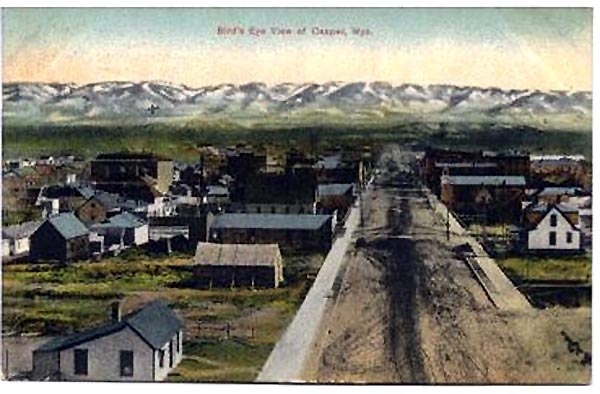
Center Street looking south, approx. 1900. Postcard by
Schulte Hardware Company.
Although, the first oil refinery in Casper opened in 1895, the real growth of the
town commenced about 1910 with the expansion of the Salt Creek oil fields in the northern
part of the County. Compare the next two views of the Richards & Cunningham Store on Center Street.
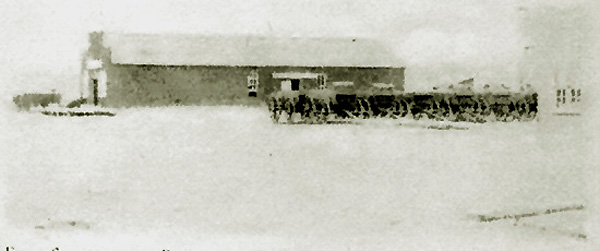
Richards & Cunningham Store, corner of 2nd and Center, 1888.
The Richards & Cunningham mercantile establishment was a successor of C. H. King & Company. It was owned by
J. DeForest Richards and Alex Cunningham.
Hotel Natrona.
The Hotel Natrona on the northeast corner of South Center and Midwest Avenue was formerly the Hotel DeWentworth.
The DeWentword was acquired by J. P. Smith in 1896. The hotel was completely
reconsructed with a new front section facting Center Street, a third floor on the new section,
and remodeling of the interior. Outside it was painted a light beige with olive trim.
The name of the hotel was done in gold leaf. In addition to family quarters, downstairs featured a dining room and barber shop and well
as other commercial space. On the upper floors there were forty-eight rooms and one interior bath. It was not unusual for even
luxury hotels in the late 1890's to have no private baths. The hotel remained in business as a hotel until about 1940 when it became
the Nicolaysen Building.
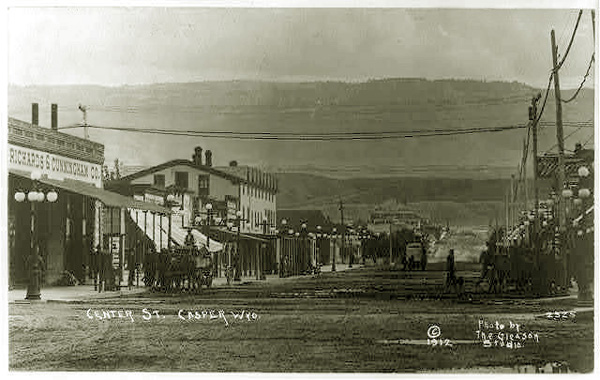
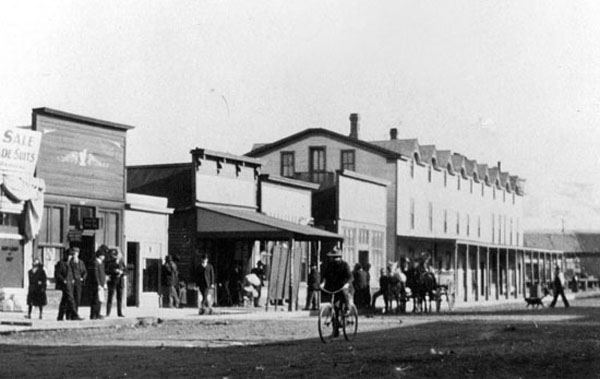
Center Street looking south, 1912, Richards & Cunningham Store on left at
107 S. Center, now 207 S. Center (the numbering was changed in the 1920's). Further down the
street on the left is the Hotel Natrona. Photo by O.S. Gleason.
The Richards & Cunningham Store was an early department store featuring everything from canned goods to
ladies' apparel. It had a branch at Wolton, about 50 miles to the west of Casper near present-day Hiland.
Wolton had sheep shearing pens and was a shipping point for sheep. Registration books for sheep shearing at the
pens were maintained in addition to the ladies' apparel in the store. Cunningham had his finger in just about every pie.
In addition to the merchantile establishment, he also was a chief shareholder and president of the Casper National Bank. Richards was
cashier. Richards also had interest in Douglas and in sheep companies and prior to his death was Governor.
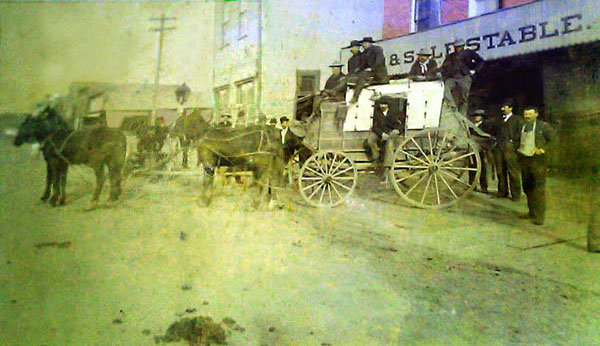
Stage in front of the Feed and Sale Stable.
In addition to running the Grand Central livery barn, M. M. "Shorty" Castle for a time operated the
Feed and Sale Stable, later known as indicated by the sign as the "Feed and Sale Stable."
Other livery
stables in Casper indluded John McClure's Livery, Feed and Sale Stable; the Star Livery. Feed and Sale Stable; Rhoades & Crum's;
and J. S. Huntley's Feed Stable. Huntley was also shown in some advertisements as the operator of the Grand Central
Stables.
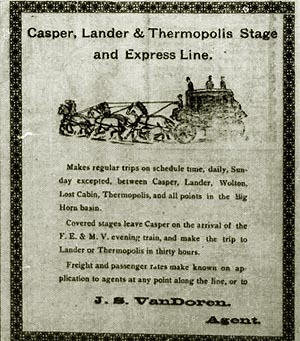 . . . .
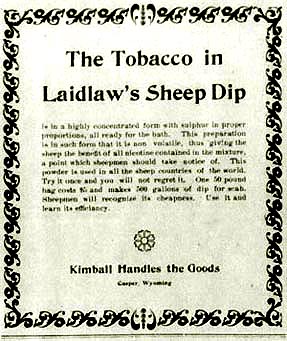
Left: 1899 Advertisment for
Casper, Lander & Thermopolis Stage and Express Line;
Right: 1902 Advertisement for Kimball's Drug Store
As suggested by the ad for the sheep dip and by the photographs on a preceeding page of the wool warehouses,
Casper in the late 1890's and early 1900's was not only the major shipper of wool in Wyoming, it was the largest shipper of
wool in the United States. In 1895, 4,000,000 lbs of wool were shipped out of Casper. The sheep dip advertisement perhaps illustrates the importance of sheep to Casper's economy at the
turn of the century. Writer's comment as to Kimball's advertisement: For some unknown reason,
disreputable saloons smelling of stale smoke remind the writer of sheep dip. The ad explains it.
John S. Van Doren, agent for the stage line, at various times served on the Town Council, as City Treasurer, and
postmaster. The owner of the line was Wm. Clark.
Prior to the extension of the Chicago and Northwestern westward to the Wind River Basin, Casper was one of the
three principle jumping off places to Lander and the Wind River and Big Horn Basins, the others being, at first Rawlins and later Rock River.
At first, the stage ran west to Lander in an "open conveyance" only on Tuesdays and Fridays via Bessimer and Rongis and later to
three days a week. At the time of the ad, stage service was nightly except on Sundays. As indicated by the
advertisment the line ran in "covered" stages every evening after arrival of the 9:00 p.m. train. The trip took 28 to 38 hours.
The stage arrived in Lander at 3:00 a.m. a day and a half after departure. The line required some 125 horses and 20 men. For a
description of the trip to Lander, see Lander. Portions of the trip were not
to be taken lightly. The stage typically arrived at Clark's home ranch aout 2:30 in the morning. A few miles beyong was a stretch affectionately known as "the Freighter's Delight" which allegedly caused
more profanity from the freighters than all the rest of the road from Casper to
Walton. In that stretch, the heavy freight wagons in wet weather could sink up to their hubs in the gumbo. Passengers heading to
Thermopolis changed coaches at Round Hill and then faced six miles over alkali flats before they got to
Lost Cabin. On the road to Thermopolis there were several daunting hills before reaching the Big Horn River. The Tribune, August 1, 1901, noted that several dozen had
lost their lives crossing the river in the previous several years.
After establishment of
the Salt Creek Oil field, a stage
ran northward thrice weekly to Salt Creek. By 1918, the latter stage was replaced by an
"automobile stage" depicted on a later page. Not withstanding the use of the automobile stage the trip to
Salt Creek particularly in the winter could be rough. In late October, 1920, it began to snow. Although the road had recently been
graded, it had not yet packed down. Thus, a passenger on the stage noted that between Casper and
Salt Creek some 14 trucks were stalled in the mud.
Next page: Second Ave.