Oil Exchange Building
Casper has recieved much of its growth as a result of being the economic heart of
Wyoming's oil industry. Other important buildings related to the oil industry include the
art deco Ohio Oil Company Building (now Marathon Oil).

Casper-Salt Creek Stage about to depart from in front of Hotel Henning, approx. 1920.
The Hotel Henning, formerly the Midwest Hotel, was on the southeast corner of Center and First. The 150 room hotel was owned
by W. F. Henning. After Henning's death, the building was sold and torn down. A bank now occupies its
location. As discussed with regard to Oil Camps, the
oil boom hit Wyoming about 1916 with the development of the Salt Creek, Midwest, and Big Muddy Oil Fields. The center
of this boom was Casper; and in Casper the Hotel Henning was the center.

Hotel Henning courtesy car, approx. 1920.
W. F. Henning, himself, had a reputation for being a bit difficult to work with. In one instance, he
had the hotel's auditor arrested for allegedly stealing a night's receipts. After the charges were
dismissed, she successfully sued, the jury finding upon disputed evidence that "some time during the year 1928
the defendant [Henning] made threats against the plaintiff that he would get even with her because she refused to give false
testimony at defendant's request in a divorce action then pending between defendant and his wife." See
Henning v. Miller, 44 Wyo 114, 8 P. 2d 825 (1932). In another action, a real estate broker managed to get Henning's
signature on a contract to sell the hotel. In an appeal, the Supreme Court noted testimony that
"any man that could deal with Mr. Henning should be congratulated as Mr. Henning was one of the hardest men
in Casper to do business with." Desmond v. Poulos, 69 Wyo. 129, 237 P. 2d 853 (1951).

Hotel Henning, 1930's
As observed by Professor T. A. Larson in his History of Wyoming,
"Speculative fever raged in Casper in 1916 and 1917 after exciting discoveries
on the Muddy east of Casper." Casper historian A. J. Mokler recalled,
"Men in all walks of life neglected their business and their professions to buy and sell oil
stocks." Leslie A. Miller, President of the Chief Oil Company, and later governor, testified before
the House of Representatives that there was a "whole herd" of promotors, who for the greater part
"do very little drilling. Once in a while to protect themselves from the Post Office Department they do a little
drilling, but their chief aim is to sell stock."
Alfred James Mokler was the publisher of the Natrona County Tribune, an ancestor of the
present day Casper Star-Tribune; editor of the short-lived Wyoming Pioneer, a bimonthly
historical journal; author of History of Natrona County, 1888-1922; Grand Historian of the
Wyoming Masonic Grand Lodge; and served two terms as Master of Casper Lodge No. 15.
Indeed, as noted by Professor Larson, most of the trading was done in the lobby of the Henning. Customers
would would overflow into the street on many evenings. Most of the speculative companies went belly-up. Most of the
oil in the principal fields was controlled by the major operators, Standard of
Indiana (now BP), the Midwest Oil Company (merged in 1920 with Standard), Ohio (now Marathon), and
Sinclair

Lobby, Hotel Henning
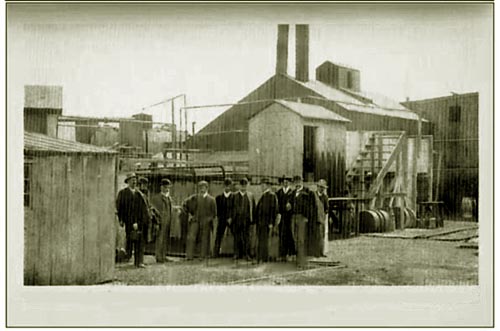
In 1894, the Pennsylvania Oil and Gas Corporation, organized by
Phillip Shannon, commenced the construction of a refinery in Casper, capable
of refining 100 barrels of lubricant a day. The refinery, however, was razed as a
fire hazard. For an example of another small refinery
see Lusk . It is doubtful that
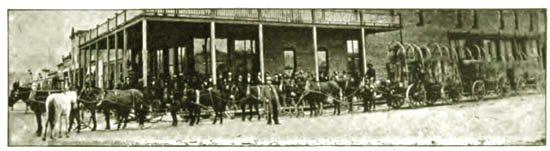
larger capacity was needed. The oil had to be brought in by wagon from the Salt Creek Field 45 miles away, a two-day trip.
The first wagon train came in in 1895.
Oil Wagon Train in front of the Grand Central Hotel, approx. 1895. Standing in front is
George B. McCalmont, Vice-President and Casper Manager for the Pennsylvania Oil and Gas Corporation.
In 1909, the Franco-Wyoming Oil Company was organized by
French and Belgian interests under Delaware law. Because of requirement of the
Paris Bourse, the stock was controlled by the Trust Francais des Actions de la Franco Wyoming Oil Co.
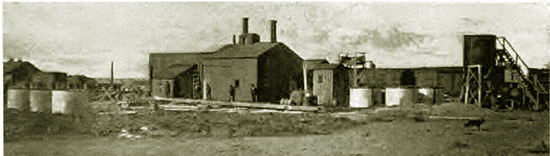
Casper's original Franco-Wyoming Refinery.
In 1911, a six inch pipeline was constructed by a subsidiary of Franco-Wyoming from Salt Creek to Casper.
In 1912, Franco-Wyoming constructed another small refinery having a capacity of
500 barrels a day.
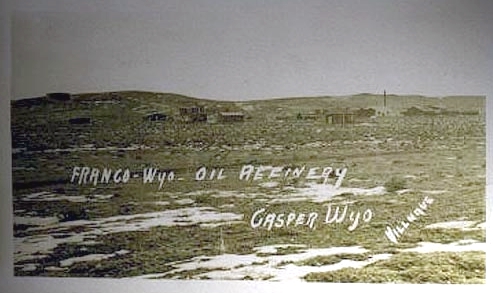
Franco-Wyoming Refinery, Casper
The Franco-Wyoming Refinery was
later acquired by the Midwest Oil Company which replaced it with a larger refinery on the
future site of the BP Refinery on the Platte River. The demand, however, for petroleum remained scant until the
world's major navies converted to oil prior to World War I and the "gas buggy" became popular.
To create a demand, Midwest convinced the Chicago and North Western to convert its coal fired
steam locomotives to oil.
Until those developments, petroleum's value was primarily for lubricants and as
a replacement for whale oil in lamps. Indeed, prior to the Civil War, Wyoming petroleum obtained from
petroleum springs was mixed with
flour and sold as a lubricant for the emigrants' wagons on the Oregon Trail.
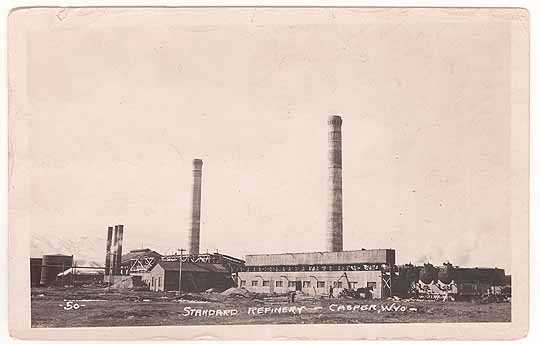
Standard Refinery, Casper, undated
It was not until 1910 and 1913,
with the development of large fields in
Salt Creek, that larger refineries were constructed in Casper by Standard and Midwest. Midwest also
constructed a refinery in Greybull, and
Producer and Refiners constructed a refinery in its planned community, Parco (now Sinclair).
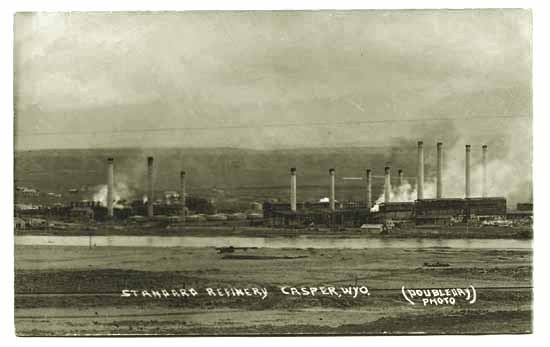
Standard Refinery, Casper, undated. Photo by Ralph Doubleday.
With the opening of the Big Muddy field near Glenrock in 1916, Ohio built a refinery in
Glenrock. The BP and Marathon refineries are gone now, but their legacy remains with the required
environmental cleanups and adaptive reuse of the BP land in Casper.
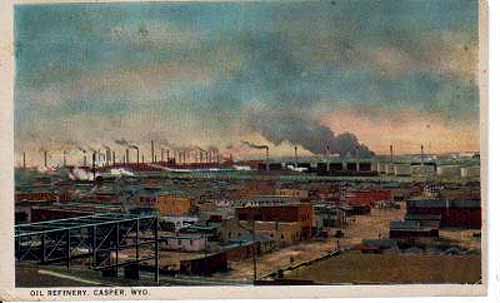
Casper Refineries, 1918
Casper Photos continued on next page.
|