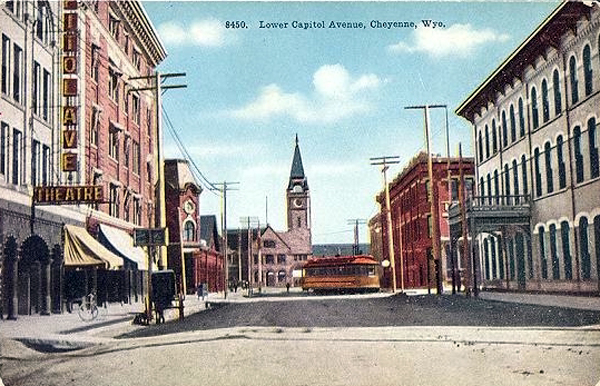
Lower Capitol Ave.
In the above scene Looking towards Union Pacific Station, Capitol Avenue Theater on Left, 5 story building immediately
past theater is the First National Bank.
beyond that with the clock is the Burlington Depot; on right, side entrance to
the Inter-Ocean Hotel,now the site of the Hynds Building. Beyond that on the right is the
is the "Phoenix Block" now known as the "Wrangler Building." At the time, large builldings were frequently
referred to as a "block" even though they did not occupy an entire city block.
As previously noted, the earlier
tramcar line operated by J. C. Abney discontinued operations in 1892. In 1908, the Cheyenne Electric Railway Company headed by
Thomas Cosgriff obtained permission to operate an electric street railway system in Cheyenne. Cosgriff was president of the
First National Bank.
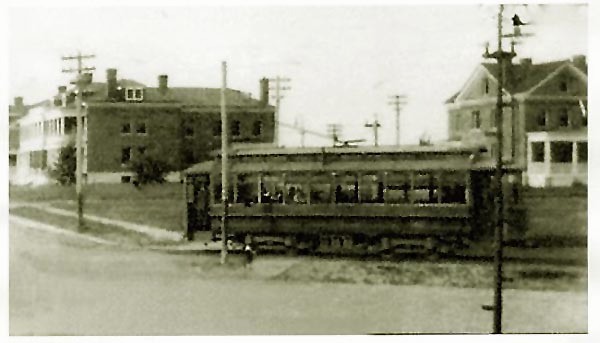
Streetcar at Fort D. A. Russell.
Lines extended out as far as Fort D. A. Russell, to the Capitol, and to the cemetary.
Fares within the city limits were a nickle. Fare to D. A. Russell were a dime. The car barn was located on
Cribbon Ave. Service was discontinued in 1924
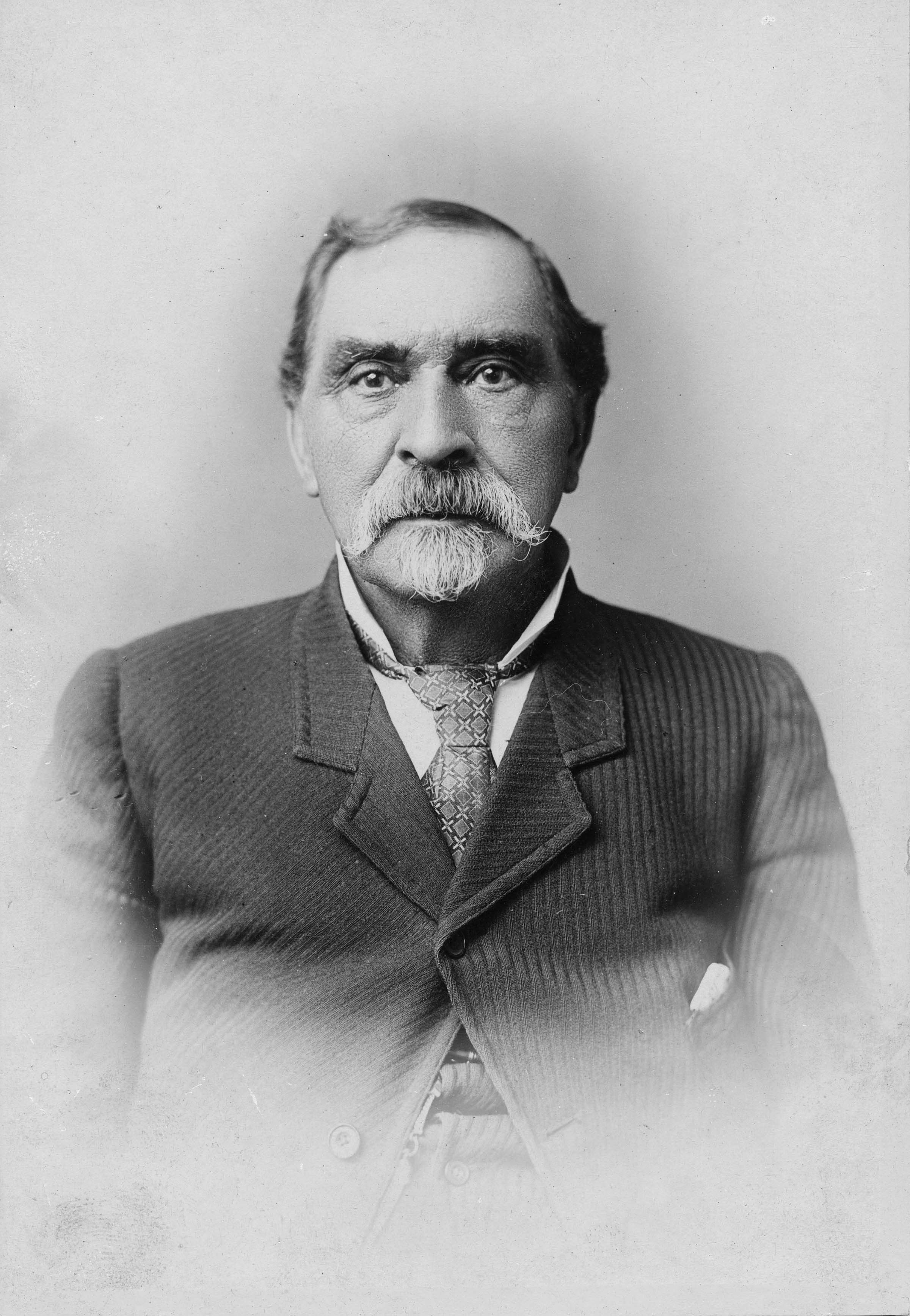
Right, Barney Ford, owner of the Inter-Ocean Hotel
Prior to the construction of the
Plains Hotel in 1910, the leading hotel in Cheyenne was the Inter-Ocean Hotel constructed by
Barney Ford (182?-1902), photo to right. The Inter-Ocean was built by Ford after an earlier hotel burned in 1870.
Ford started life as a slave in Virginia Various dates and locations of birth are given for Ford,
from 1822 to 1827 with place of birth being given by different sources as
Virginia or South Carolina. Records were generally not kept for slaves. As to Ford's
date of birth, it is doubtful that he himself knew either his age or birthday.
Barney Ford's mother, Phoebe, was killed during an
escape attempt when Ford was 17 or 18. The 19th Century escaped slave and
abolitionist Federick Douglass in his 1845 "Narrative of the
Life of Frederick Douglass, Written by Himself," explained:
I have no accurate knowledge of my age, never having seen any authenic
record containing it. By far the larger part of the slaves know as little of
their age as horses know of theirs, and it is the wish of most masters within my
knowledge to keep their slaves thus ignorant. I do not remember to have ever met a
slave who could tell of his birthday. They seldom come nearer to it than planting-time, harvest-time, cherry-time,
or fall-time. A want of information concerning my own was a source of unhappiness to
me even during childhood. The white children could tell their ages. I could not
tell why I ought to be deprived of the same privilege. I was not allowed to
make any inquiries of my master concerning it. He deemed all such inquiries on the
part of a slave improper and impertinent, and evidence of a restless spirit.
The nearest estimate I can give makes me now between twenty-seven and twenty-eight years of age.
I come to this, from hearing my master say, sometime during 1835, I was about seventeen
years old.
Indeed, Douglass was not even sure of who his father was, although it was "whispered that
my master was my father." Although Douglass knew who his mother was, "I never saw my mother,
to know her as such, more than four or five times in my life; and each of
these times was very short in duration and at night." Douglass's mother would sneak away at night
from the farm on which she was employed twelve miles away to see her son. If she was not in the
fields at sunrise, she would be whipped. Douglass wrote that he did not "recollect of ever seeing my mother by the light of
day."
At some point, Ford was hired out by his then master to work on a Mississippi
river steamer as a cook and waiter. The steamer docked on the Illinois side of the river and thus Ford made good his escape from slavery. He made
his way to Chicago where at first he worked in a livery stable and then after taking a $2.00 tonsorial course, he worked as a barber. But prior to the Civil
War because of the Fugitive Slave Act, it was still dangerous
in the so-called "free states" to be an escaped slave. Even legally free Negroes were taken and reduced
back into slavery on a mere affidvit that they were escaped slaves. To marry or to work it was necessary to have a name. At the suggestion of his
future wife, Ford adopted the middle name "Lancelot" [also spelled Launcelot] and the surname of "Ford,'
allegedly taken from the name
of a locomotive.
In Chicago, Ford married and his wife helped him to learn to read and write. In the early 1850's, the Fords decided to
go to California to seek gold. The fastest and least expensive route to
California was by way a newly established route created by Commodore Cornelius Venderbilt. The route by sea to Nicaragua was by sea from New York on one of
Vanderbilt's steamers to
Greytown (San Juan del Norte), up the San Juan River, across Lake Nicaragua and to La Virgen and then to San Juan del Sur where the intrepid
traveler would travel on another of Vanderbilt's steamers to San Francisco.
Advertisements of the day promised that with the purchase of a "through" ticket, one
would go up the river in an iron steamer and then travel the last twelve miles from the lake to
San Juan del Sur in a stage coach.Fares ultimately were reduced to as low as
$100 for cabins and $35.00 for steerage.
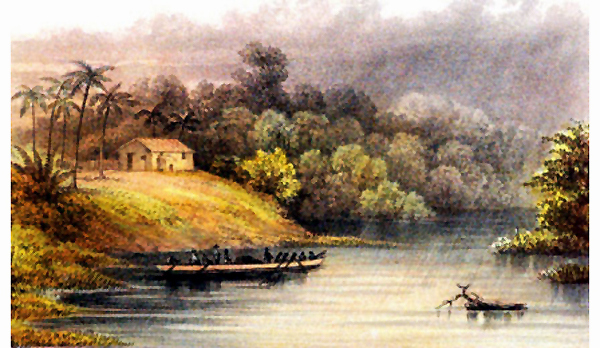
A "bungo" on the San Jaun River.
Neverthess the pricing and advertisements took on some aspects of a classic
"bait and switch." The river had rapids which meant that the iron steamer could go only a few miles. Thereafter, the
trip up the river was in "bungoes," dugout canoes, and walking through the mud
as much as six inches deep around the rapids. From the lake, the trip to
San Juan del Sur was by mule. Some bungoes are more luxurious than others. Thomas Belt, "The Naturalist in Nicaragua,"
Balantine Press, London descriped a portion of one such journey on one of the better bungoes poled by naked bungo-men:
The bungos are flat-bottomed boats, about forty feet long and nine
feet wide. There is generally a little cabin, roofed over at the stern,
in which the wife of the captain lives. The bungo is poled along by twelve
bungo-men, who have usually only one suit of clothes each, which they do
not wear during the day, but keep stowed away under the cargo that it may
be dry to put on at night. Their bronzed, glistening, naked bodies, as they
ply their long poles together in unison, and chant some Spanish boat-song,
is one of the things that linger in the memory of the traveller up the
San Juan. Our boatmen paddled and poled until eleven at night, when we
reached Machuca, a settlement consisting of a single house, just below the
rapids of the same name, seventy-seven miles above Greytown. We breakfasted
at Machuca before starting next morning, and I walked up round the rapids
and met the canoe above them. About five o'clock, after paddling all day,
we came in sight of Castillo, where there is an old ruined Spanish fort
perched on the top of a hill overlooking the little town, which lies
along the foot of the steep hill; hemmed in between it and the river,
so that there is only room for one narrow street.Belt: 2nd Ed Revised & Corrected, p. 31
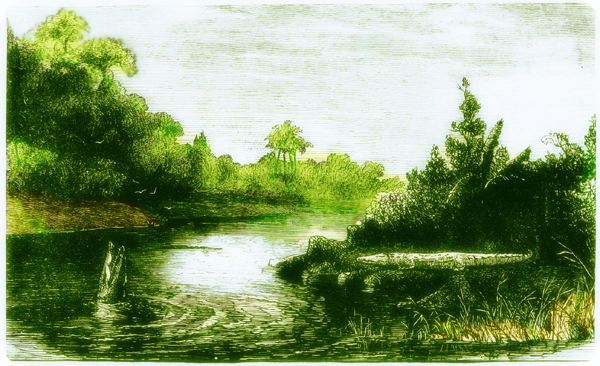
Alligators along the San Juan River..
On reaching San Juan del Sur, the Fords discovered that there were no inexpensive berths on any of the steamers to
take them to California. The only space available was "first class" which they could not afford. Space in hotels while they awaited
passage to California was prohibitively expense. The ramshackle Amerian Hotel charged $14.00 a day, equal to aproximately
$322.00 a day in 2016, more than the entire cost of the voyage. Adolphe Boucard observed in his
"Travels of a Naturalist:"
Several hotels hastily built to supple the wants of the numerous
passengers passing consantly from New York to San Franscisco and vice
versa. In the American hotel, the charges were twelve shilings a day, and
in the French from eight to ten shillings.
Boucard stayed in the latter.
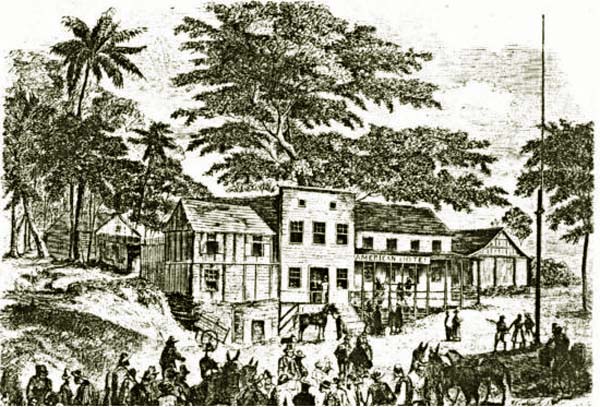
The "American Hotel" San Juan del Sur, Nicaragua, 1856.
The Fords decided that the way to riches was to open their own hotel. They ultimately opened two,
The Unites States Hotel in Greytown and another in La Virgen. Nicaragua may have seemed ideal. Slavery had been
abolished in 1842. There was no danger as there might be in California as a result of the
Fugitive Slave Act. Greytown, named after a British governor of
Jamaica, although a part of Nicaragua was fairly well administered by the British. Unfortunately, he failed to
foresee the consequences of an American adventurer, William Walker.
Walker recognizing the weakness of the Mexican Republic invaded Baja California with a force of forty-eight men.
Hw was actually able to take two towns and proclaimed himself as President of Bara Californa. Setting his eyes on
a larger target he then proclaimed himself as President of the "Republic of Sanora." He was defeated by Mexican forces and fled to
the United States and put on trial for his actions. He was acquitted in eight minute. He then set his sights further south.
In 1855, Walker invaded Nicaragua, held an election in which the votes in some instances totalled four times that of the
population of the town supposedly casting the balots. As President of Nicaraqua, Walker then again made slavery legal and
expropriated Vanderbilt's routes and properties. Vanderbilt was, needless to say, unhappy and managed on his own to
put the various Central American Republics into a coalition to oppose Walker. Additionally, the United States intervened. On July 13, 1854,
San Juan del Norte was bombarded by the United States Frigate Cyano. In the bombardment
Ford's Unites states Hotel was burned down. In 1856, On the Pacific coast, American Ships bonbarded San Juan del
Sur, burning down the American Hotel. Walker was defeated and fled back to
the United States.
After the destruction of the hotel, the Fords returned to Chicago with profits from the hotel opperations of
$4,940.00 equal to approximately $130,000.00 as of 2016.
In 1860, The Fords
moved to Colorado where Ford staked a mining claim southeast of
present day Breckinridge. Since Blacks were not permitted to own land in their
own name the claim was placed in the name of a lawyer who promptly stole ownership
of the claim and had Ford evicted. The location was subsequently known as
"Nigger Hill" until 1964 when it was renamed "Barney Ford Hill."
After the eviction, Ford
engaged in the restaurant and hotel business. Ford also owned an
Inter-Ocean Hotel on the corner of 16th and Blake Street in the
"LoDo" section of Denver. At the time the Lower Downtown was the center of Denver commerce, but after the turn of the
century slowly declined becoming an area in which one would literally have to step
over the recumbent winos in doorways. Indeed, originally when LoDo was the center of commerce,
Ben Holladay, the stageline king, had the center of his Denver operations in the area. A street
was named in his honor. Denver's Holladay Steet became so notorious for its opium dens and parlors of
iniquity that the Holladay family insisted that their name be removed from the
street. It is now known as "Market Street." In the 1970's, the Denver Inter-Ocean was pulled down before
the area had its present resurgence as a trendy area for yuppies.
Ford is generally credited with
precluding the Colorado Consitution from eliminating sufferage for Blacks by successfully
lobbying Congress against statehood until the proposed Constitution protected
the right to vote. In contrast, Wyoming's statehood was delayed because of
its refusal to eliminate universal sufferage. For discussion of woman's sufferage, see South Pass.
True universal sufferage, however, did not come in the
United States until the the passage of the Indian Citizenship Act of 1924 which recognized Native Americans born within the United States as
citizens. Even then as late as 1947 two states, Arizona and New Mexico excluded Native Americans from voting who
resided on a reservation and were, thus, regarded as wards of the federal government and excluded from voting
by vitue of being under "guardianship."
Between, 1856 and 1869 Walker made several more attempts to invade and hold Nicaragua. His last attempt was in 1859 when he attempted to invade
Honduras. He captured the town of Truxillo. This time the Royal Navy intervened. Truxillo was beseiged by land forces of the Honduran Government and by sea by
by the HMS Icarus under the command of Nowell Salmon, VC, later Knight Grand Crss of the Order of the Bath and Admiral of the Fleet. Perhaps knowing his fate at the hands of
the Honduran Government, Walker surrendered to Sir Nowell. Walker undoubtedly thought the British would return him to the United States as the American
Navy did earlier. Salmon was required only to make appropriate disposition of Walker. He did so by turning his
prisoner over to Honduran authorities. Walker issued a statement accusing
Nowell of perfidy:
PROTESTATION OF GENERAL WALKER.
By the present, I protest, before the civilized world, that when I surrendered to the Capain of the Steamer
Icarus, this officer has declared to receive my sword and postols, as also those ofColonel Ruddler, and that
my surrender has been made expressly to him as a representative of her Majesty.
S/ William Walker
On board the steamer Icarus, this 5h day of September, 1860.
The Honduran Government put Walker on trial. He was convicted and taken before a firing squad.
Vanderbilt had proposed to build a canal connecting the two oceans through
Nicaragua. Both the United States and the British Government supported the idea. That idea and that
concept of the Canal resonates in Wyoming even today. Former Vice President Cheney in his
autobiography credits Jimmy Carter for Cheney's later political success. IN his first campaign for
Congress, Cheney used President
Carter's actions in "giving away" the Panama Canal as the centerpiece of the campaign. The issue of
a Nicaraguan two-ocean canal remain. The Chinese are now (2016) constructing the
new larger Panamanian Canal and have received a concession from the Nicaraguan Government to construct
a second canal in their country.
In Cheyenne, at the beginning of the Twentieth Century, the Inter-Ocean served as the center of everything.
It hosted among others Col. Roosevelt on his visits to Cheyenne.
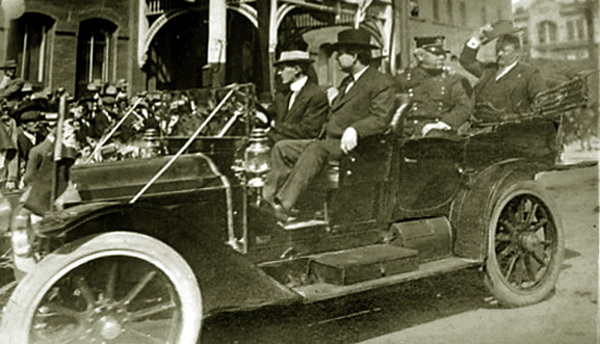
Col. Roosevelt at Capitol Ave. entrance to the Inter-Ocean Hotel, 1910.
Photo by J. Schimitz.
For discussion of Roosevelt's visits to Cheyenne, see Frontier Days .
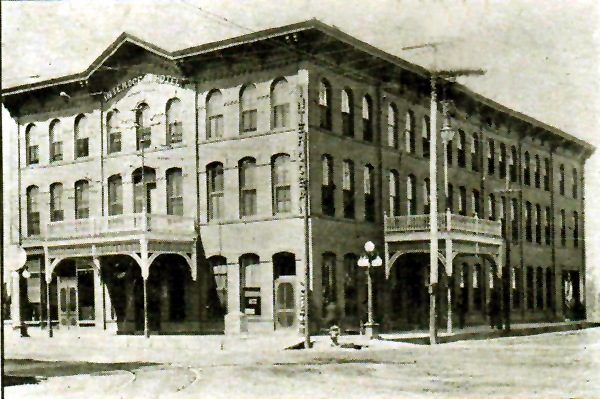
Interocean Hotel, approx. 1912.
The Inter-Ocean also acted as a principal watering hole in Cheyenne. Tom
Horn observed in his infamous conversations with Joe LeFors (See Tom Horn.):
"If you go to the Inter-Ocean to sit down and talk a few minutes
some one comes in and says, 'Let us have a drink,' and before you know it
you are standing up talking, and my feet get so [expletive deleted] tired it
almost kills me. I am 44 years, 3 months, and 27 days old, and if I get killed
now I have the satisfaction of knowing I have lived about fifteen ordinary lives."
Indeed, after Horn's statements to LeFors, Horn was arrested in the bar of the
Inter-Ocean.
In 1898, Barney Ford was named to the
Denver Social Register, the first Black to be so honored. By the time of his death in 1902,
Ford had amassed a fortune of over $500,000 in 1902 dollars. Today, a brass plaque on
a wall on Blake Street near Coors Field, makes note of Ford and his Inter-Ocean hotel. A stained class window in the
Colorado also honors his memory.
The Inter-Ocean burned on December 19, 1916. Six, all from the same family, were killed in the fire including the father
who was killed when he leaped from a third-floor window and fell into live electric wires and
a nine-month old baby who was rescued by firemen but later died from burns. Fifteen others
were saved by firemen.
Cheyenne Photos continued on next page.
|