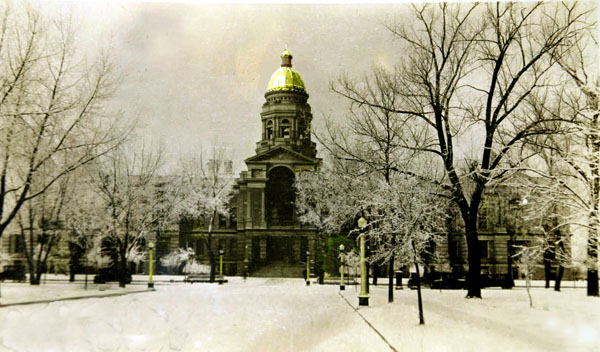
Wyoming State Capitol Building, Winter, 1924.
The dominating features of Capitol Avenue are the Capitol Building at the north
end and the Union Pacific Passenger Station at the South end. Along the Avenue were the Burlington Station,
the Inter-Ocean Hotel, the Stockgrower's Bank, the Cheyenne Opera House, the High School, the Carnegie Library and a City
Park.
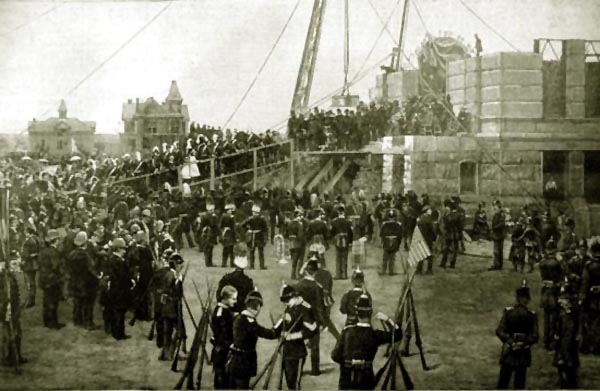
Laying of the Wyoming Territorial Capitol Building cornerstone, May 18, 1887, looking West to the
residence of Hyrem Kelly on Ferguson Street. See photo lower on page.
In 1886, the Territorial Legislature authorized the design and construction of a new capitol building at a cost
not to exceed $150,000. The site of the Capital was at the junction of twenty-fourth Street and Capital Avenue.
David W. Gibbs (1836-1917) of Toledo, Ohio, was selected as the architect.
Gibbs designed a number of courthouses in Ohio including the Marion, Washinton, Union, Henry, and Butler
County Courthouses. The design for the center section of the new Wyoming capital building bore a striking
resemblance to his various courthouses. Gibbs later became for a short period of time mayor of
Oklahoma City. Adam Feick & Brothers, of Sandusky, Ohio, were awarded the contract for the construction of the
new building. Ground was broken on September 27, 1886.
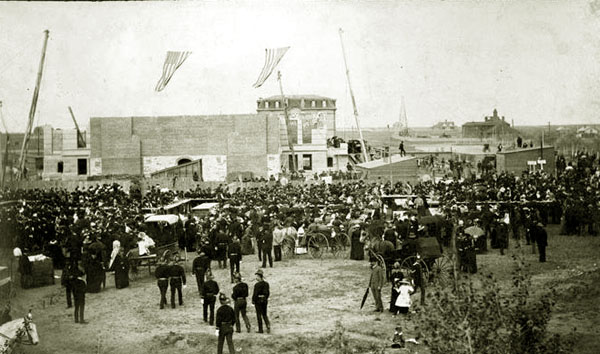
Laying of the Wyoming Territorial Capitol Building cornerstone, May 18, 1887.
The festivities were led off by a grand parade headed by the 17th Infantry from Fort D. A. Russell, circling through downtown, started from the corner of 17th and Eddy streets, then east on 17th to Captaol, north to 18th, east on
18th to Evans, south on Evans to 16th, west on 16th to Ferguson, north on Ferguson to twenty-fourth. The cornerstone was installed in accordance with Masonic rites and bore the inscription,
"Laid by the Grand Lodge A.F. and A.M. A.L 5287, A.D. 1887. N.R. Davis, Grand Master."
A highlight of the ceremony was a patriotic oration given by Judge Joseph M. Carey. Others
participating in the ceremony included former mayor Luke Murrin and governor Thomas Moonlight. Following the ceremony,
the crowd consumed 1,350 pounds of beef, ten sheep and two hogs in a mammoth barbecue prepared by Tillford W. Ashford (1863-1909), barber and
long time janitor of the Senate.
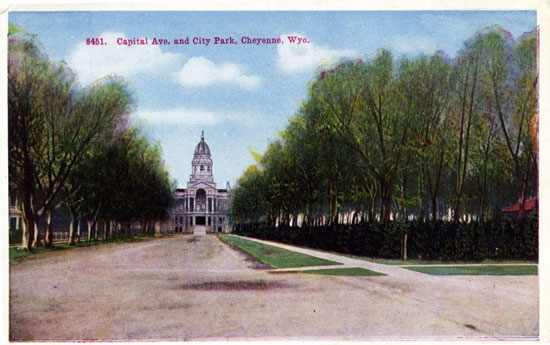
2300 Block, Capital Ave., approx. 1908. City Park on Right.
Through the trees on the lower right of image may be seen the red roof of the "Rest House" in the Park.
See below.
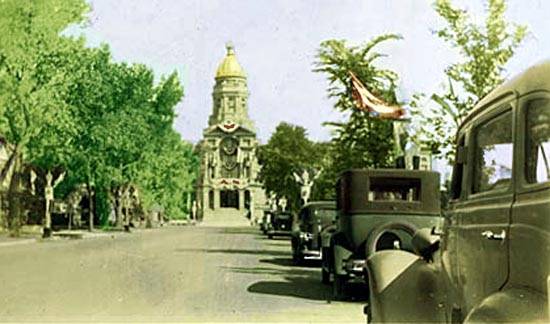
2300 Block, Capital Ave., approx. 1936. City Park on Right.
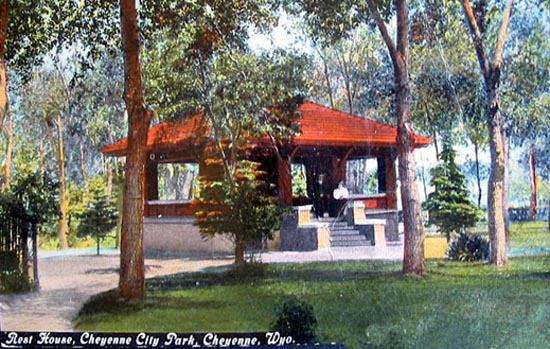
"Rest House," City Park, 1908. Photo by Barkalow Brothers.
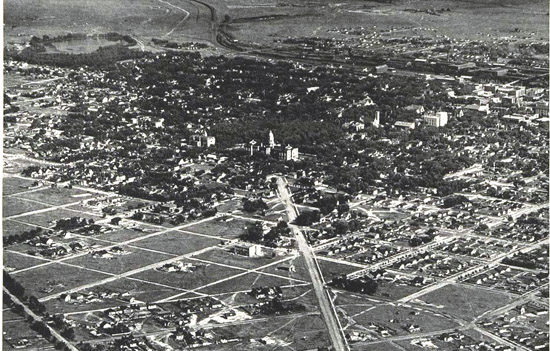
Aerial view of State Capitol, looking southeast along Randall
Avenue from above Fort D. A. Russell.
Photo by Capt. Albert W. Stevens, U. S. Army Air-Corps photographer, 1926.
Beyond the Capitol is the wooded city park. Further to the upper left n the photo is Lake Minnehaha. The railyards are
visible to the upper right. Compare with aeerial photo on next page. Captain Stevens enlisted in the
army as a private during World War I and later in the 1930's became famous for his photographs taken from the
stratosphere in balloons. In 1928, he ascended to 37,200 feet with Captain Jimmy Doolittle. At that height, the aircraft's equipment including its oxygen equipment froze.
Capt. Stevens lost consciousness. Fortunately, he came to just as Capt. Doolittle lost consciousness. Thus Capt.
Stevens was able to bring the aircraft to a safe landing. In 1935 with Orville A. "Andy" Anderson, Capt. Stevens ascended to 72,395 feet. In an
earlier attempt to set a record, the balloon burst at 60,000 feet. Thus, Stevens held a record at the time for
highest parachute jummp.
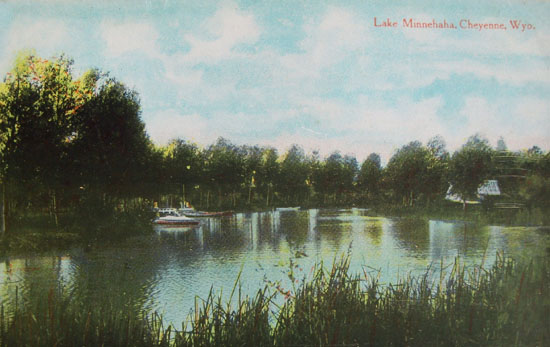
Lake Minnehaha approx. 1909.
Lake Minnehaha was acquired by the City about 1875 and was developed into Holiday Park. The Cheyenne Daily News, June 5, 1875 noted the City's plans to
deepen the waters of the lake and cause it to be "free from such obstancies as will make the the water obnoxious."
In the summer the waters develop an unpleasant aroma. In 2011, the City was still studying the problem of the
noxious aromas arising from the lake. The studies costing $39,500, revealed that a solution to the problem might cost as much
as much as $1,500,000 dollars. Filling in the lake would, however, have untoward consequences to the quality of the water in
Crow Creek.
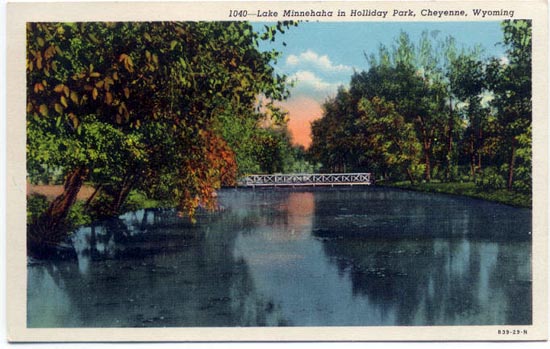
Lake Minnehaha approx. 1939. Photo by William P. Sanborn.
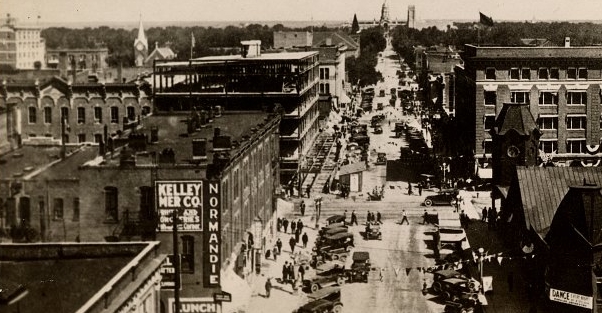
Hynds Building under construction, Capitol Ave., approx. 1919.
As previously noted, the Inter-Ocean Hotel burned down. In its stead, H. P. Hynds constructed his new
fire proof building on its site. Hynds' wisdom was proven in the fire of December 2004. See photo previous page.
next page, Capitol Ave. continued.
|