|
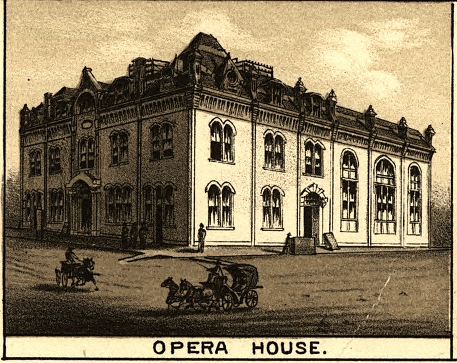
Cheyenne Opera House, 1882.
Note from the scaffolding on the third floor chimneys and the material outside the Capitol Ave. entrance that the
building is still under construction.
Public spirited citizens formed a corporation for the construction of the Opera House. Among those
subscribing were J. M. Carey and F. E. Warren. In May, 1882, the magnificent new $50,000 house opened replacing
James McDaniel's 500 seat Cheyenne Theatre as the grandest place for theatrical performances in all
of Wyoming. The Opera House opened to a performance by William J. Comley and James Barton's Opera Company of
Edmund Audran's hit farcical comic opera Olivette. The hit song was The Torpedo and the Whale, about a love-smitten
whale who mistook a A Woolwich torpdeo for a rival. The Company of Olivette came from
New York's Fifth Avenue Theatre and opened in Cheyenne before opening at Denver's Tabor
Grand Opera House at the end of the month. Olivette had played for more than a year
at London's Royal Strand Theatre at Aldwych. The Royal Strand was torn down in 1905 to make
way for an Underground station. The station is allegedly haunted by an actress awaiting
her final curtain call. Special trains brought in an opening night audience from Laramie and Fort Collins. Many of those coming by train undoubtedly
booked lodgings at the Inter-Ocean Hotel but a block away.
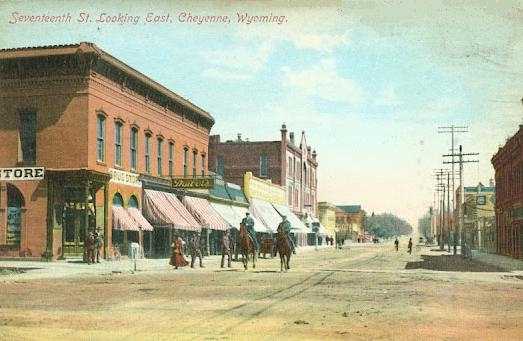
17th Street looking east towards Capitol Ave. Opera House in center of photo on the left side of street.
In the distance is the Elks Lodge at the corner of Central and 17th.
As the opening night audience poured into the building, they ascended the grand staircase to the central lobby or atrium illuminated
during the day by the skylights above. Ladies recieved silk blue and white programmes. Following English
practice, the programmes had been perfumed by pharmacist George W. Hoyt. At the south end of the lobby there was a
fireplace. From the third floor balcony surrounding the lobby, one could look down on the
crowd below. In the main auditorum the grand chandelier 38 feet above the floor provided lighting in the evening.
The building was lit by both gas and electricity. The theatre boasted some nineteen complete changes of sets useful for
all occasions. The stage was larger than New York's Madison Square Theatre and Haverty's Chicago Theatre. Additionally, the
building had a large hall suitable for dances and other large gatherings. There was one difficiency noted, there was no place for the
ladies to stow their hats.
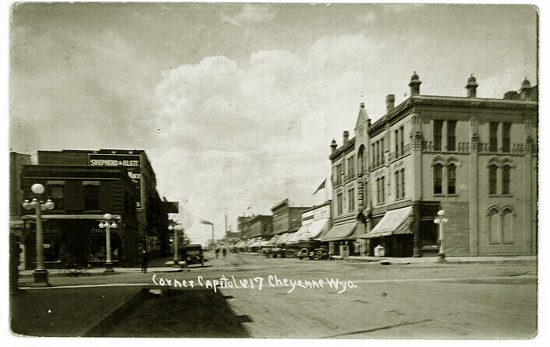
Cheyenne Opera House, 17th Sreet looking west.
Cheyenne, being located on the main line from the
East Coast to San Francisco, made larger theatrical presentations possible in contrast to most of the
Rocky Mountain West which was limited to resident stock companies or stagecoach production companies traveling from town to town, playing in
makeshift opera houses with musical accompanyment by local four-piece "orchestras." In contrast, the Cheyenne Opera HOuse would book in large companies.
New York's Casino Company when it played in Cheyenne had a sixy-member company including its own
orchestra and a chorus of forty voices. Ignacy Paderewski's 1892 national tour which played at the Opera HOuse required
a private railcar, manager, piano tuner, valet, piano tuner, chef, two porters, and, of course, the
Steinway. Others who played in Cheyenne included Edwin Booth appearing as Hamlet,and Lillie Langtry, the Jersey Lily. Although, the Opera House engaged
a varied schedule of programs ranging from Grand Opera to Barlow-Wilson Minstrals, most popular were
Gilbert and Sullivan operettas. The Mikado appeared multiple times and the most popular of all,
"H.M.S. Pinafore; or, The Lass That Loved a Sailor," the overture of which is the background music for this page.
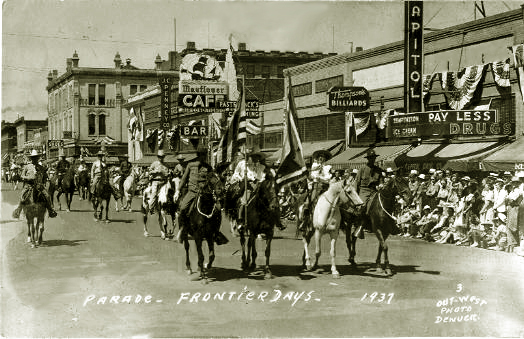
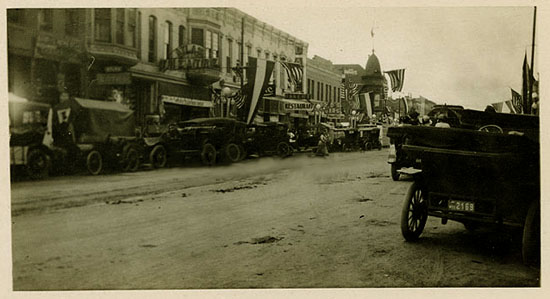
Frontier Days Parade, 1937. 17th Sreet looking west. Photo by A. E. Gordon.
A fire
struck the Opera House in 1901, destroying the stage and auditorium. Thus, at the time of the above photo the
auditorium was replaced by a building known as the "annex" and the rest of the building rennovated.
Following the fire, the Opera House
was converted to apartments. The Annex provided rooms for railroad locomotive engineers, firemen, and
conductors laying over in Cheyenne. The railroad would relay orders to the men by women messengers known as
"call girls." later, the orders would be delivered three times a day over a local radio station. In
1985, the radio "callboard" was replaced by a toll-free telephone number. The Opera House and the Annex were torn down in 1961.
Atlas Theatre, south side of 16th Street, 1914. The Tivoli Building is at the
end of the street.
Note indications in the street that horses continue to be used. The Atlas Building was originally constructed with retail stores on the ground floor and offices on the two
upper floors in 1887. In 1908 the building was reconstructed as a theatre. In 1930, the building was renamed as the
Strand. For a short time in the early 1960's it operated as the "Pink Pony." In 1971, it reopened as a little theatre. The
structure is on the National Register.
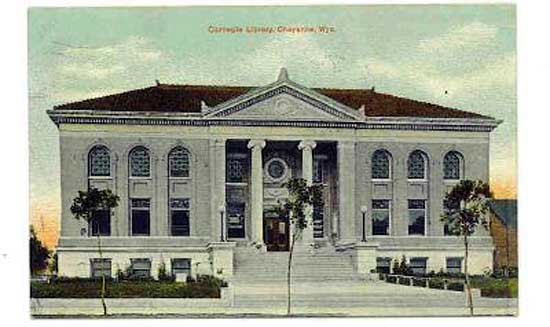
Carnegie Library, southeast corner of Capitol Ave. and 22nd Street, 1909.
The first county library was established in rooms on Ferguson Street (now Carey Ave.). The library depicted was
constructed with the aid of a $50,000.00 gift from Andrew Carnegie and opened in
1902. It was torn down in 1969.
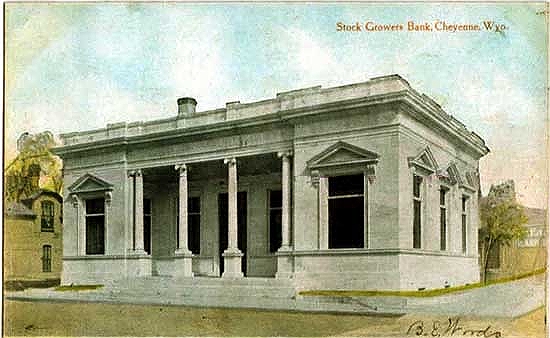
Stockgrowers National Bank.
Music this page the Overture to H.M.S. Pinafore, courtesy Horse Creek Cowboy and his
Horse Creek Cowboy Midi Orchestra:
Cheyenne Photos continued on next page.
|