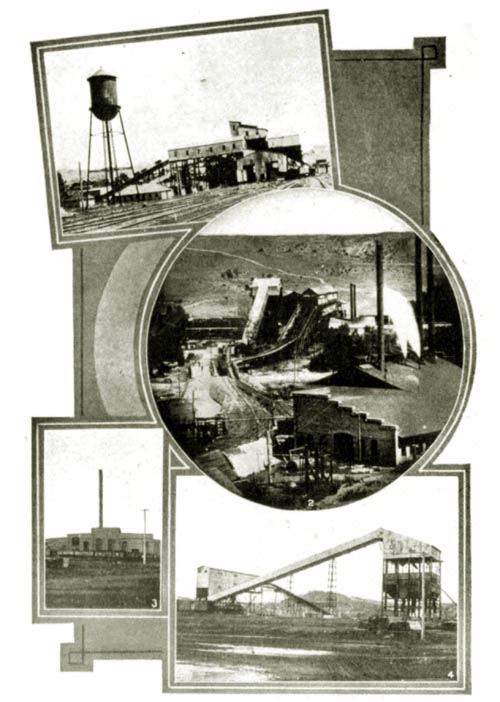
Sheridan Area Coal Camps, 1920
1. Caney Coal Company Tipple, Carneyville;
2. Tipple, Monarch, Wyoming Coal Mining Company;
3. Power Plant, Sheridan Gas & Fuel Company;
4. Acme Coal Company Tipple, New Acme, Wyoming.
The Sheridan area, like most of Wyoming, had its share of coal camps most of which have become
ghost towns. Camps in the area included Dietz,
New Acme, Carneyville, Kooi, and Monarch, all clustered about half way between Sheridan and
Ranchester near the confluence of Big Goose Creek and the Tongue River. The miners in the
area were primarily Polish.
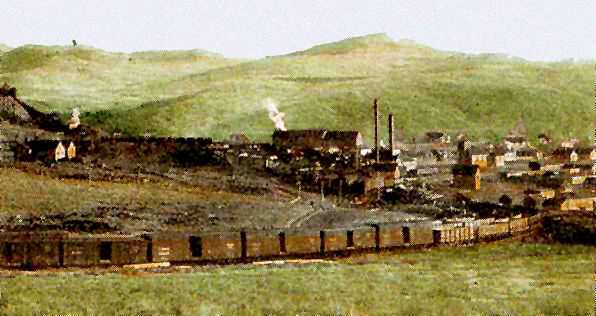
Dietz, 1909
Dietz was originally called Higby, named after Anson Higby, a Deadwood banker. It was later
renamed after the owners of the Dietz Lumber Company of Omaha, Charles N. Dietz, Gould Dietz, and
J. Frank Dietz. Gould Dietz is remembered today for his sporty 40 hp., $3,000.00, 1907 Thomas Flyer.
Dietz's automobile was used to chauffeur Col. Henry Carrington on his triumphant restoration of
reputation visit to Omaha in 1908. Carrington also was the man of the hour in Sheridan. Dietz was also a
witness to the 1897 "airship" seen by numerous witnesses in
Michigan, Kansas, and Nebraska.
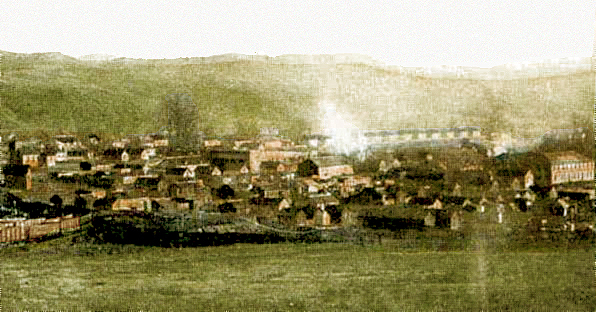
Deitz, 1909
Coal was discovered at Dietz by Cornelius H. Grinnell, general superintendent of the Grinnell Live Stock Co.. Grinnell, with
H. F. Cady and George Beck organized the Sheridan Fuel Company and operated a small wagon mine until about 1893 and the coming
of the Railroad when, with C. N. Dietz, production was increased. The coal was of a lower quality than that
normally used by railroads. Beck invented a process for making the lower quality coal into pellets which would give the
coal the same qualities as the higher quality required for locomotives. The Burlington system also adapted its
locomotives by changing grate size so that it could use the Dietz coal. Beck, however, lost his interest in the
mining company, selling to Cady. It was alleged in an 1899 lawsuit that
Dietz managed to freeze out the original owners. See Omaha Bee, March 16, 1899. The case was
later settled. See Omaha Bee , May 19, 1899.
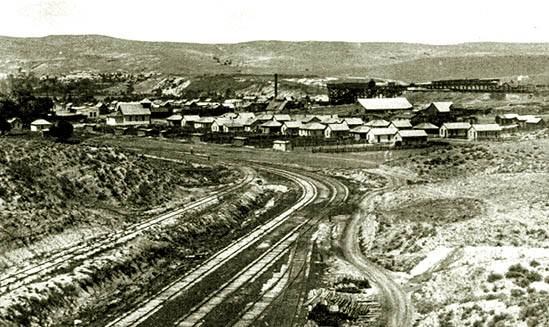
View of Dietz taken from top of Tipple, 1920
Dietz was not so much as one town, but a series of towns or camps:
numbered, Dietz #1, Dietz #2, Dietz, #3, Dietz #4, Dietz #5, and Dietz #7. These
sprang up near each of the eight mines. The camp had a number corresponding to the number of the
mine. Thus, Dietz was near the Dietz Number 1 Mine, the town of Dietz #2 was at the Number 2 Mine, and so forth. However,
there were no towns of Dietz #6 or #8 because there was no camp at Mine Number 6, and
Mine Number 8 was in the same vicinity as Dietz #5.
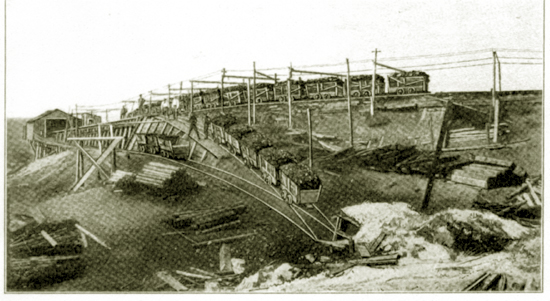
Dietz Mine No. 1, with Slope No. 4, 1907
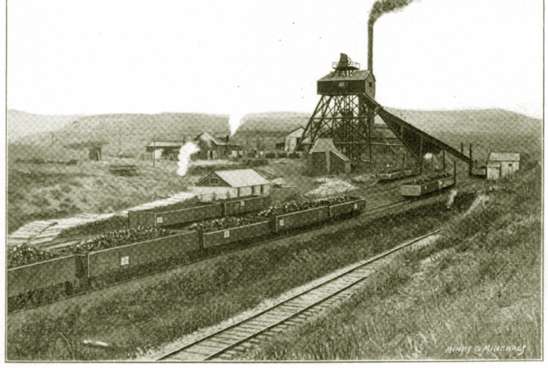
Dietz Mine No. 2, 1907
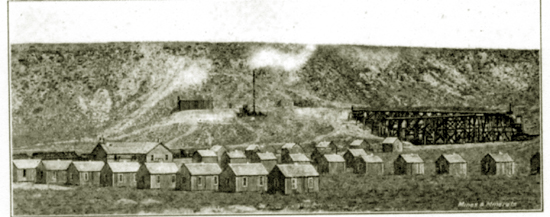
Dietz Mine No. 5, 1907
In her account of her visit to Sheridan in My Army Life and the Fort Phil Kearney Massacre
Frances Courtney carrington described Dietz as a "town of cottages and gardens." Beauty is, as they say,
in the eyes of the beholder.
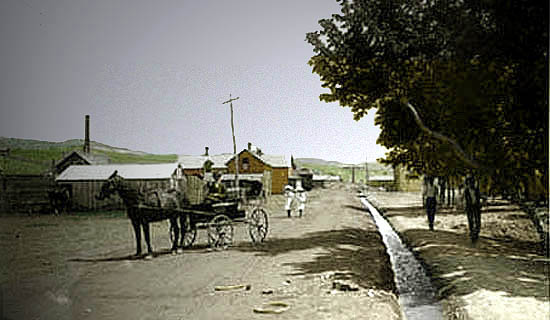
Dietz, approx. 1907.
By the time of the above photos, Dietz had 2 churches, 2 schools, a company store, 2 saloons, a pool hall,
a union hall, and a hotel. Today Dietz is a ghost town.
Next page, Monarch.
|