|
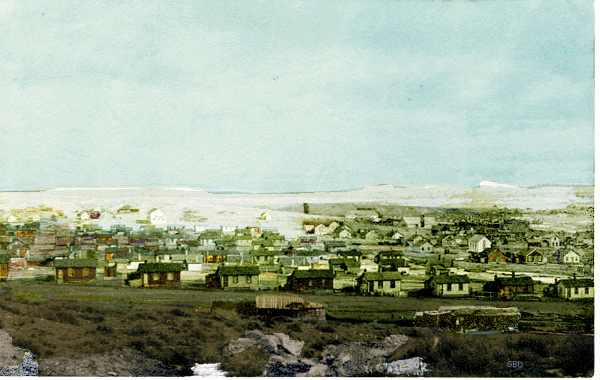
"Spring Thaw in a Wyoming Coal Camp".
A view of Hanna, Wyo. approx. 1910.
When the Union Pacific began crossing Wyoming, in addition to Rock Springs, its major sources for coal were
Alma near Evanston and Carbon. In the mid=1880's it became apparent that the coal in both
Carbon and Alma was giving out and that an additional source of coal would be required on Company land. One of the
areas that was available to the railroad was near Chimney Springs. Chimney Springs took its name from smoke emitting from
a shallow coal deposit. In an 1889 report, "The Resources of Wyoming," Territorial Secretary S. D. Shannon noted that at Chimney
Springs a number of seams were found, two of which were reported to be twenty-feet in thickness.
In Wyoming an early advantage for coal mining is that coal deposits are directly on the surface. Thus,
in many parts of the state, in addition to large corporately owned mines, there were mines
operated by single individuals. One of the areas where there are surfacial deposits of coal
was Chminey Springs. By 1886, Union Pacific had established mines at Chimney Springs. The railroad changed the name to Hanna in honor of
Marcus A. Hanna, an influential Ohio politician, mining, shipping, and
railroad magnate. Hanna is also noted as having rescued Ohio Governor William McKinley from
financial failure. Hanna subsequently served as McKinley's campaign manager. He strongly disagreed
with the reform policies of President Theodore Roosevelt, referring to Roosevelt as "that
damned cowboy." At the time of his death in 1904, Hanna was being groomed for a
possible race against Roosevelt for the Republican presidential nomination.
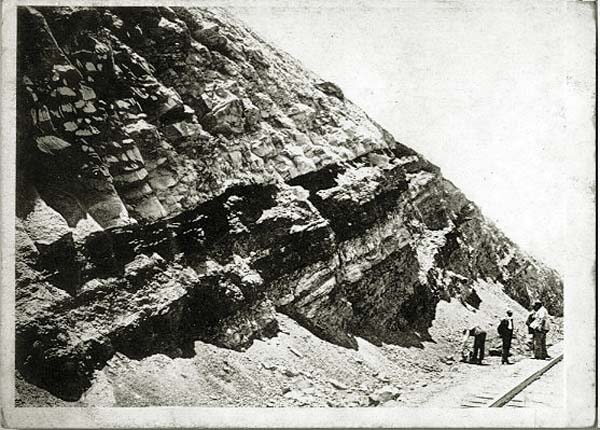
Surface vein of coal near Hanna. Photo by J. E. Stimson as
published by the Albertype Company, Brooklyn, N. Y.
Hanna consisted of two towns, each numbered after a mine to which it was in proximity, i.e.,
Hanna No. 1, Hanna No. 2, and Hanna No. 3, Hanna No. 4, Hanna No. 5. There were in actuality a number of mines, Hanna No. 1, Hanna No. 2, Hanna No. 3, Hanna No. 3 1/2, Hanna No. 4, Hanna No. 4A and
Hanna No. 5. In the image at the topof the page,
Town One was nearest the viewer and was located on the south side of the railroad tracks. Town Two was on the north side of the tracks to the right
of the water tank in the center of picture.
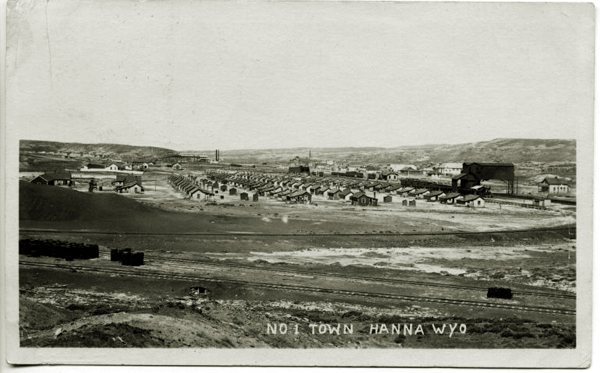
Town of Hanna No. 1, approx. 1910.
Town Two is the far side of the tipple over the railroad tracks. Some tipples
had facilities for sorting the coal by size and removing stones. The term "tipple" took its name at an early
period of mining when the small hopper tram cars or "tubs" were mannually tipped to empty the coal into a chute for loading into
the railroad hopper cars. In the foreground of the photo, is the railroad "wye." The wye permitted a train to be backed up one
leg of the wye and then proceed out the other. In this manner the train could be turned around.
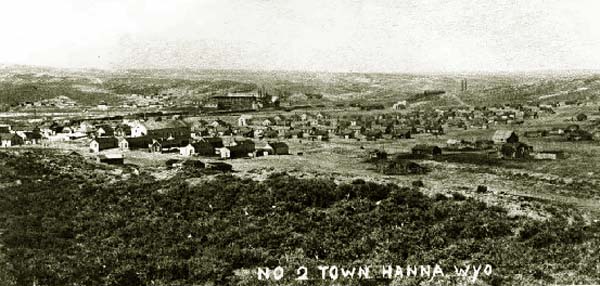
Town of Hanna No. 2, approx. 1910.
Town No. 3 was about a mile south of present-day Elmo.
When Carbon closed down in 1902, a number of buildings were brought to Hanna including the
Finnish Lutheran Church, the Finnish Temperance Hall, the saloon, and part of what later became the hotel. Some of the Houses were broght from Almy near
Evanston when the mines there closed and some from Carbon.

Town of Hanna No. 3, approx. 1910.
The town was a company town. Therefore, any businesses were located in buildings owned by the Union Pacific Coal Company. The primary business area
was in Town Two on the north side of the tracks. The old Lincoln Highway passed through Town Two. Later it was moved south and even later returned.
Originally, Hanna was on a spur line running off the main line at Allen Station, a community which at its peak consisted of little
more than a section house. By 1916, it consisted of less. The main line ran
through Carbon. With the discontinuance of mining at Carbon and the necessity of avoiding the
hill at Simpson, the main line was relocated through Hanna. With the railroad, Hanna became a center for
stagelines serving outlying areas. It had a drugstore, bank, hotel, hospital, churches, and a Finnish Temperance Hall.
Lodges included the Knights of Phythias and Vuorelaine Lodge No. 16 of the Knights of Kaleva, the
Kalevalan Ritarit a Finnish fraternal order based on the Kalevala the epic Finnish saga dating back to the
Middle Ages and similar to the Icelandic sagas. Other lodges of the Knights of Kaleva were found in
Rock Springs and Diamondville. The order is still active.

Hanna, Temperance Hall, undated.
The Finnish Temperance Hall, at the time was the most prominent structure
in the Town. It hosted all types of activities, plays, dances,
and visiting politicians. The highlight of the 1908 Hanna social season, according the the Rawlins paper was the Mule Skinner's Ball held
at the Temperance Hall. The term "temperance" with Finnish miners did not necessarily have the same meaning as commonly
understood by native Anglo-speaking persons. The town dentist, Charles Stebner wrote:
[The miners] "were pretty good guys, but others were too
crude. They drank moonshine whiskey during Prohibition. It was wild,
especially on paydays when they gathered on the cement floor in the
washhouse. I often heard them sing ribald songs and some played string musical insturments.
Often they fought one another just to see who was the toughest." As quoted by Strayer-Hanson, Francis E.:
Medicine Bow Valley Pioneers, iUniverse, Bloomington, Ind. (2009), p. 196.
One wag commented, "what to a Finn is temperance would in some cases seem to
other people immoderation." There was one time when the lack of temperance went a little too far. The ,
Sept. 17, 1902, noted the appearance of the Morrison Sisters Stock Company for a week's engagement at the Temperance Hall.
They, the paper said, "would have left in the
good graces of all, had they not shown themselves to be confirmed and inveterate followers of Bacchus."
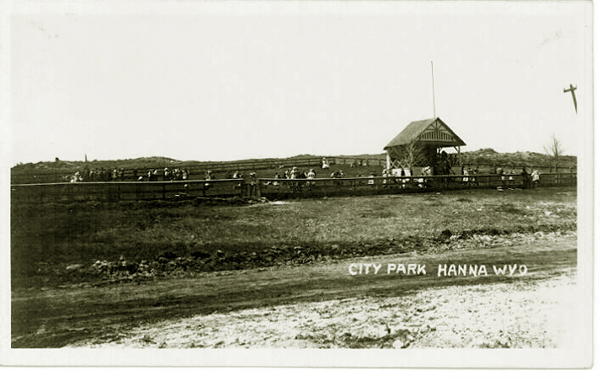
Baseball game, Park, Hanna, approx. 1910.
Teams from Hanna would play other teams from Rawlins, Medicine Bow, and Fort Steele. On occassion, the Coal Company would employ
ringers to play on the team.
Next Page: Hanna Continued.
|