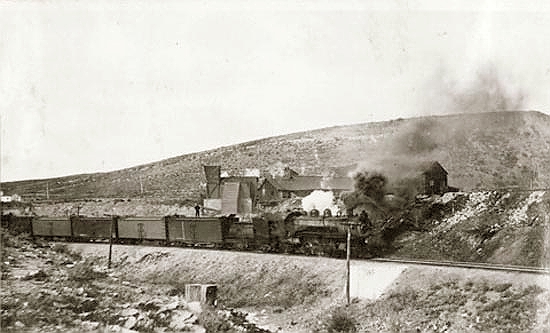
Diamondville Mine, undated. Photo courtesy of
John S. Gilchrist.
Diamondville, two miles south of Kemmerer, another important coal town,
traces its history back to a homestead established in 1868 by Harrison
Church. High quality coal was known to be in the area as a result of the
original governmental surveys undertaken in 1874. Church interested
investors in his Hams Fork Coal Company which ultimately became the
Diamond Coal and Coke Company, a subsidiary of the Anaconda Copper Company.
The Town, itself, was incorporated in 1901 with Scotsman Thomas Sneddon
(1855-1920) as its first mayor. Sneddon became superintendent of the
Diamondville Mine in 1898. Like many of the other miners in the area he
previously had been in the servce of the Union Pacific Coal Co. in Almy near Evanston.
The Diamondville Mine was the scene of several major fires and explosions. On December 26, 1898, a fire
broke out in the mine. The standard method of fighting such fires was to seal off the area and thus
sufficate the fire while operations continued elsewhere in the mine. For six weeks the company battled the
fire. On February 12, 1899, the fire broke out again and two miners, John L. Russell and L. E. Wright were killed by the
"black damp." "Black Damp" is a mixture of unbreathable gases in an enclosed area and mainly consists of
nitrogen, argon, carbon dioxide and water vapor. The gases displaces oxygen in the air.
The term black damp comes from the German dampf, "vapors." "Damp" is used in other mining terms "white damp,"
carbon monoxide; "fire damp," methane; and "stink damp," hydrogen sulfide.
The company was certainly aware of the dangers from coal dust.
In 1900, company superintendent Thomas Sneddon was part of a team investigating another mine
disaster in Utah. As a result he was later quoted as saying,"When I go back to
Diamondville I will have the mine of which I am superintendent prinkled at once, because
it is easier to water the mine than to pack dead bodies out." See Salt Lake Herald,
May 8, 1890, p. 2.
Nevertheless, less than a year later on February 26, 1901 another fire hit Mine No. 1 at the beginning of the night shift.
It was believed to have started from a miner's lamp in the oil room. Initial newspaper reports indicated that some fifty miners and
fifteen horses were entombed when the mine was sealed to extinquish the fire.Because of the belief that
all within the mine had been killed, work was directed to saving the rest of the mine.
Only one man, John Anderson,
managed to escape. Later reports put the number of dead at 32. Most of the men were Ialians, Finns, and Austrians.
Of the crew, three were Americans,
a father and son, Thomas and Everett Simpson. Everett was 17 years old. The third, William O. "Willie" Jarman, had
moved to Diamondville from McAllister, Indian Territory (present day Oklahoma), only two month before.
His wife with their baby was visiting her family at the time. Several weeks before, he wrote expressing his
loneliness and that he did not plan on staying much longer. The company did not have the name of
one miner known only as "Frenchie."
The Deseret News, Feb. 28, 1901, described the scene as families waited outside a barrier for word:
Leaning against the baggage car which contains a score of coffins sent by Underaker S. D. Evans, of Salt Lake, all day long
there has been a knot of sober faced men and grief stricken women, silent and woebegone. Some of
the women bear traces of their headlong flight toward the scene of the horror of the night
previous, as an occasional bandaged head testifies in mute testimony to the blind stumbling in the dark over the railroad
tracks, through the mud, slush and rivulets of water that abound on all sides."
IDENTIFIED VICTIMS OF
1901 DIAMONDVILLE MINE FIRE
FEBRUARY 25, 1901
BATISTA BASSOIA.
EDUARDO ROANI
P. ROANI
JOE FRANZOI
LAWRENCE FRANZOI.
CHARLES ZANOLALI
FIARIANO AVANSINA
ALEX BARIAGNELI
EMANEIO BARTAGNELI
SANTO FORMOLLE
JOE ANDREONI
G. GAHARDI
DEMENICO di FRANCISCO
LARADI ANGELI
ATEGLIO ZEROCAL
WILLIAM JARMAN
FRENCHIE
EMIL AHO
JOHN BANTA
JOHN HEINKINEN
MAT TASANEN
JOHN TASANEN
HUNINING LAPTI
JOEL LAPTI
EVERETT SIMPSON
J. T. SIMPSON
|
On December 1, 1905, the entire night shift of eighteen miners lost their lives in a coal dust explosion. The night shift at the time
was considerably smaller, the work consisting of prepping the face. The San Francisco Call, February 3, 1905, described the shock
of the explosion as being felt all over the town, "rocking buildings so violently that their occupants ran out
into the open." The company, according to the New York Tribune, December 3, 1905, anticipated having the mine reopened in a week.
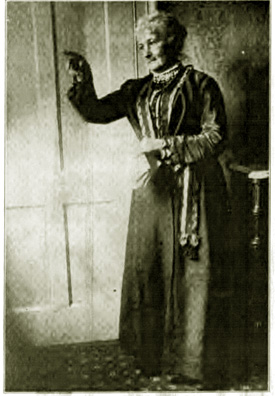 Mary Harris "Mother" Jones Mary Harris "Mother" Jones
The company was also hit with a number of strikes. There were strikes in 1898, 1899, 1903, and as a part of a state-wide strike in
1908. The company did not restrain itself in its fight against strikers. In the 1898 strike, the company brought
eviction proceedings to remove strikers' families from their company-owned houses. A Salt Lake City attorney who frequently represented
Italians and miners, Wiley L. Brown was arrested in Diamondville for perjury in the cases. At one time,
Brown was a prominent attorney but slowly descended into the depths of being a political and
legal gadfly. He was active in the Republican Party. His legal career ended when his behavior became more and more bizarre. He was arrested in
1904 when the police claimed that he had been "acting in a strange manner of late." He was adjudged insane but released on his
own recognizance on his promise to behave. The following year, he disappeared. His body was found after three weeks in
the mountains. To those who knew him, the circumstances of his mysterious death were not a surprise. The Desert Evening News, November 22, 1905,
explained: "The fact that he was mostly disrobed caused little surprise as he was known to disrobe himself on
occasions and not long ago he was found in the city and county building in a nude condition and was arrested."
In the 1899 strike, the company brought in non-union men who operated the mine. The 200 wives and daughters of the striking
miners marched on the mines and forced the non-union miners to flee. The Saint Paul [Minn.] Globe, December4, 1899, in reporting the
story referred to the non-union men being attacked by a "Mob of Amazons." The next day, over seventy-five deputies appeared on the scene.
A mounted contingent, according to the Salt Lake Herald, "made a dramatic enrance into town. they were all mounted and forming in
columns of two, rode down the main street. The inhabitants ran out of their houses like ants out of an ant-hole to view the
novel sight."
In 1903, the United Mine Workers announced that they were sending Mother Jones to help organize the twenty-one
unorganized coal camps in the state. Superintendent Sneddon announced that the mine operators were prepared for
her appearance and that if she attempted to interfere in any way with the miners or influence them to quit work she would be promptly jailed.
Mother Jones was ordered out of the State of Colorado. In Utah, Mother Jones, age 74,
was held in a quarantine house by local authorities on the basis that she had allegedly been exposed to small pox. In order to
free her, union members burned down the quarantine house. The strike was broken when 182 miners were arrested.
Nevertheless, the Union ultimately succeeded in unionizing the camps in Wyoming. As discussed later, the Union then turned its
attention to Colorado.
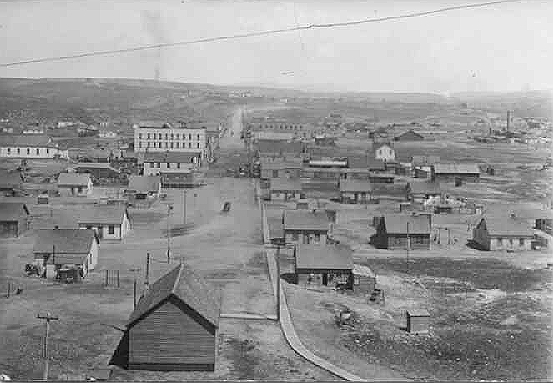
Diamondville, 1913, looking north along Diamondville Ave.
The two-story building on the right-hand side of Diamondville Avenue past the three-story building
is the Mountain Trading Company Building. The Mountain Trading Co. dates to before 1900 and at one time had three
separate stores in the area. Other mercantile companies included the Diamondville Mercantile Co. Additionally, by
1894, the town had the Daly Hotel, named after Montana copper magnate and co-founder of the
Anaconda Copper Co., Marcus Daly (1841-1900). Churches included a Mormon Meeting House and a
Union Church in which the other denominations would meet.
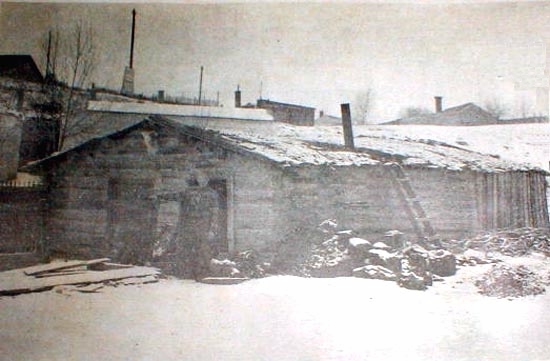
William Fenn's butcher shop, Diamondville, undated.
Fenn had a ranch in the area. He is now noted as having sold a horse, unknowingly, to Butch Cassidy prior to
the Wilcox robbery.
A second "hotel" in the town, not quite as decorous, was one operated by Joseph Kandelhofer. It was described by Justice Sidney Sanner of the
Montana Supreme court:
Diamondville, Wyo., is a mining camp consisting largely of Italians and Austrians, and there
one Joseph Kandelhofer maintains a �boarding house�; this place has two stories, and on the
ground floor are a barroom, leading off from which is a hallway with doors on each side, and
further on a dining room; the doors leading off from the hallway give entrance to a wineroom
and to bedrooms; the wineroom is a dance hall, and the bedrooms are occupied by miners who
lodge at the place; girls and young women were employed there whose principal duties were to
dance with men in the wineroom, drink with men at the bar, and otherwise �entertain� the men
who frequented the place, during all hours from 7 p. m. to 8 a. m.
State v. Reed, 53 Mont. 292, 163 P. 477 (1917)
Justice Sanner continued, noting that evidence "tends to show that the place was not one where a girl could live
for any lenth of time and be respectable." Kandelhofer's facility was closed by the town as a
"public nuisance."
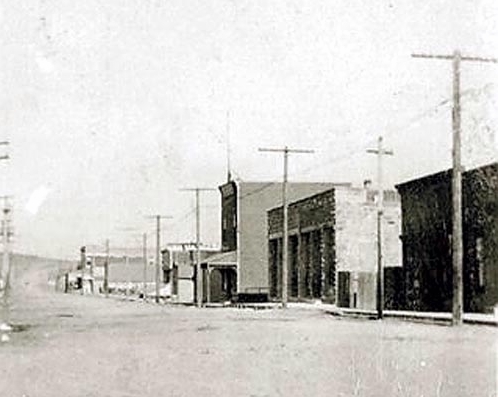
Diamondville Ave, looking north. Photo courtesy of
John S. Gilchrist.
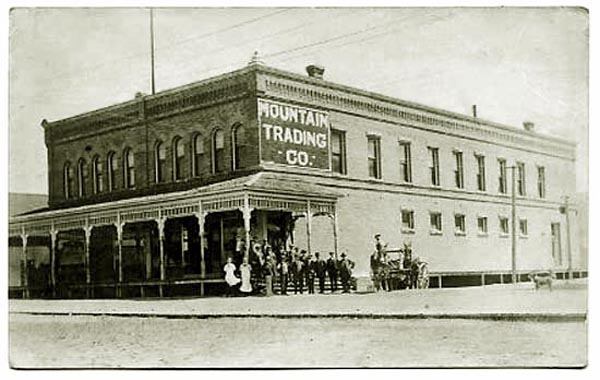
Mountain Trading Company Building, approx. 1914.
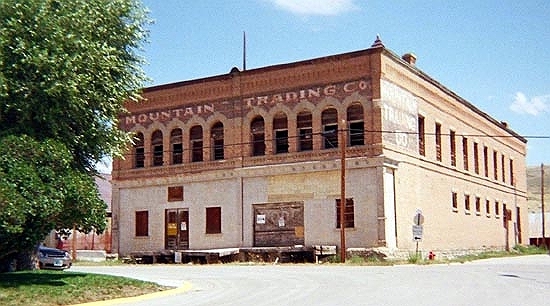
Mountain Trading Company Building, August 2003, photo by Geoff Dobson
In January 2003, the Town Council, concerned with asbestos, voted to demolish
the building which had been empty for many years.
The building was torn down in December 2003.
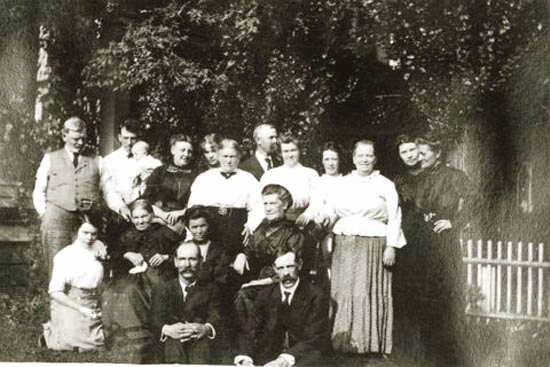
Sneddon family, undated. Photo courtesy of
John S. Gilchrist, whose mother Elizabeth Sneddon is depicted in the photo.
The Sneddon family home is the white house located on the right in the next photo.
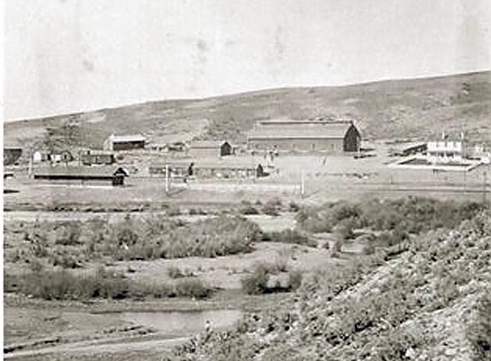
Diamondville Mine Buildings. Photo courtesy of
John S. Gilchrist.
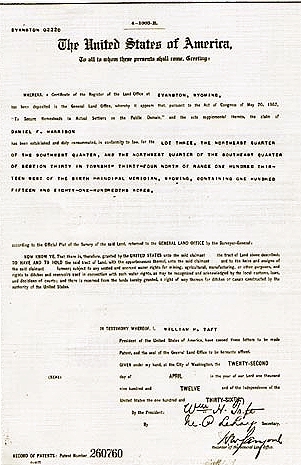
Land Patent in favor of Daniel F. Harrison
As in the instance of the formation of the Union Pacific Coal Co., discussed on a
preceeding page, old fashioned greed came into play. Commencing in 1894,
Sneddon and Daniel F. Harrison began a scheme to
acquire over 2,000 acres of the coal lands by having strawmen file for homestead on the coal lands. Homestead
could be claimed only on non-mineral properties. Each of the applcations for
homestead were accompanied by false affidavits from Sneddon that he was acquainted with the
property and there were no minerals of value on the lands. After government patents were obtained the
properties were transferred to the Company with the patentees being paid $500 each for their cooperation.
A similar scheme was used by the Cambria Fuel Company in Cambria,
which required employees to apply for homesteads which were then conveyed to the Company. Commencing
about 1917, the Government brought actions to set aside over 34 patents on the basis that they were
based on fraud. Twice the action wended its way to the United States Supreme Court which in 1921 ruled against the
company. Justice Van Devanter explained the basis of the lawsuit:
This was a suit by the United States, against an incorporated company
engaged in coal mining, to regain the title to about 2,840 acres of
land in Uinta county, Wyoming, theretofore patented to Thomas Sneddon
and Daniel F. Harrison, and by them conveyed to the coal company. The
patents, thirty-four in number, were issued under the homestead law
upon what are called soldiers' additional entries. The applications
for the entries were made at various dates beginning with May 1, 1899, and
each application was accompanied by an affidavit, by either Sneddon or
Harrison, stating that he was [233 U.S. 236, 238] well acquainted with
the land, had passed over it frequently, and could testify understandingly
about it; that there was not, to his knowledge, any deposit of coal or
other valuable mineral within its limits; that it was essentially
nonmineral, and that the application was made with the object of securing
it for agricultural purposes, and not of fraudulently obtaining title to
mineral land. Mineral lands, including coal lands, are not subject to
acquisition under the homestead law (Rev. Stat. 2302, 2318, 2319,
2347-2351, U. S. Comp. Stat. 1901, pp. 1410, 1423, 1424, 1440, 1441),
and these affidavits were made and submitted as proof that the character
of the lands applied for was such that they properly could be acquired
under that law. The land officers accepted the affidavits and the
statements, therein as true, and allowed the entries and issued the patents.
The bill charged that the affidavits were false and that the entries
and patents were procured in the execution of a fraudulent scheme to
acquire known coal lands under soldiers' additional homestead entries.
The mine closed in 1928.
Music this page:
Hard Times, Come Again No More
by
Stephen Foster
Courtesy Horse Creek Cowboy
I.
Let us pause in life's pleasures and count its many tears
While we all sup sorrow with the poor;
There's a song that will linger forever in our ears;--
Oh! Hard Times come again no more.
CHORUS
'Tis the song, the sigh of the weary;--
Hard Times, Hard Times, come again no more.
Many days you have lingered around my cabin door;
Oh! Hard Times, come again no more.
II.
While we seek mirth and beauty and music light and gay
There are frail forms fainting at the door;
Though their voices are silent, their pleading looks will say--
Oh! Hard Times, come again no more.
(REPEAT CHORUS)
III.
There's a pale drooping maiden who toils her life away
With a worn heart whose better days are o'er;
Though her voice would be merry, 'tis sighing all the day--
Oh! Hard Times, come again no more.
(REPEAT CHORUS)
IV.
'Tis a sigh that is wafted across the troubled wave,
'Tis a wail that is hear upon the shore,
'Tis a dirge that is murmured around the lowly grave,--
Oh! Hard Times, come again no more.
(REPEAT CHORUS)
Next Page: Oakley.
|