|
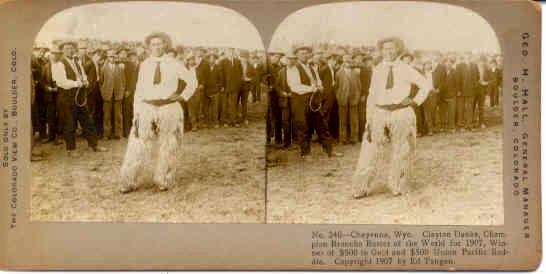
"Clarence C. "Clayton" Danks, 1907 Bronco Riding Champion, photo by Ed Tangen, 1907.
Ed Tangen (1873-1952) was a Boulder, Colo. photographer, known as the "pictureman." During the course of
his career from 1906 to 1951, he took an estimated 16,000 photos primarily of the
Boulder area. Of those, only approximately 800 exist today. In addition to photography, he became a self-taught
expert in fingerprints working for the Boulder County Sheriff's office. He was also noted as being somewhat
parsimonious, residing for thirty years in a tent behind 1942 Canyon Blvd.
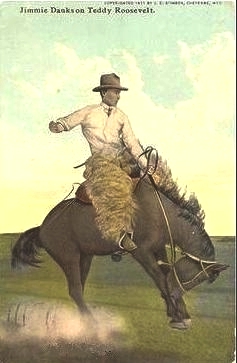 . . . . 
Left: James T. "Jimmie" Danks on Teddy Roosevelt, 1911, photo by
J. E. Stimson.
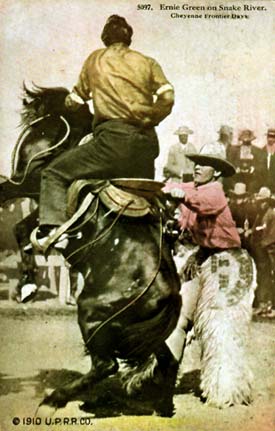
Right: Ernie Green on Snake River, photo by Ralph J. E. Stimson, 1910.
Clayton Danks and Jimmie Danks grew up in Long Pine Canyon, Nebraska, where their father was the
operator of a stage station. The two brothers later worked as range riders for the Two Bar in Chugwater. Clayton
homesteaded property in Valentine, Nebraska, while Jimmie with another brother Harry settled down in
South Dakota. A fourth brother Lawrence received a patent to land in Niobrara County.
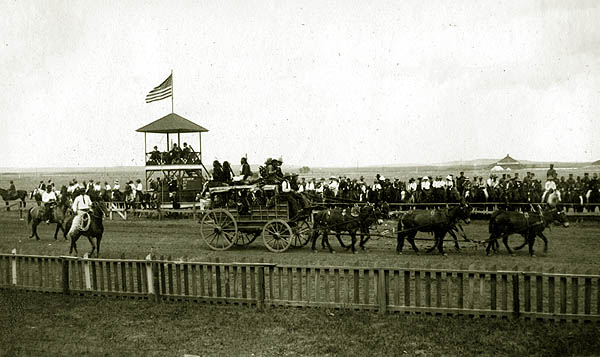
Deadwood Stage leading off the Hippodrome Parade. Photo by Oscar C. Hayes, 1912 courtesy of Armstong Archives.
In the following sequence of photos, note the rain clouds moving across from the right.
The Deadwood Stage was owned by C. B. "Charley" Irwin and used in the Irwin Brothers Wild West Show discussed on a subsequent page.
On board the coach were members of the Frontier Days Committee. After the Irwin Brothers Show closed in 1917, it resumed use in Frontier Days
until 2010. Over the various years, various liminaries such as Wendle Wilkie and Lyndon Baines Johnson rode on its hurricane deck. The 1912 show commenced on August 14 and ran the 14th, 15th, 16th and the 17th.
The show on the 15th commenced with the
"hippodrome" parade. The weather was beautiful on the 14th, but on the 15th there were showers in the morning which
hardly "settled the dust." It was hoped that the rain would pass in the afternoon.
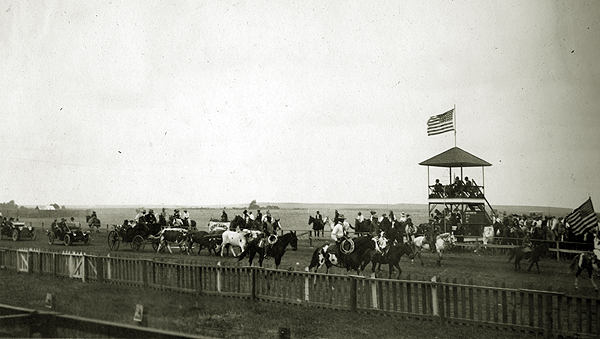
Hippodrome Parade, 1912. Note the ox drawn phaeton carriage. It was sometimes used to
convey Frontier Days officials.
.
Writer's note: Each of the 1912 Frontier Days photos on this page were taken by Mr Hayes. Copies were provided by the Arstrong Archives for which the
writer is grateful. The 1912 celebration brought automobilists up from Denver. On the 15th four train loads of spectators also came up from Denver. Spectators coming up from
Denver on a train is a tradition that is still carried on under the sponsorship of the Denver Post. For most of the time the "Denver Post Special" was limited to politicians and
such. Both Wilkie and L. B. J. arrived in Cheyenne on the Denver Post Special. Originally ridership was by invitation. Only in recent years with the
revival of the train have mere mortals been permitted to ride.
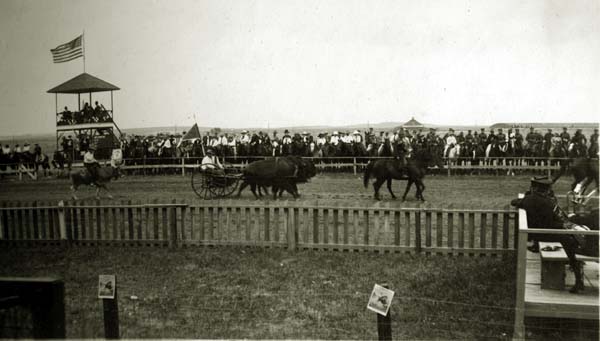
Scptty and Pete, 1912. The bison were driven by Curley McGuken.
Note the rain clouds on the left.
Scotty and Pete were advertised by the show's producer C. B. Irwin as the world's only trained buffaloes. The tenth event of the day was a display of the riding and driving of the only
buffaloes in the world broken to harness.In the event, Kid Moore rode Scottie bare back.
The 1912 Frontier Days celebration was significant in one aspect. As discussed later, it was the last main Fronter Days
show produced by C. B. "Charley" Irwin. He later produced the night show and produced his own "Cheyenne Frontier Days" Show. The later show resulted in the Frontier Days
Committee and Charley Irwin taking pot shots at each other at twenty paces with forty-four caliber lawyers. The dueling lawyers ended up in a draw, but ultimately
the Frontier Days Committee outlasted Charley. Charley was using the celebration for promotion of his own show and his own movie company.
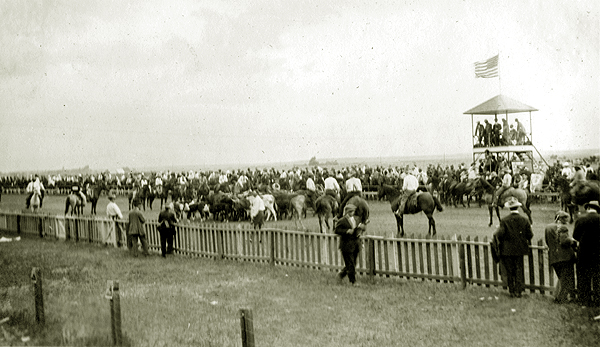
Large individual on horse to right of center back from action believed to be C. B. Irwin. Photo by Oscar C. Hayes, 1912, Armstrong Archives.
The first event of the day was a demonstration of fancy shooting by Captain A. H. Hardy an exhbition shooter for the
Peters Cartidge and Ammunition Company and by Rush Razee of Denver for the Remington Arms Company. Other events included a cow pony contest, the one-hald mile indian race,
Military Maneuvers by the 9th Cavalry from Fort D. R. Russell.
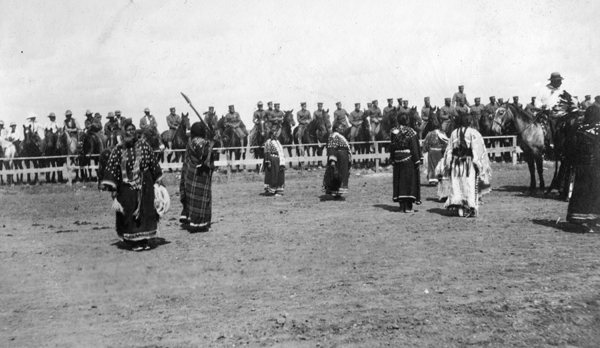
Getting ready for "Squaw Race, 1912.
In the background are members of the 9th Cavalry from Fort D. A. Russell. In 1912, the War Department delayed paying the soldiers until after
Frontier Days. The Committee decided on free admission for any soldier in uniform . If they wanted a seat, however, they would have to pay
for it.
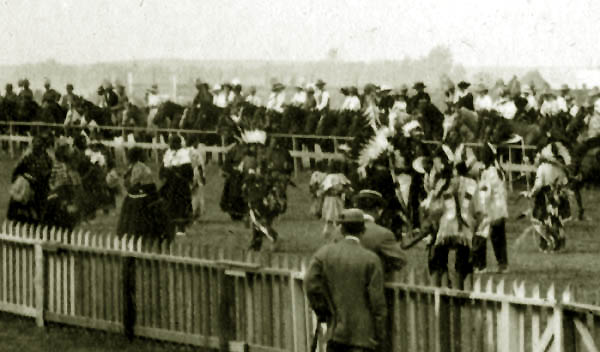
Indian Dance, 1912.
In the next photo, note the bone work vest on the one individual.
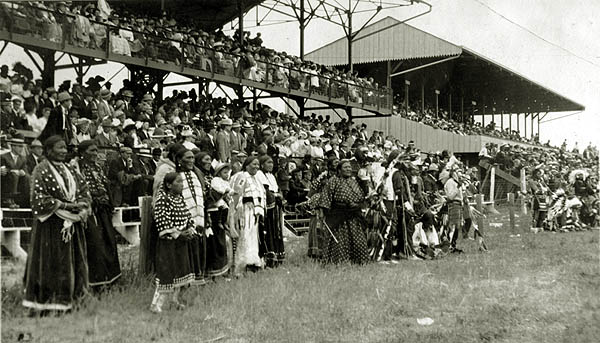
Indians watching event, 1912.
Mext page: 1912 Frontier Days continued, the effect of the loss of
charley Irwin
|