|
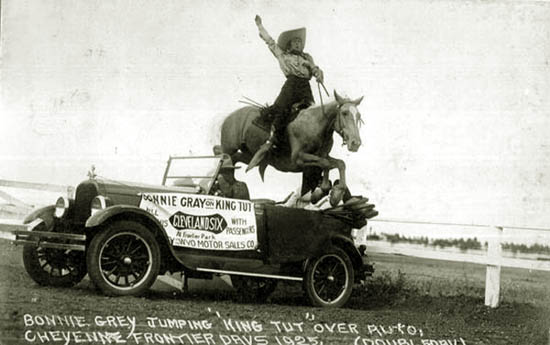
Bonnie Jean Gray on King Tut leaping over Cleveland Six. Photo by
Ralph Doubleday, 1925.
Bonnie Jean Gray won the Lady's Trick Roping Championship of the World at the
Pike's Peak Rodeo. She was college educated (undergraduate University of Idaho, post-graduate University of
Chicago) and was an accomplished pianist. In the 1922 Frontier Days she duplicated Leonard Stroud's under belly trick. In
1930, she married Donald W. Harris in California. Everyone in the ceremony, including the minister, were on horseback.
After the ceremony she and her horse King Tut leaped over the open car in which her new husband and her
bridesmaid were sitting. The Cleveland Six over which Bonnie and King Tut are leaping was
manufactured by a subsidiary of Chandler Motors. The company was merged with Chandler and ultimately sold
to Hupp. The car came only in two shades of blue. With pinstripes, black leather tufted upholstery,
the double nickle plated bumpers, aluminum trunk rack, body bars, and overhead valve engine, it sold for
$1,145.00. The running boards were an optional extra.
But if Len Stroud and Bonnie Gray's leaps were spectacular, more spectacular was some trick riding featuring a team of horses owned
by Buck Lucas
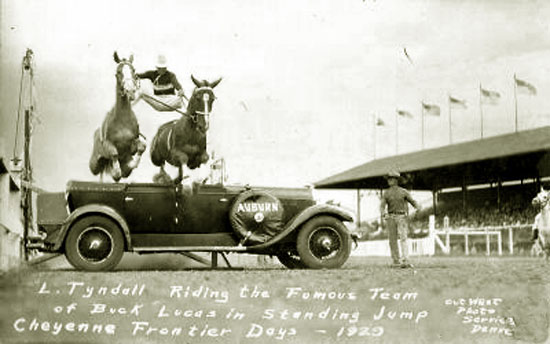
L. Tyndall on a team owned by Buck Lucas. Photo by A. E. Gordon, 1929.
James Edward "Buck" Lucas (1898-1960) was a bulldogger and bronco rider from Nebraska.
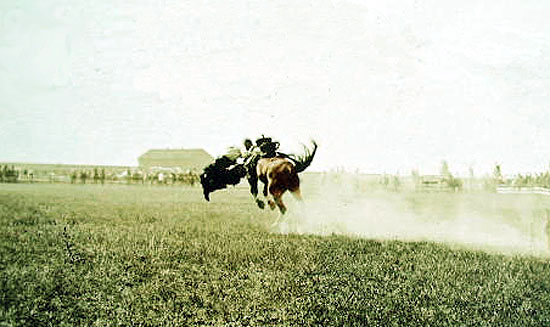
Buck Lucas being thrown from General Pershing, Frontier Days, 1920.
In 1924, Lucas won the steer wrestling contest at Pendleton and participated in Tex Austin's First International Rodeo and Cowboy Championships in Wembley Stadeum in
London. In New York prior to departure, he married Barba Inez Barnes (1902 -1990) who was also
participating. Later Lucas organized the Triangle Rodeo Company and acted as a rodeo judge.
Other trick riders included Daisy Parsons from Folsom, Montana.
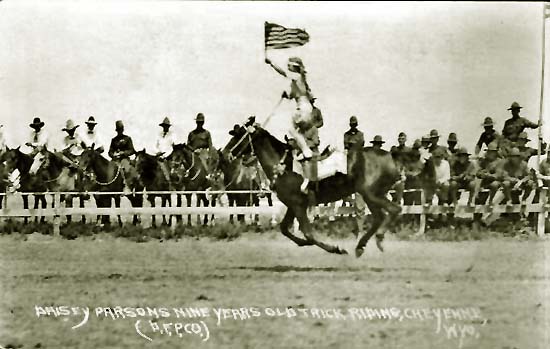
Daisy Parsons, Frontier Days, 1919.
Miss Parsons apparently misrepresented her age. She was actually born in 1908. She appeared the same
year at the Calgary Stampede. There, rather than holding an American flag, she stood upright on the
horse with both arms stretched out. In Calgary she also did a
"Russian drag," a stunt in which one hangs on to the horse with one foot while dangling almost to the ground.
Trick riding was not limited to horses.
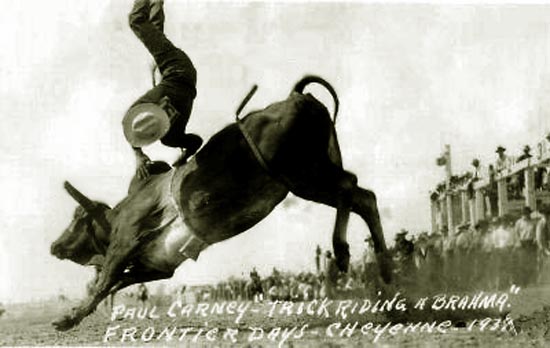
Paul Carney trick riding a brahma, 1938.
Paul S. Carney (1912-1950) was world champion steer rider in 1937 and 1939. He was a part of the original
Cowboy Turtle Association a predecessor of today's Professional Rodeo Cowboy Association discussed on the
next page.
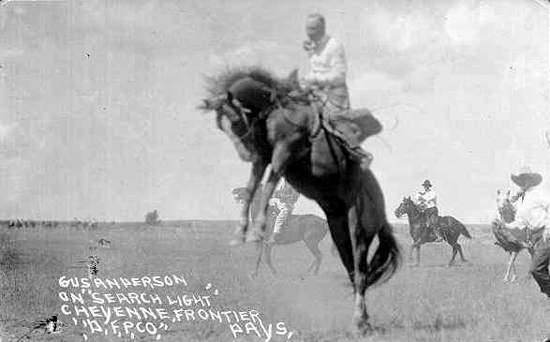
Gus Anderson, undated, photo by Ralph Doubleday.
Anderson was the 1913 Colorado state champion bronc rider winning an H. H. Heiser saddle.
Herman H. Heiser started making saddles in Denver about the time of its foundings and subjectly had a
saddlery in Central City and Black Hawk before moving back to Denver. In Denver his saddlery was
located at 379 Blake Street. The company continued in business until it sold out to
Denver Dry Goods in 1945. Anderson also won the San Diego [Calif.] Fair bronco championship in
1924.
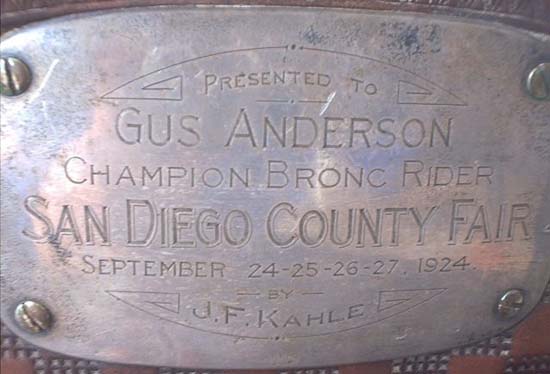
Plaque from championship San Diego championship saddle
J. F. Kahle operated a saddlery in San Diego on the first floor of the Brooklyn Hotel. The hotel
building has since been moved and is now a part of another hotel. Anderson also appeared in
western movies, including the 1931 Riders of the Cactus.
Music this page: Chariot Race or Ben Hur March by Edward Taylor Paul (1858-1924).
Next page, Frontier Days continued.
|