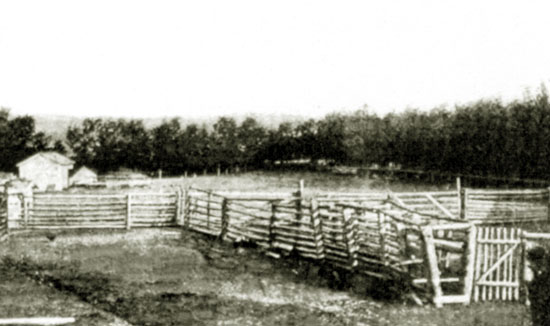
Johnson County War
Continued from Previous Page

From Wyoming Tales and Trails

This page: Johnson County War, the Seige of the TA, the Red Sash Gang.


Big Horn Basin Black Hills Bone Wars Brands Buffalo Cambria Casper Cattle Drives Centennial Cheyenne Chugwater Coal Camps Cody Deadwood Stage Douglas Dubois Encampment Evanston Ft. Bridger Ft. Fetterman Ft. Laramie Frontier Days Ghost Towns Gillette G. River F. V. Hayden Tom Horn Jackson Johnson County War Kemmerer Lander Laramie Lincoln Highway Lusk Meeteetse Medicine Bow N. Platte Valley Overland Stage Photos V Rawlins Rock Springs Rudefeha Mine Sheepherding Sheridan Sherman Shoshoni Superior Thermopolis USS Wyoming Wheatland Wild Bunch Yellowstone

Home
Table of Contents
About This Site


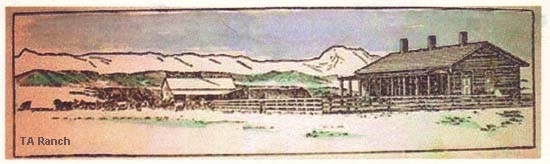
The TA Ranch

Following the killing of Nick Ray and Nate Champion the regulators rested at a friendly ranch and the following day headed out in the direction of Buffalo. The Regulators had stationed Phil DuFran, formerly Horace Plunkett's foreman, in Buffalo to spy on the town. Outriders were warned by DuFran of the approach of Sheriff Angus with a posse of 150 armed men. Sam Clover, a reporter for the Chicago Herald covering the expedition, decided that he did not need to stick around and took off for Buffalo. Fortunately, he had a friend in the military stationed in Buffalo who vouched for him. Richard M. Allen, the assistant manage for the Standard Cattle Company, determined that discretion and good sense was the better part of valor and also left for Buffalo. Clover, on his arrival in Buffalo, lied and said that he was just passing through town and sought the protection of a friend in a local military unit who vouched for him. Allen was less fortunate. He left his horse at the livery stable and attempted to depart on the next stage. Both he and the brand on his horse were recognized. He was removed from the stage and taken into custody. The stage left without him.
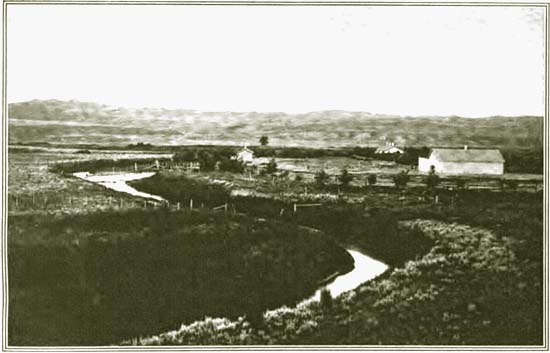
Back south of town, Major Wolcott, resuming commnand, ordered, over the objection of Smith and Canton, a retreat to the TA Ranch. The TA Ranch was ideally suited for defense. The house already had a 7 ft. fence around it and was situated in a bend in Crazy Woman Creek. Behind the house was an ice house which would provide a defensive outpost.
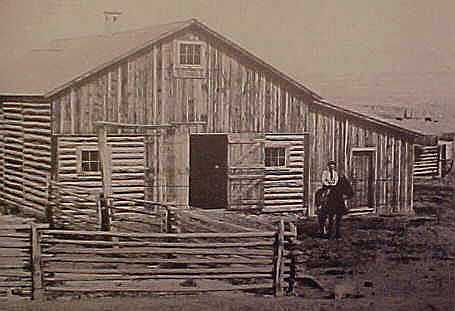

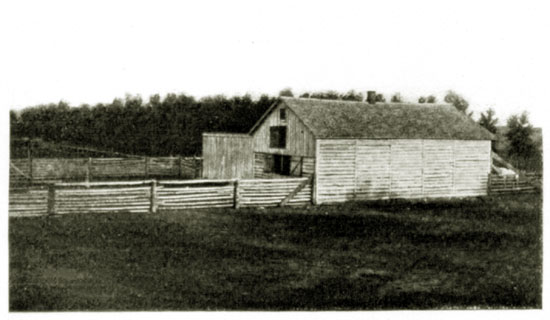
The Stable at the T A

To the west of the house was the stable. In the loft, the regulators drilled holes to provide gun ports, visible below the loft window in the photo above. To the west of the stable was a knoll on which the regulators undertook the construction of a fort. A defense breastwork was also constructed to the rear and east of the house.

Map of the Seige of the T A Ranch.

Soon the posse arrived and began construction of its own breastworks. In Buffalo, the hardware store was opened with its owner furnishing amunition and weapons to anyone who would join the posse. The ladies of the town set up a kitchen, dispatching food by wagon to the men. For two days there was a standoff. John J. Baker, a waddy in the posse, later recalled in an oral account given as a part of the Federal Writers' Project, that the regulators had better weapons than the posse. The posse had only ordinary guns and six-guns, but the regulators had high-powered rifles. Thus, the sheriff's men could not get within range. There was one exception. In the posse was one old "rawhide" with an old muzzle loading single shot gun. Baker recounted:

"That rawhide was as cool as a steer's nose and all he did was load that buffalo rifle and shoot. While loading the gun he would chew steadily on a cut of 'baccy. He would pack the powder and ball keeping his jaw working in time with the up and down movement of the ramrod. When he got her all set and a cap on the firing pit, he would turn his head and let out a squirt of 'baccy juice and raise the gun and BOOM it would go and a ball would hit a door or window every time he shot. * * * * The old fellow kept his work up for two and a half days. He sent a waddy to his home with orders to his wife for ammunition and for her to get to making bullets and a steady supply kept coming. She was on the job doing her part too.

Although the Wyoming Inland Telegraph Company was making every effort to get the line to Cheyenne open, messages were unable to get through to Cheyenne. On Tuesday, a message finally reached Acting Governor Amos W. Barber, yet no reply came from Cheyenne.

From within the beseiged T A, Mike Shonsey rode out under a white flag. The sheriff's men though he wanted to parley, but then Shonsey made a break for it. He was able to get through the surrounding lines and rode 100 miles further to the south where a telegraph line was open. With a message concerning the dire straits the regulators found themselves, action was taken by Acting Governor Barber. Certainly, among those beseiged were some who were not without political influence. W. C. Irvine and Hubert E. Teschemacher had been members of the 1889 Constitutional Convention. Acting Governor Barber promptly telegraphed Senators J. M. Carey and F. E. Warren in Washington, who in turn rushed to the White House and aroused President Harrison from his bed. Presidential Orders went to Fort McKinney to relieve the seige and take the regulators into custody.
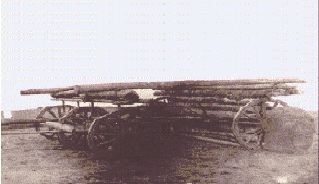
Movable breastwords

On Wednesday morning like the scene from MacBeth when Birnam Wood to Dunsinane came, the beleaguered regulators looked out and saw one of the breastworks moving toward them. Baker, explained:

"The second night we held a talk feast on ways and means. The old rawhide offered a plan. If my mind is working correct I would say the old fellow's name was Boon. "Fellows in them thar wagons are some dynamite. I reckon them skunks calculated on blowing up some ranch with it. This outfit it as good as any to do the blowing and the time is fitting. All you waddies that can put a hand on an ax get hold of one and go down to the creek bed and start cutting. Cut logs about 15 feet long and six inches thick. The rest of you all that are not busy mount your critters and drag the timber up here. What we are aiming to do is put them timbers tied to the hind end of them wagons and make a moving breastworks. We'll push the wagons backwards towards the buildings until we are in throwing distance and then throw the dynamite into the pits. That will clean them skunks out of thar.'
"I started at once for axes at the various ranches. By mid-night there were cutters working and it was not long until timber began to be placed on the ground. We tied the logs with our ropes to the rear end of the wagons and by daylight had our breastworks ready. At daylight we started to push the wagons ahead of us moving slowly towards the ranch buildings a short distance at a time. There was only 60 of us that could get shelter besides the pushers and we kept up a steady fire. Among us was the old Buffalo gunner.

The defenders observed the wheels and realized that the freight wagons used by the regulators, had been coverted into a movable breastwork and from which the dynamite brought in by the regulators would soon be lobbed. Baker estimated that the men on the movable breastworks were within a half hour of being within throwing range. In the distance, however, a bugle was heard, signaling the arrival of the 6th Cavalry led by Col. James Judson Van Horn. Beneath a white flag, Major Wolcott, gave a bow to Col. Van Horn, and offered his surrender to the 6th Cavalry, but refused to surrender to Sheriff Angus. Angus, however, secured the agreement that the expedition would be turned over to Civil Authority for trial. The prisoners were sent to Fort McKinney. Authorities fearing the wrath of the local citizenry, transferred the prisoners to Fort D. A. Russell for safe keeping. Their fears may have been justified, for a few days later the barracks at McKinney were bombed, by three cowboys who were allegedly members of the "Red Sash Gang."


Johnson County Invaders, prisoners at Fort D. A. Russell, 1892, photo by Charles D. Kirkland
L to R, 1st Row seated: W. Little, Jeff Mynett, Bob Barlings, S. Sutherland, Buck Garrett, G. R. Tucker, J. M. Benford, Will Armstrong.
2nd Row seated: W. H. Tabor, J. A. Garrett, W. A. Wilson, J. Harlings, M. A. McNally, Mike Shonsey, Frank Canton.
3rd Row standing: Tom Smith, A. B. Clarke, J. N. Leslie (short individual in "Boss of the Plains" hat), E. W. Whitcomb, Frederic O. DeBillier, Ben Morrison, W. J. Clarke, Hubert E. Teschemacher, B. C. Schulze, Fred Hesse (short individual in "Dakota" style hat), Major Frank Wolcott, W. C. Irvine, Joe Elliott, Scott Davis. Behind Wolcott, Irvine and Davis are W. E. Guthrie, Bob Tisdale (in bowler), and John Tisdale (on end).
4th Row: D. Brooke (behind Leslie), W. B. Wallace, Chas. Ford (in "ten gallon hat"), A. R. Powers, A. D. Adamson, C. A. Campbell, and Frank Laberteaux.

The Court held that the regulators probably would be unable to receive a fair trial in Buffalo and, thus, transferred venue to Laramie County. In 1890, Johnson County had but a population of 2,357 and in 1900 only four more. The cost of feeding and housing the inmates was visited upon the nearly empty County coffers. Thus it was that the County literally could not afford the cost of the prosecution. By the time the case was called for trial the County owed more than $18,000 and the case was dropped. That, however, did not end the tale.

Acting Governor Amos W. Barber

Public outrage resulted in the loss of the gubernatorial office and both houses of the Legislature to the Democrats. Not withstanding that some of the leaders of the regulators such as W. C. Irvine were Democrats, in the popular mind the regulators and large cattle interests were associated with Republicans. Dr. Barber completed his term as Secretary of State. Under the Wyoming Constitution, in the absence of the Governor, the Secretary of State becomes Acting Governor. Thus, the Democratic governor John E. Osborn was unable to leave the state lest Dr. Barber in Osborn's absence would do something politically untoward such as appointed a Republican United States Senator. During the Spanish-American War, Dr. Barber saw servce in Cuba. He later testified as an expert witness in the Tom Horn trial.

And of the individuals directly involved?

Jim Dudley, as the regulators were riding toward Buffalo, was thrown from his horse. From his injuries he contracted gangrene and died in angony, crying out for his family in Texas

Top, Phil Dufran
Center Left, Fred Hesse; Upper Center Right, Frank Wolcott
Lower Left, Richard Allen; Lower Right, Frank Canton

Frank Wolcott's role in the invasion did not protect him from rustling. In August, George Arnold, was arrested and later convicted and sentenced to three years in Laramie for killing one of Wolcott's neat cows. [Writer's note: "Neat cattle" are bovines as opposed to other cloven hooved animals. Neat's foot oil is derived from the hooves of neat cattle.]. In 1894, Wolcott left Wyoming and became general agent of the Omaha Stockyards. He died in Denver in 1910.

The Cheyenne Club defaulted on its bonds and was foreclosed upon.

Phil DuFran fled to Arizona where he worked for the Hashknife. He ultimately returned to the Dakotas and for a while acted as a representative of Rosenbaum Brothers of Chicago. Later he operated a saloon in Le Beau, South Dakota. With the construction of a sput line into LeBeau, the town became the major shipping point for the giant Matador Land and Cattle Company. During the summer of 1909, 150,000 head were shipped out through LeBeau It was said that the saloon took in more money during the season than did the local bank. On December 11, 1909, a bartender, "Bud" Stephens, in DuFran's saloon shot David G. "Dode" Mackenzie twice in the chest. Mackenzie was the son of Murdo Mackenzie, the legendary general manager of the Matador. As Dode staggered out the door of the saloon, the bartender pumped another two bullets into Dode's back. Bud was tried for murder. Murdo Mackenzie hired one of the highest priced lawyers available to prosecute Stephens. DuFran could only afford a young, still wet-behind-the-ears, 23 year-old attorney to defend Stephens. The jury was composed of homesteaders who had no use for the Matador. In March, Stephens was acquitted -- self defense. The Matador shipped all of its cattle from elsewhere. About two months following the acquittal, a major portion of the town burned down -- arson by persons unknown. With no cattle to ship, the Chicago, Milwaukee & St. Paul pulled up its tracks. The town has not exactly dried up -- it is now under the waters of the Oahe Reservoir.

By the end of the year, Hubert E. Teschemacher and Frederic O. DeBillier, liquidated the Teschemacher and DeBillier Cattle Company, owners of the Duck Bar Ranch. While being held pending trial, DeBillier suffered from a mental breakdown allegedly as a result of the thin air in Wyoming. Acting Governor Barber had him released to seek a lower elevation to regain his mental faculties. DeBillier left for France where he died in 1935. His partner Teschemacher also left for France but after several years returned to the United States.

Fred Hesse remained in Wyoming and after several years returned to Johnson County to manage his ranch. In 1906, he switched his operations to sheep. He served as Highway Commissioner 1927-1928 and died in 1929.

Thomas Smith returned to the Indian Territory and became a deputy United States Marshal. He was shot to death on November 4, 1892, on a train in Indian Territory when he entered a coach reserved for blacks.

Mike Shonsey, in 1893, had a confrontation with Dudley Champion at a cowcamp near Manville. At the end of the confrontation, Champion lay dead, his gun unfired, jammed with dirt. Shonsey turned himself in to authorities in Douglas and claimed self-defense. He was released and moved to Nebraska where he became a successful stock grower.

Frank Canton went to Nebraska and Alaska. He ultimately returned to Oklahoma and became deputy marshal for Judge Isaac Parker. In 1907, he became adjudent general of the Oklahoma National Guard, serving until he died in 1927. Following his death, it was revealed that his real name was Joe Horner, a wanted outlaw, murderer, and bank robber.

The "Texas Kid," was hanged after he killed his wife following an argument relating to his adventures in Wyoming.

Elias W. "Pops" Whitcomb was struck dead along the Belle Fourche by a lightening bolt on Jan. 1, 1915.

Sheriff Angus was defeated for reelection, but later served as deputy clerk and county treasurer.

Pending trial of the Invaders, the two trappers Ben Jones and Bill Walker, as material witnesses to the murder of Champion and Ray, were placed in protective custody in the Converse County Jail in Douglas. By some mysterious means, they were broken out of the jail and taken to Nebraska by a local liveryman working for the cattlemen. Wyoming authorities learned of the flight to Nebrakska, and telegraphed ahead to have the two taken into custody. Hugo Donzelman, a high-powered lawyer for cattle interests in Cheyenne, arranged for the two to be taken to Chadron by special train where a local judge granted a writ of habias corpus. Donzelman was formerly the territorial attorney-general. To preclude the two from being seized by Wyoming authorities, the two were immediately taken into custody by an assistant United States marshal and taken to Omaha on an alleged charge of selling liquor to Indians. According to Nebraska historian A. E. Sheldon, "A Nebraska Episode of the Wyoming Cattle War," Nebraska State Historical Society, 1899, the writ of habeas corpus was issued upon the deposit of $120.00 with the judge to "meet all possible costs." Sheldon noted that no accounting of the money and no record of the writ has ever been found. In Omaha, the two were supposedly given $3,000.00 each and placed on a train and sent to St. Louis from whence they disappeared.

Jack Flagg gave up ranching and moved into Buffalo to publish the Voice Newspaper.

Debate rages to this day as to who had advance knowledge. Among those contended to have known in advance are Acting Governor Barber, Sen. Warren (denied by him), and Sen. Carey (it was believed that the foreman of the CY cut the telegrah wires).

Finally, was there a "Red Sash Gang" of which Nate Champion was a member? Probably not. The reference to such a "gang" was more likely an after the fact attempt by the large cattle interests to justify their actions by portraying the invasion as an effort to eliminate a gang of rustlers that Johnson County authorities would not bring to justice. The reference to a red sash comes from the report by Chicago Herald reporter Sam Clover that Nate Champion was wearing a red sash when he was killed.

Left, Addison Spaugh wearing sash; right Mexican vaquero with sash.

In actuality, the use of a sash, in lieu of a belt, was at the time a common item of cowboy apparel, dating back to the Quebecois voyageurs and coureurs de bois employed by the Hudson's Bay Company and Mexican vaqueros. Their use was picked up by American mountain men, such as Joe Meek. Washington Irving in his 1837 Adventures of Captain Bonneville observed of the early mountain man that there was "girt around his waist * * * a red sash, in which he bestows pistols, knife, and the stem of his Indian pipe; preparations for either peace or war."

At the same time, Mexican vaqueros used sashes. Much of our modern cowboy attire such as chaps (from chaparejos) and cowboy hats, were adopted by Texan cowboys from their Mexican counterparts. Thus, many cowboys used a red sash including Montana cowboy artist Charlie Russell and James B. "Wild Bill" Hickok who carried two pearl gripped revolvers in his sash, grips out, cross-draw fashion. Hickok's use of a red sash earned him the appellation, the "pimp marshal." Thus, although references to a "Red Sash Gang" appear in literature with regard to cowboys in the Powder River Basin, Brown's Hole, and with regard to the dispute between ranchers and miners in Tombstone, Ariz., there has been no definitive evidence that the use of a red sash was other than a sartorial affectation.

Next page, Tom Horn