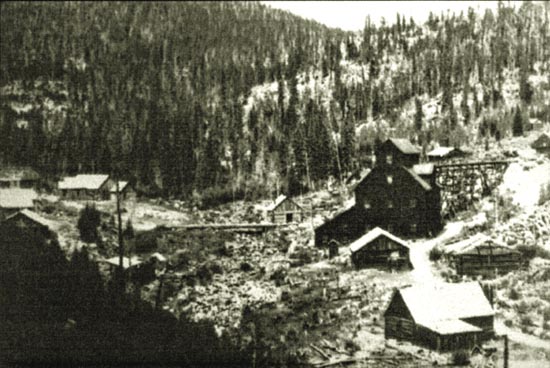
Keystone Mine, undated.
The history of mining in the Centennial Ridge and the Douglas Creek and Keystone Mining Districts has been
one of periodic gold and copper rushes following by periods of disappointment. Rumors circulated
since the 1850's of gold in the Douglas Creek area. Allegedly, a member of Sir St. George's hunting expedition discovered gold in the area.
The first confirmed discovery of placer gold was by Iram H. Moore in 1868. Douglas Kearns apparently discovered gold along
Beaver Creek two miles east of Encampment about 1878. The Keystone was a copper mine owned at first by the Kearns Consolodated Copper Mines Co. which
in 1004 was absorbed into the Keystone Mining & Development Co. In 1891, the New York Times reported the discovery of
silver at Gold Hill at the head of Brush Creek. Then State Senator (later Governor) Fennimore Chatterton indicated that
he anticipated a "Leadville boom." In 1892, Large scale mining commenced with the formation of the Douglas Consolidated
Mining and Milling Company. In August 1906, the New York Times again
reported hopeful discoveries of heavy gold-bearing sand along Douglas Creek. The paper estimated that there
was over $20,000,000 in gold along the creek.
In 1907-1908, the Keysotne was managed by world-famous mining engineer Frederick Percy Rolfe. He came to
Wyoming from Western Australia. Subsequently he managed mines in Colombia, Spain, the Transvaal and Rhodesia.
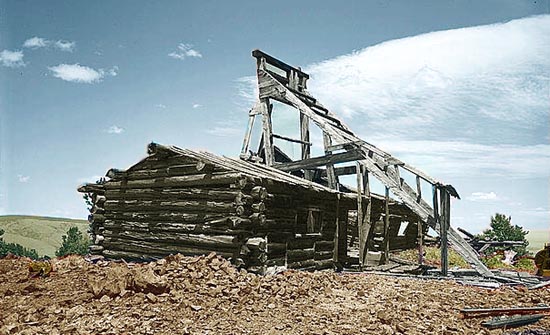
Queen Mine, Shaft House, 1989
In the 1920's another metal rush hit Centennial Ridge and Albany County and, like the previous
rushes, it too faded. The Queen Mine, technically the "Platinum Queen," was established
in 1924 by Andrew J. Hull, Jessie Northrup and B. F. Northrup of the "Wyoming Platinum and Gold Mining Sydicate" to mine platinum and
gold. Small traces of platinum and gold are found at the botton of the
160 ft. shaft. Hull was ultimately indicted for mail fraud in connection with
his promotion of the mine and Platinum City.
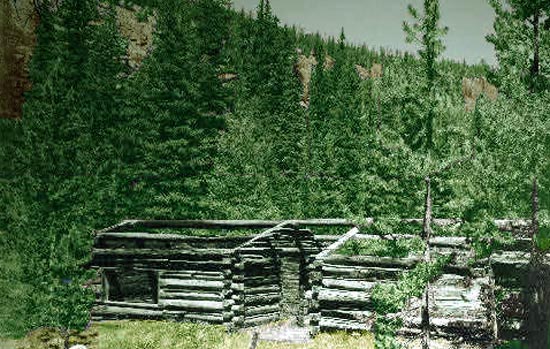
Bunkhouse, Cliff Mine, Keystone Mining District, 1989.
The Cliff MIne was operated by the Cliff Gold Mining Co. in th early 1930's. The was mine was on several levels accessed from a
tunnel some 534 feet in lenth. The Company claimed that ore in the mine
ran $5.25 per ton. In 1932, the mine was leased to the proprietors of two adjacent claims, the Ocean Wave and Ocean
Wave No. 1. Unfortunately, there was no ore and the mine was abandoned, replaced by lawsuits.
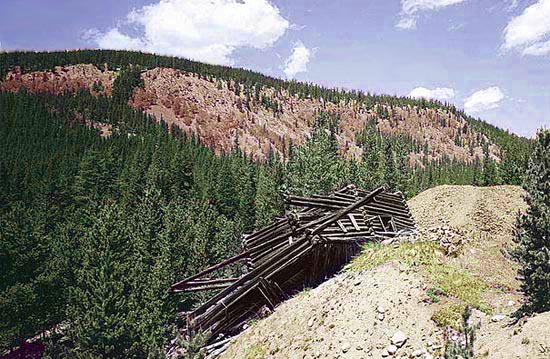
Ruins of Amalgamation Mill, Cliff Mine, Keystone Mining District, 1989.
An Amalgamation Mill is one in which "free" gold is separated from other material by being amalgamated with mercury. The mercury is
then distilled off leaving the gold. "Free gold" is gold in metalic form included within the rock and not combined with
sulphur or other minerals. The gold is separated from the rock by a stamping mill before being amalgamated.
The Queen Mine and the Joker Mine,
shown below are in the Centennial Ridge and Douglas Mining Districts, located about 2-3 miles
from Centennial.
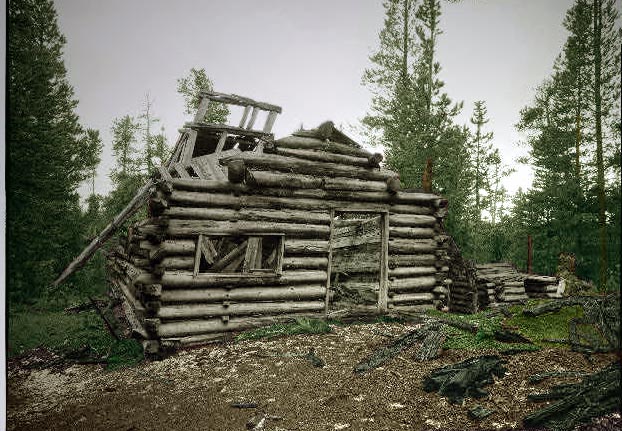
Joker Mine, 1989
The Joker is located at 9,620 ft. elevation .7 miles south of Rambler. It requires
requires about a third of a mile hike through timber.
Platinum City, in Albany County was founded in 1928 but lasted
only ten years failing by 1938.
Hope springs eternal. In December of 2000, the
Wyoming State Geological Survey announced that a sample rock had been found at
Centennial Ridge that was
"highly anomolous in gold," leading to the possibility that commercial quantities of gold may
yet be found.
Southern Wyoming was not the only area to have short-lived gold rushes. In some instances rather than being found
in pockets of ignious rocks or along stream beds, it was found in pockets of gullible
investors. In 1891, the Fortunatus Mining and Milling Company was incorporated in the State of Colorado
by a group of Upstate New York. The name "Fortunatus" comes from the story of the "Pocket of Forunatus" dating from
the 16th Century. As a young man Fortunatus had been given a magic pocket which would always have gold in it.
Soon news articles began appearing relating to the Company's properties at Bald Mountain
City to the west of Dayton. The articles gave glowing reports. The Sheridan Enterprise, February 13, 1892,
proclaimed the Bald Mountain claim as the "the laargest, and a fact that will, beyond the
cavil of a doubt, be absolutely substantiated within four months, the richest placer field, in the
known world." Various values were assigned to sand taken from the site ranging from $4.80 per cubic yard to $14.74. The Sheridan
Post, March 24, 1892, noted even based on $2.00 a yard the property would make a grand total of
$46,464,000. The Post reported, September 14, 1893, p. 1, that Bald Mountain City had
grown to 21 log houses, a number of tents, two or three stores, a post office, and a saloon.
Development of the property proved to be slow. The Sheridan Post, May 21, 1896, noted that
"the confidence in Bald Mountain mines has been sadly shaken by the dilatory and
do-nothing policy pursued by the former managers of this company."
However, with a spate of new publicity and the arrival from Elmira, New York of C. L. Tewksbury, new
stock was issued. The Company was advertised as being capitalized at $2,000,000. The Wyoming Tribune, Jan. 22, 1896,
reported that there was "no longer any doubt"as to to "a bright future for the camp."
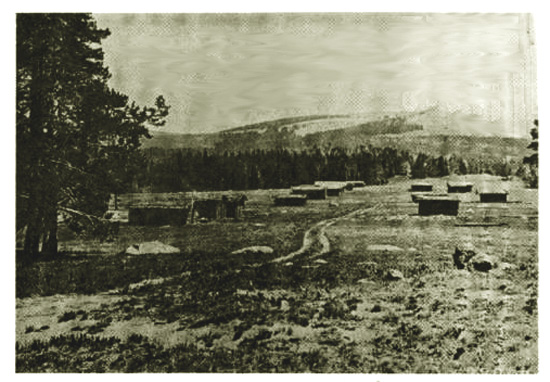
Bald Mountain City, undated.
In late 1896, mining engineer and professor of chemistry and geology at the University of Montana,
Fred D. Smith, in the Engineering and Mining Journal exposed the claims as being exaggerated. The October 22, 1898, issue
of United States Investor rported that Tewksbury "is said to be prospecting in
another part of the mountains." The Investor reported that the stock "is considered as
worthless by stockholders in Sheridan County, Wyo." and "some even think that the company was gotten up for the
purpose of floating stock and speculating without regard to the
real value of the mining interest. As indicated by the following
two photos taken from approximately the same location as the above photo, Bald Mountain City slowly rotted away.
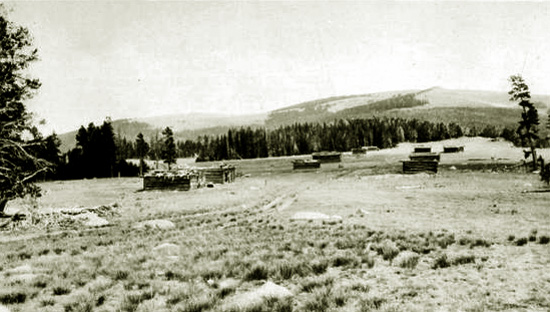
Bald Mountain City, 1930's .
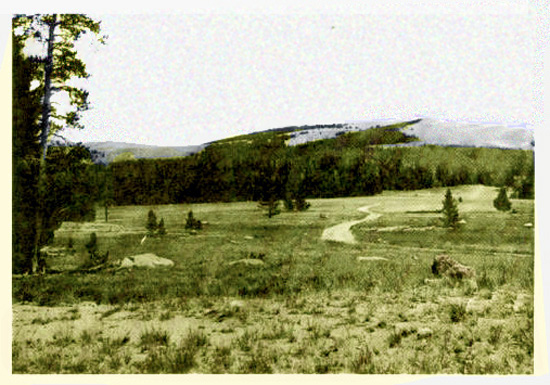
Bald Mountain City, approx. 1960.
Next Page Grand Encampment Mining District.
|