|

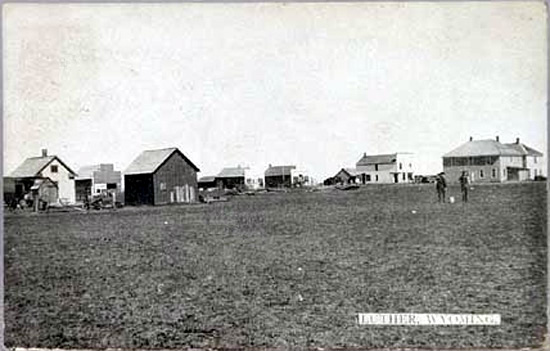
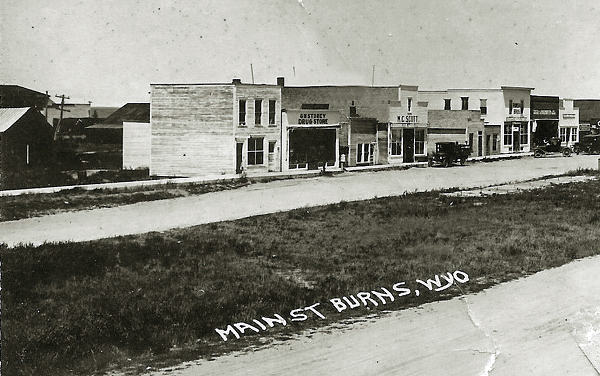
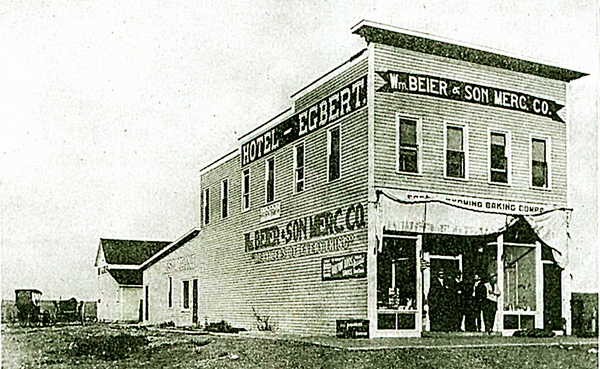
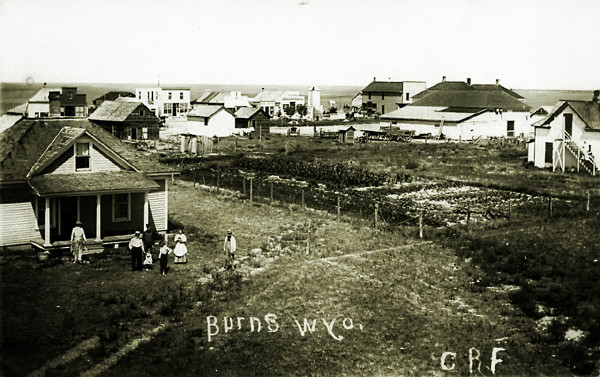
Burns, Wyoming, 1908 (See text below).
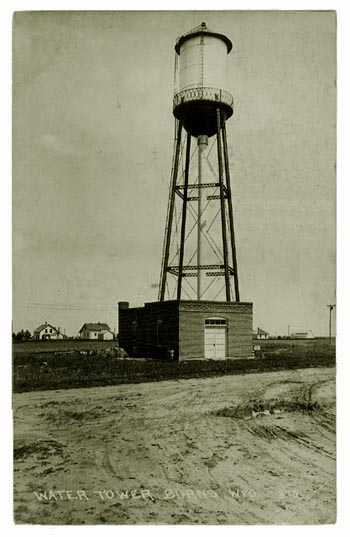
Burns, Wyo. water tank, approx. 1915.
Approximately five miles to the west of Pine Bluffs was the rail siding of
Tracy also named after DeWitt Tracy. And further to the west, as indicated
by the above map, the Lincoln Highway originally proceeded
through the towns of Egbert, Burns, and Hillsdale, all of which were originally established by the
railroad as rail sidings. On those sidings, before the days of block signals, a train would await the passage of
higher priority train. At the beginning of the railroad, trains were managed by a system of
time schedules and orders. The orders indicated what trains were on the line, the respective priorities, and where trains
were to be sidetracked awaiting the passage of higher priority trains were relayed by telegraph, written down on
light paper knowns as "flimsies," and conveyed to the conductor of the train. The conductor was the officer of the
train, the "master of the ship" so to speak.
It then became necessary that each such siding have a clear distinctive
identity. Therefore, all sidings were named. Around some small towns would develop. Those towns would take on the
name of the siding. Such are Egbert, Burns, and Hillsdale, each having assumed the name of a siding. Others, such as
Tracy remain even today as mere sidings. On back roads paralleling railroad tracks, one may observe sidings on which there may be a
sign giving a name. It is not necessarily the name of a long-gone defunct town, but, instead, the name of the
siding.
Egbert was named after Augustus A. Egbert (1835-1895) who joined the railroad in 1867 as a conductor. He worked his way
up to a railroad superintendent. His brother, Daniel W. Egbert (1834-1923) also worked for the
railroad and ultimately served as a yard master in Iowa.
Burns, Wyoming, was also an early railroad siding until 1907. In that year, some German Lutherans established a
town next to the siding. The Lutherans attempted to name the newly formed town after Martin Luther. Burns was the center
of the Golden Prairie District promoted by the J. Ross Carpenter's Federal Land & Securities Co. formed in 1905.
By 1908, Burns had a newspaper, The Golden Prairie Herald. It later changed its name to the
Burns Herald.
Carpenter (1867-1943) sold land
using leases with options to buy. Carpenter, Wyoming, south of Burns, is named for him. With the
end of the "Dry Farming" boom, Federal Land & Securities Co. was out of business by 1922.
By 1910,
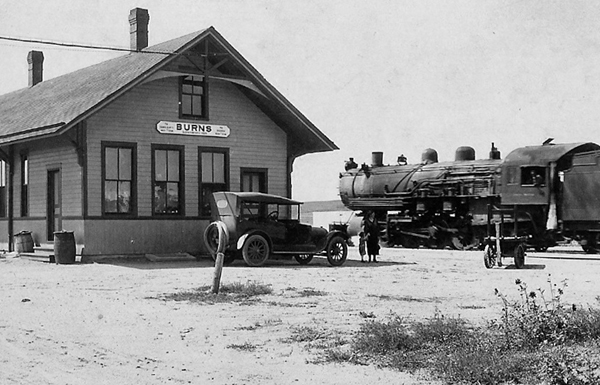
the area gained enough population to warrant a post office. The same year, the Union Pacific constructed a depot. The depot, similar to
many stations along the line, was a prefabricated structure, with waiting room, office, freight room, and quarters for the
agent. The question of the name again arose.
The railroad in its dispatches had continued to use the name "Burns." Thus, the older name which had been in use by the railroad since
its construction, was used for the
post office, the name having come available for postal use when a post office of the same name
in present day Sublette County closed. By 1920, Burns had achieved a population of about 300 and had
two banks, the Burns State Bank and the Farmers State Bank organized in 1919.
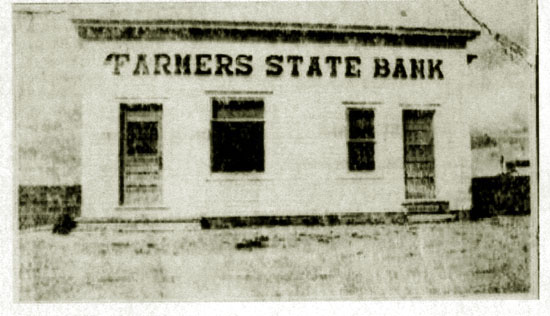
Farmers State Bank, 1920
Burns was apparently named by the railroad after J. J. Burns an
early railroad telegrapher. Burns worked his way from telegrapher to operator, assistant store keeper and ultimately to
purchasing agent for the Union Pacific.
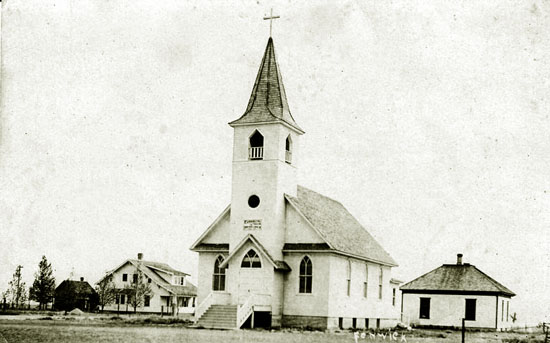
Luthern Church, Burns, Wyoming, undated.
Besides providing for transcontinental travel, the Lincoln Highway reduced the necessity for reliance on
the railroad for local trafic. Trips to and from Cheyenne were no longer arduous.
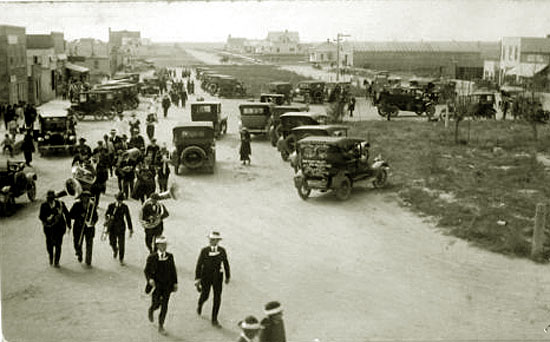
Cheyenne Chamber of Commerce promotion, Burns,
Wyoming, October 7, 1920.
About 200 members of the Cheyenne Industrial Club (the Chamber of Commerce) participated in a promotional
tour of eastern Laramie County, including Hillsdale to the north of Burns, Pine Bluffs, and Carpenter.
The band in the photo is the Burns Town Band which travelled to Hillsdale and accompanied the
Chamber of Commerce members back to Burns. An aeroplane travelling overhead led the procession. After
distributing advertising material to the various businesses in Burns, the group again led by the
aeroplane proceeded on to
Pine Bluffs.
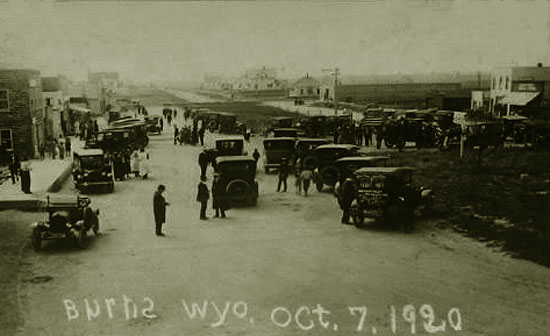
Cheyenne Chamber of Commerce promotion, Burns,
Wyoming, October 7, 1920.
The motorcar with the sign on the back is a factory-sponsored air-cooled Franklin.
In Pine Bluffs, Representative Frank Mondell gave a speech at the Pastime Theatre, dinner was provided by the
Ladies Aid Society at the Opera House, and some of those that were Masons sat in while degree work was
performed. The group then proceeded on to Carpenter and Grover, Colorado.

Union Pacific Depot, Burns, Wyoming, approx. 1915.
The depot was moved later to Greeley, Colorado, where it is a part of the Centennial Village Museum.

Hillsdale, Wyoming, 1901.
Hillsdale was named by Gen. G. M. Dodge after Lothrop L. Hills (1831-1867), an assistant engineer and head of
an enginering party for the Union Pacific. Hills was killed by
Indians on June 11, 1867 about six miles east of present-day Cheyenne. To protect Union Pacific crews a cavalry post
was established at Hillsdale. The names of some of the streets,
streets, Nash Ave., Coates Ave., and Markley Ave., recallduring the dry farming era when the town was at its
peak. Charles N. Coates, a railroad telegrapher, is regarded as having established the town.
He homesteaded some 300 acres and went into the
real estate business. He advertised the area as "the best dry farming land in Wyoming." Hillsdale was
promoted as the "garden spot of Wyoming." In 1916, John C. Nash, a local rancher established the Hillsdale State Bank.
Stanley K. Markley, was one of the founders of the local church and served as its pastor. Later he went into the real estate business
advertised that he sold homesteads and irrigated ranches and farms. In 1917, Markely established the town newspaper,
The Hillsdale Review
By the early 1920's storm clouds were on the horizon for the little town. A drought hit the area. In January 1921, the town was rocked by headlines in the
leading Wyoming newspapers revealing that Harry H. Nash, the twenty-one year old son of the town's banker
had been arrested in a Los Angeles pool hall for the murder in Arizona of Martin F. Schwab, a traveling typewriter and cash register salesman.
. . .
Left, Harry Nash, right, J.C. Nash
Photos from Coconino Sun, February 4, 1921
Harry Nash was a fancy and trick roping cowboy. Allegedly he had appeared in the Frontier Days celebrations but had left Wyoming
for the bright lights of Los Angeles and the movies. In April of 1920, the 50 year-old Schwab had been in Flagstaff, Arizona, and was going to proceed to
Winslow as his next call. Schwab normally wrote his wife in Utah daily. Schwab and his large 7-passenger Chandler
Automobile vanished. Mrs. Schwab wrote the sheriff in Flagstaff, but no reports of Schwab were received. That fall,
a new sheriff, Wm. Campbell, was elected. In the meantime, an elderly
hotel clerk from the Daly Hotel in Salt Lake City, B. F. Pearson, dreamed that Scwab had been murdered and that his body was
buried outside of Flagstaff. Several friends of Pearson wrote Campbell of the dream. Campbell travelled to
Salt Lake City to interview Pearson. Sheriff Campbell was convinced that Schwab had been murdered. On September24, the first break came when
two boys discovered buried in an old dry well outside of Flagstaff a typewriter and a skull. Investigation of the well also
revealed a sample case, a miniature saleman's sample cash register, a body, and documents that demonstrated that the body was that of
Schwab. Sheriff Campbell immediately suspected Harry Nash, his brother Roy Nash, and another rodeo
cowboy who had been in Flagstaff at the time of Schwab's disappearance. Harry had made some comments in
Flagstaff that he was going to buy Schwab's big Chandler. Yet, Harry appeared to be down on his luck. He had
hocked his saddle at Harper's Second-Hand Store. Harry's wife was working at the Commercial Cafe as a
waitress. Shortly after Schwab disappeared, Harry and his companions also left town to follow a wild west show. Sheriff Campbell
believed that if he could find the Chandler, it would lead back to Harry.
In October, the big break in the case came, a rodeo cowboy passing through Weiser, Idaho, had sold a large
seven-passenger Chandler. The car still had Utah license plates, but the plates had been modified to change some of the numbers. Additionally,
an effort had been made to modify the appearance of the car. Sheriff Campbell's belief proved out.
The car had been sold by Harry Nash. Upon his arrest, Nash confessed to shooting Schwab but he contended that
the 50-year old Schwab had offered him a ride to Winslow. According to Harry, on the way Schwab tried to rob him. Harry argued that
Schwab, a Mormon, appeared to be drunk. Therefore, he Nash shot Schwab in self defense. He contended that originally he intended to
turn himself in, but was afraid he wouldn't be believed. Nash therefore took the body out to an old well
he discovered and stuffed the body, sample case, and typewriter down the well, and covered the body in the well with several feet of dirt.
He used Schwab's watch to redeem his saddle. Thereafter, he followed the Rodeo circuit to Magdalena, New Mexico, up to Nebraska, to Wyoming, and
then to Idaho were he sold the car for $500.00.
Nash's father employed one of the most prominent attorneys in Los Angeles as well as Flagstaff lawyer C. B. Wilson to lead the
defense. The state traced with witnesses from all over the west Harry's movements, identification of the watch, and the car.
One of those who travelled to Flagstaff to assist in the defense as a character witness was S. K. Markley.
Even though J. C. Nash was president of the Hillsdale Bank, the cost of the trial put a strain on
his finances. According to the Coconino Sun, Sepember 16, 1921, p. 6,
the elder Nash had to borrow money from relatives and sell
a portion of his lands to pay for the defense.
The jury settled on a "compromise verdict," finding Harry guilty of second degree murder thereby saving him from the
gallows. The court denied a motion for new trial. A life sentence was declined by the court. If the court had given a life sentence,
application for parol could have been made at any time. Instead, the court sentenced
Harry to "not less that 65 years" nor more than 75 years in the state prison at Florence. Under Arizona law at the time,
application for parol could not be made before the 65 years had been served. He was initially assigned as an
assistant painter to a fellow inmate who had painted Flagstaff with bad checks. He was later assigned to the kitchen. In September 1922,
Harry attempted to escape from the prison, but was stopped by an alert guard. He was ten transferred to the "Snake Pen," i.e.
solotary confinement.
Harry's father refused to authorize an appeal. Harry's wife, who had worked as a waitress in Los Angeles, had travelled to
Flagstaff at her own expense to testify on behalf of Harry/ At the emd pf tje trial, accprdom tp
the Coconino Sun, she was "stranded without even enough money to pay her board bill. Sheriff Campbell asked
J. C. Nash to pay for his daughter-in-law's fare back to Los Angeles. The elder Nash refused.
Sheriff Campbell felt that Mrs. Nash was not getting a fair deal and paid for her transportation back to Los Angeles out of his own
pocket. By his confession, Harry saved his brother Roy from also being charged with the murder.
In 1923, the Lincoln Highway was reconstructed and moved further to the south bypassing Hillsdale.

Reconstructed Lincoln Highway, east of Cheyenne, 1924.
With the drought and the bypassing of Hillsdale, the little town faded. By 1926, the Bank was in receivership. In 1927 the Hillsdale
Review suspended publication. As of the 2000 census, the town (unincorporated) had a population of 149.
Next Page, Lincoln Highway, Cheyenne to Tree-in-the-Rock.
|