|
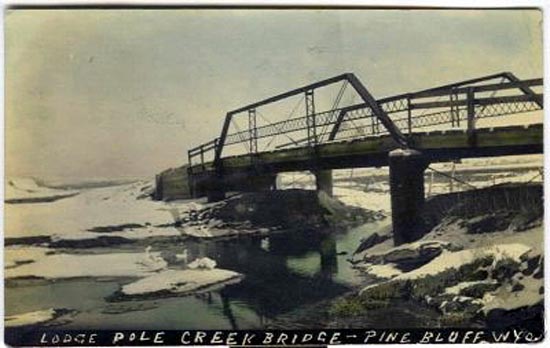
Bridge over Lodge Pole Creek, Pine Bluffs, Wyoming, approx.
1910.
Lodge Pole Creek, although slight in water, is significant as a transportation route. Ever since the construction
of the Union Pacific Railroad in the 1860's, transportation followed the creek from Chappell, Nebraska, almost to Cheyenne. Thus,
the Lincoln Highway parallelled the creek for almost 120 miles. The creek, 212 miles in length, has been described as
the longest creek in the United States. It rises along the eastern slope of the divide between
Cheyenne and Laramie, flows north of Cheyenne, crosses into Nebraska east of Pine Bluffs, turns south near
Chappell, Neb., crosses into Colorado and flows into the South Platte near Julesburg.
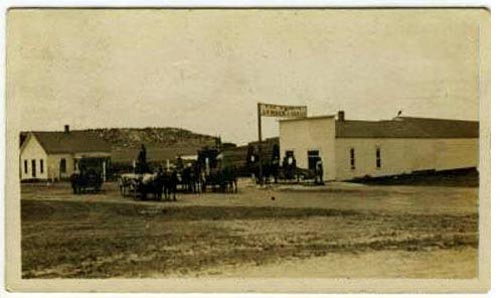
Pine Bluffs, 1909.
Pine Bluffs, originally "Rock Ranch," was the first town on the Lincoln Highway coming from
the east and the last town before Nebraska heading east. It received its
start with the arrival of the Union Pacific in 1868. Nearby tie contractors for the railroad harvested pine from the nearby bluffs
leaving the bluffs crowned with scrawny trees unfit for proper service as a railroad tie. The nascient town
consisting of a saloon, a tent, a slab shack with a stone chimney, and a square shed of canvas-covered poles.

Pine Bluffs, 1868. Photo by Arundel C. Hull
With the growth of the cattle industry,
Pine Bluffs became a shipping point for
cattle coming up the Texas Trail. For discussion of the Texas Trail, see Lusk.
Two years after the railroad came, over 6,000 head of cattle passed
through town. Eventually at the height of the 1880's cattle boom, the town was the major shipping point on the
Union Pacific. The town was also one of the earliest centers for ranching in the Territory.
and was the home ranch of DeWitt Clinton Tracy. Tracy was, according to a 1930's anomymous description in the State Archives,
"irrascible and high-tempered" who carried with him on roundup crackers and canned sardines and "would
not eat the palatable and nutritous food of the cow camp." For a description of the
food of the cow camp see Cattle Trails .
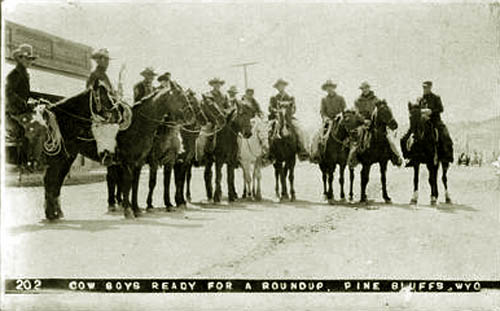
Pine Bluffs, 1911.
Rock Ranch according to Crofutt & Eaton's 1870 Great Trans-continental Railroad Guide,
"was famous for the immense amounts of 'tangle leg' and 'chain lightning' compounds sold at
25 cents per drink. Rarely did the unfortunate purchaser
survive his rash act long enough to buy the seccond one."
Sir Richard Burton wrote of tangle leg, "Whisky is now tested by the distance a man can walk after tasting it.
The new liquor called 'Tangle-leg' is said to be made of diluted alcohol, nitric acid, pepper, and
tobacco, and will upset a man at a distance of 400 yards from the demijohn."
William A. Mailie-Grohman in his 1910 Camps in the Rockies said of tangle leg,
"But my men and I knew too much of Western " tangle-leg " and its vile poisonous qualities.
That good old 'cowboy' saying, which tells you that one drink of it tempts you to steal
your own clothes, two drinks makes you bite off your own ears,
while three will actually make you save your drowning mother-in-law,
was not invented for us;' for,'as Henry the boy cook quizzically put it, 'our clothes
arn't worth stealing, our ears are too big and too tough, and our outfit ain't
got no mother-in-laws about it.'" At the height of shipping season, the town might attract
"professional women" from Cheyenne. The Cheyenne Leader described two such visitors:
"Both wore yellow hair and store complexions. The garments which they
wore weren't very costly but were rather variegated and colors
bordring on crimson predominated. Each had on a Leghorn
hat, which was only less elevated than a steeple, and wore
bangle bracelets and jewelry till you counld't
rest. The jewelry was of that
character which is euphoneously termed
'snide,' but it shone like a tin pan on a
milk house."
The Railroad changed the name of Rock Ranch, but the town remained a
a tad rough even into the early years of the 20th Century. In 1909, Leonard Wood sent a
factory Mitchell Ranger across the continent as an experiment in the use of automobiles by
couriers for the Army. The driver,
Frank Zirbes, noted that he arrived at Pine Bluffs the day
after the sheriff rescued a horse thief from being
strung up on a telegraph pole. Lieutenant Ben Rosenthal, the Army Signal Corps observer on the journey and supposedly
having duties relating to bridges, was less than impressed by the road in Wyoming, referring to them as
"gelatinous" A Mitchell factory brochure referred to some of the roads as being "mortar troughs." Automobiles were not
the first vehicles to use the proposed route. In 1884, early bicyclist Thomas Stevens used the basic route of the
Lincoln Highway crossing the continent on a Polk "Standard" 50-inch "penny farthing." He described his
passage through Pine Bluffs:
Gradually the Rockies have receded from my range of vision, and I am all alone on the
boundless prairie. There is a feeling of utter isolation at finding one's self
alone on the plains that is not experienced in the mountain country. There is
something tangible and companionable about a mountain ; but here, where there is no
object in view anywhere,�nothing but the boundless, level plains, stretching away on every
hand as far as the eye can reach, and all around, whichever way one looks,
nothing but the green carpet below and the cerulean arch above, � one feels that
he is the sole occupant of a vast region of otherwise unoccupied space.
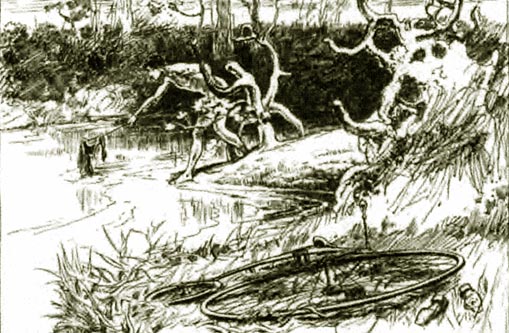
"Whilst fording Pole Creek"
This evening,
whilst fording Pole Creek with the bicycle, my clothes and shoes, � all at the
same time, � the latter fall in the river; and in my wild scramble after the shoes
I drop some of the clothes; then I drop the machine in my effort to save the clothes,
and wind up by falling down in the water with everything. I fish everything out again
all right, but a sad change has come over the clothes and shoes. This morning I was
mistaken for a homeless, friendless wanderer; this evening as I stand on the bank of
Pole Creek with nothing over me but a thin mantle of native modesty, and ruefully wring
the water out of my clothes, I feel like one ! Pine Bluffs has the honor of providing me
with shelter for the night, and a few miles travel next morning take me across the
boundary-line into Nebraska.
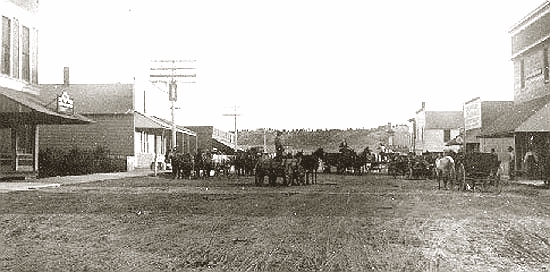
Pine Bluffs, approx. 1910.
Pine Bluffs was one of two principle shipping points for cattle baron John Iliff. Many large cattlemen shipped from Pine Bluffs.
Montana cattle began being shipped from Pine Bluffs as early as 1879 with the
reopening of the Bozeman Trail. Morton Frewen shipped from here. Even Texas Contract drover J. R. Blocker is known to
have trailed cattle to Pine Bluffs. With the end of major cattle drives and the arrival of railroads further to the north and to the
south, by 1890 major shipping from the town was substantially reduced. By the early 1900's, Pine Bluffs began to
recover as a result of dry farming. Southeastern Laramie County was promoted by real estate men as
the "Golden Prairie District." In 1906,Charles Lee Beatty,
a Cheyenne banker and real estate developer began promotion of the town. In 1911,
at the Omaha Exposition he claimed Pine Bluffs was largest grain shipping point on the Union Pacific. By 1922, he
claimed to have relocated 1,000 families to Pine Bluffs and sold 200,000 acres to farmers. The thousand families may
have been a slight exaggeration. In 1910, Pine Bluffs had a population of 146 and by 1920 a population of 618.
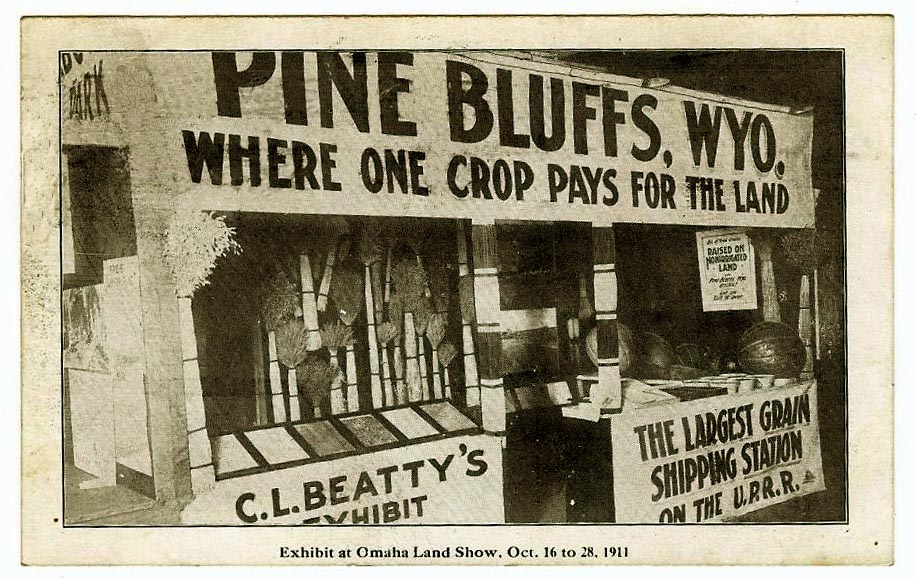
Pine Bluffs Exhibit at 1911 Omaha Exposition.
At the same time,Pine Bluffs boasted, 2 hotels, 2 banks, livery stable, Ford dealership, a baseball team
and a gravelled road. By 1920, the State Highway Commission furnished Laramie County a truck and grader which in
turn were loaned to local residents to work the roads. The Burns Herald noted that the
roads "long needed attention and it is thought that now that this excellent
outfit is available, much can be done toward making some good highways in this part of
the county." The Pine Bluffs Post also commented on the roads a bit sarcastically, referring to
the road leading south to Grover, Colorado, as the "fine (?) hill road south of town."
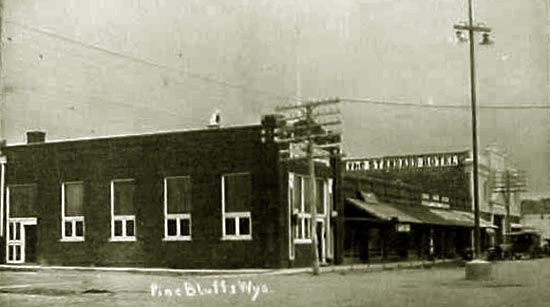
Pine Bluffs, Standard Hotel.
Beatty had his fingers in every
pie. He was president of the Pine Bluffs State Bank, a shareholder and director of the Peoples Telephone Co., the Pine Bluffs Lighting Company,
and the Frontier Millings & Elevator Co. and further to
the west, the Luther State Bank.
Fron 1910 to 1915, Beatty served as mayor and from 1915 to 1917 he served in the
State Legislature. His house in Cheyenne is now on the National Register.
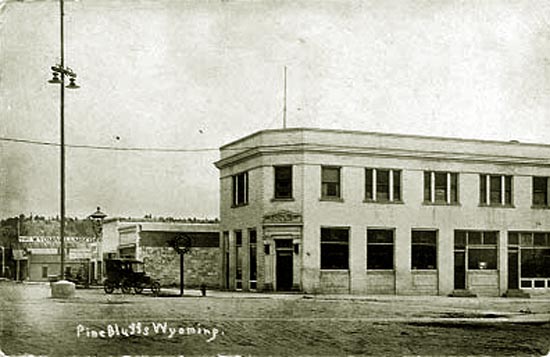
Pine Bluffs. Pine Bluffs 1st State Bank. Note street lights also provided
by Beatty's lighting company.
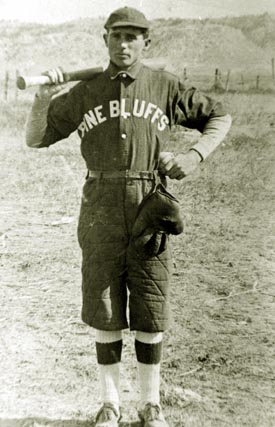 Arthur John Brown, circa 1907. Photo
courtesy of his grandson, Jerry Brown. Arthur John Brown, circa 1907. Photo
courtesy of his grandson, Jerry Brown.
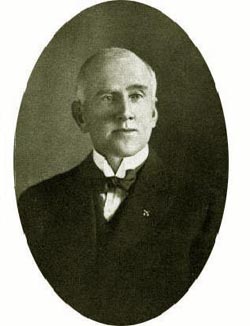 Charles Lee Beatty
|
In addition to playing baseball, Arthur Brown was an accomplished foot racer. At the turn of the
century, foot races were a popular sportwith professional foot racers traveling about the country earning a living
by betting on foot races against local racers. Many of the professional foot racers were scam artists.
Brown, himself, however, beat out at least one of the professionals in which the
bet was a horse. After winning Brown declined the horse.
Pine Bluffs was not unique in having a baseball team. Baseball was the most popular
sport in Wyoming at the time. Baseball came at the very beginning with the military and the railroad
workers. In 1869, the Cheyenne Eclipse played the Fort
Laramie Alerts. Other teams included the Cheyenne Devils, the Laramie Wolverines, the
Rock Springs Mavericks, and the Kemmerer Coal Diggers. Just about every small
town had a team. There were turn-of-the century teams in Lander, Manderson,
Lusk, Manville, Laramie, Green River, and Shoshoni. There were temas playing in South
Pass City and Atlantc City. Forts D. A. Russell, Sanders, and Laramie each had
teams. Workers on the Union Pacific played baseball. The outlaw Kid Curry
showed his proclivity for violence by getting into a fight at a baseball game.
Even the prison had a team, the "All Stars."
In contrast to Nebraska, Wyoming had Sunday baseball. Later many of the Wyoming teams
played with teams from the Nebraska League formed about 1906.
Music this page:
GET OUT AND GET UNDER
Johnny O�Connor bought an automobile.
He took his sweetheart for a ride one Sunday.
Johnny was togged up in his best Sunday clothes,
She nestled close to his side.
Things went just dandy �till he got down the road,
Then something happened to the old machinery.
That engine got his goat, off went his hat and coat,
Everything needed repairs.
He�d have to get under, get out and get under
To fix his little machine.
He was just dying to cuddle his queen,
But every minute when he�d begin it,
He�d have to get under, get out and get under,
Then he�d get back at the wheel.
A dozen times they�d start to hug and kiss
And then the darned old engine, it would miss.
And then he�d have to get under, get out and get under,
And fix up his automobile.
Millionaire Wilson said to Johnny one day,
"Your little sweetheart don�t appreciate you,
I have a daughter who is hungry for love,
She likes to ride, by the way."
Johnny had visions of a million in gold,
He took her riding in his little auto.
But every time that he went to say, "Marry me!"
�Twas the old story again.
He�d have to get under, get out and get under
To fix his little machine.
He was just dying to cuddle his queen,
But every minute when he�d begin it,
He�d have to get under, get out and get under,
Then he�d get back at the wheel.
A dozen times they�d start to hug and kiss
And then the darned old engine, it would miss.
And then he�d have to get under, get out and get under,
And fix up his automobile. |
Next Page, Lincoln Highway, Pine Bluffs Continued.
|