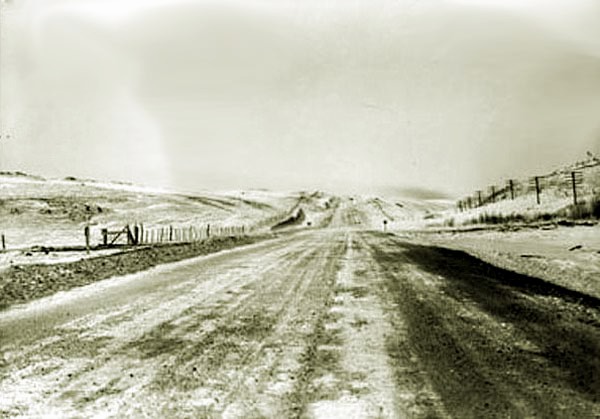
Lincoln Highway near Rock River, 1924.
Ninteen miles west of Bosler the traveler came to Rock River. Rock River traces its
beginnings to 1898 when the Union Pacific moved its station from Rock Creek as a part of its revamping its
tracks between Wyoming Station and Granger. One of the building that moved from Rock Creek to Rock River was the
Cosgriff Brothers' Store. The Cosgriff Brothers of Rawlins, T. A. Cosgriff, John Cosgriff, and James Cosgriff, owned a
chain of stores in southern Wyoming as well as number of banks. At one time
they had as many as 125,000 sheep.
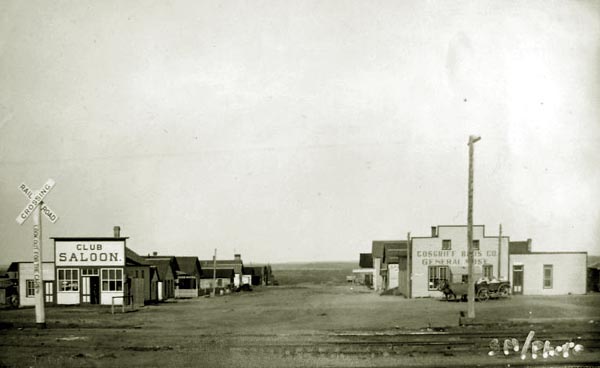
The Rock River Cosgriff Store.
.
Thomas A. Cosgriff started with one store in
Cheyenne which rapidly grew to stores in Sheridan, Rawlins, Laramie, Rock Springs, Saratoga. Encampment and Medicine Bow.
In some of the stores he organized banks such as
the Cosgriff and Fuller Bank in Rock Springs. Soon there was a banking
empire banks extending into Wyoming, Idaho, Utah and Colorado. In Cheyenne he was a major shareholder of the
First National Bank of cheyenne and organized the First National Bank at Rawlns.
He was one of the largest stockholders in the Continental Bank at Salt Lake
City, of which one of his brothers, James E. Cosgriff, was the president.
He was an organizer of the Cheyenne Street Railway.
On June 5, 1905, the Cosgriff Store was held up by Herbert Ambler. A posse caught him at the Quealy Ranch 16 miles east of Saratpga.
The Cosgriff Store continued as the major mercantile in Rock River until
March 24, 1917. The clerk slept in a small room on the second floor and awoke from smoke. He made his escape by smashing out the window sash
and leaped to the ground. The fire was of an unknown origin. The building housed the store and the bank
was totaled. Records for the store and bank were held in the bank's safe and thus saved. The building was insured for
only $3,000. It was not rebuilt. The town's was supply was frozen and water to fight to
fire was supplied by the Union Pacific.
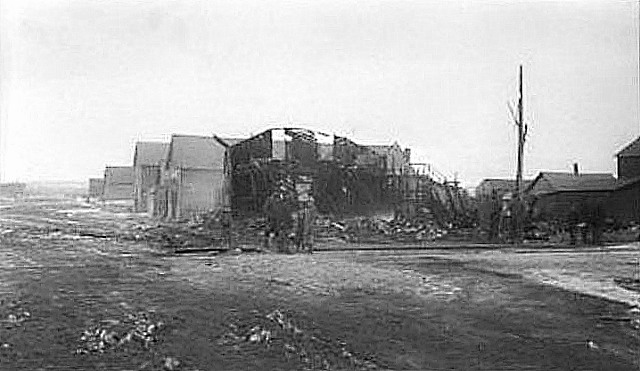
Remains of the Cosgriff Store following the fire. Photo by Leslie C. John.
Leslie C. John (1885-1960), was a certified public accountant who arrived in Rock River in 1909. He was employed as
Secretary of several ranches including the Crescent Cattle Co. and the Rockdale Livestock Co. and served in the State House of
Representatives for one year in 1912. As suggested by the freezing of the town's water supply, winters could ocassionally prove to be
brutal. The winter of 1916-1917 was particularly harsh.
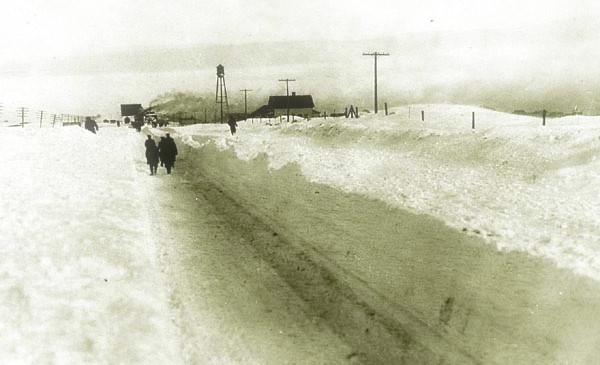
Snow along highway, Rock River, 1917.
As discussed with additional photographs, see Pacific Railroad.
Trains were stuck and ran out of water and had to be towed to Laramie. It is, of
course, an ill blizzard that blows no good. The railroad established a plant
for construction of snow sheds in Rock River.
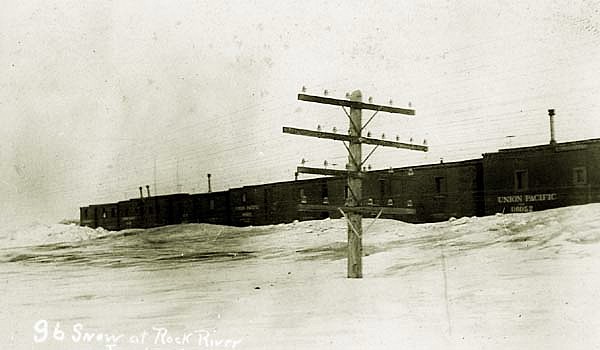
Train blocked by snow, Rock River, 1917.
Upon the formation of the First National Bank in 1919, Leslie C. John served as one of the Directors.In 1918, he formed
the Fair Trading Company, a gemeral mercantile. Following the failure of the Bank, as discussed on next page,
John moved to Fort Worth. See 1940 census and the Morgantown PostAug. 31, 1960.
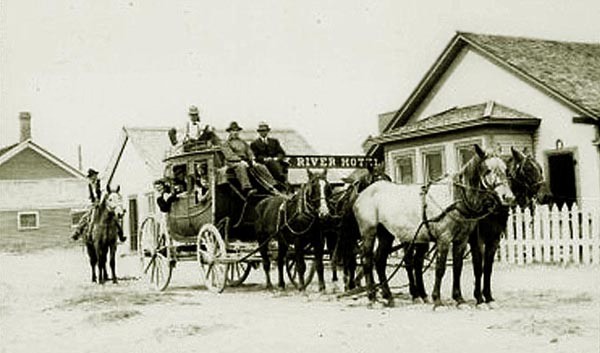
Old Stagecoach from the Patrick Brothers Stageline, July 4, 1911. Photo by Leslie C. John.
For discussion of the Patrick Brothers stageline, see
Dayton. After the stageline north
to Fort Fetterman and the station had been abandoned at Rock Creek, the old stage coach was acquired by
Dorrance "Jack" Linscott. Linscott was a rancher who in 1894 proved up his homestead north
of Rock River just south of the confluence of Rock Creek and Meiser Creek near the old Fort Fetterman Road. There he also mined
what was later known as "bentonite" and sold it as a lubricant for oil well drilling. The mining gave out when the
railroad was relocated.
Linscott was indirectly involved in the saga of
Tom Horn. It is alleged that he rescued Horn's Winchester from Coble's ranch following the
murder of Willie Nickell. Additionally, Horn contended that Linscott could provide an
alibi that Horn was at Alex Seller's ranch north of Rock Creek the morning and evening of the day that
Willie was killed. Horn complained to John Coble that Linscott would not answer his letters.
Horn tried to use Seller as an alibi apparently forgetting that the alibi would conrtradict
his claim that he was in Laramie City. Seller denied the truth of the aleged
alibi.
At the time of the photo, the old coach was owned by J. F. "Sam" White who had
acquired it from Linscott. The Jan 16, 1908, the Laramie Weekly Republican p. 10, commented as to Linscott and White's dogs.
Three dogs had been poisoned. Two belonged to White and one to Linscott. According to the
paper, Jack's "dog could talk and Mr. White's dog nearly as proficient."
The coach was apparently in bad shape. At one point Linscott had overturned the coach in a washout at
Harper Station south of Rock River. By 1908, Linscott's condition was similar to that of the old coach.
In his almost usual "semi-intoxicated state" he missed some steps and fell.
the result was that traumatic gangreme set in one arm and it had to be amputated at the shoulder.
For a number of years the coach was used in parades in Laramie.
Linscott survived the operation, but it probably contributed to his sale of the coach to White.
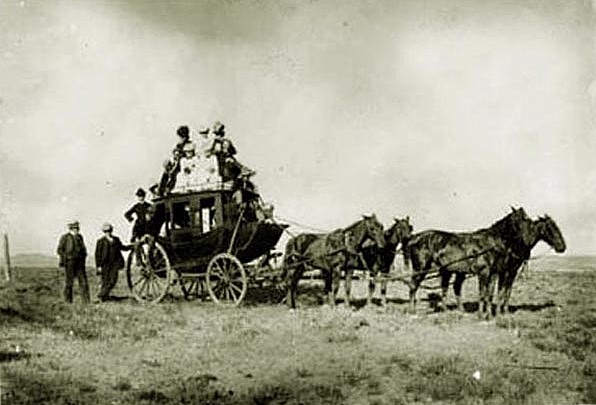
Old Stagecoach from the Patrick Brothers Stageline, undated.
During Linscott's and White's ownership the old coach was used in parades in
Laramie.
By 1923, the coach had been
acquired by Lewis Butler mayor of Rock River and cashier of the Rock River First National Bank.
Money was raided by public subscription to buy the coach and dedicate it to the children of
Rock River. Then the issue arose as what to do with it. It was proposed to build a glass outside display case outside
the school building. Apparently nothing came of that proposal and ultimately it was located
adjacent to the Lincoln Highway for a number of years and until it finally mouldered away.
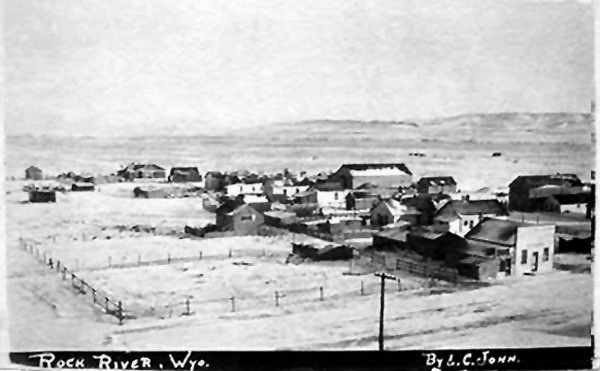
Rock River, 1910. Photo by Leslie C. John.
In 1917, the Ohio Oil Company which had earlier explored for oil at Grass Creek, Ten Sleep, and in the Lance Creek
area turned its attention to an area about 12 1/2 miles south-west of Rock River on the British-owned Cooper Ranch.
There, in conjunction with the Continental Oil Company, in May 1918 the first well came in. Suddently, prosperity came to
Rock River. At the site of the well field, a new oil camp originally called "Ohio City" arose. In 1920,
the oil camp was renamed McFadden after the Rocky Mountain field superintendent for the
Ohio Oil Co, John "Uncle Jack" McFadden. In Rock River, the two-story Lincoln Hotel was constructed. The hotel building is still in existence as a private
residence. The Bishop Land Company laid out a plat for
a commercial district.
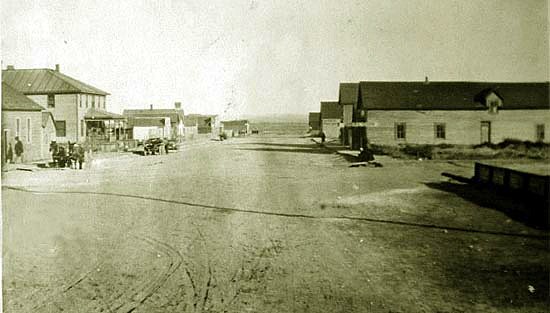
Rock River, 1917.
The town had three banks, the Citizens' State Bank of Rock River, the Rock River State Bank,
and the First National Bank of Rock River. An insignia for the town's success was the First National constructed in 1919 and housed in
a building that looked like a Greek temple with Ionic columns and Doric pilasters. The town was governed by leading businessmen. The treasurer, H. A. Thompson, was the
chief shareholder in the Rock River Mercantile.
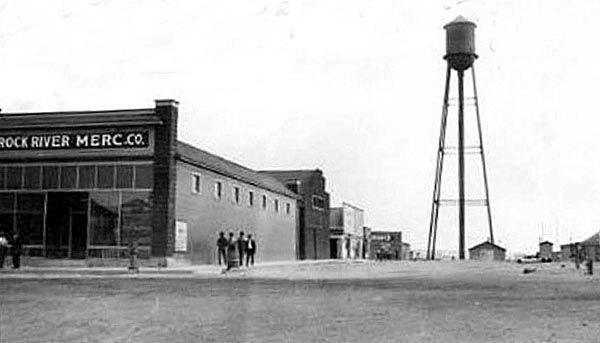
Rock River Mercantile, Approx. 1920 with town
water tank in background.
H. A. Thompson was also the chief stockholder in the First National Bank.
The town's mayor, Lewis C. Bishop, was the cashier of the Rock River State Bank and later the vice-president of the
First National Bank. The town floated through the mayor's bank two $7,000 bond issues to acquire water and sewer systems.
All looked rosy for the town's future.
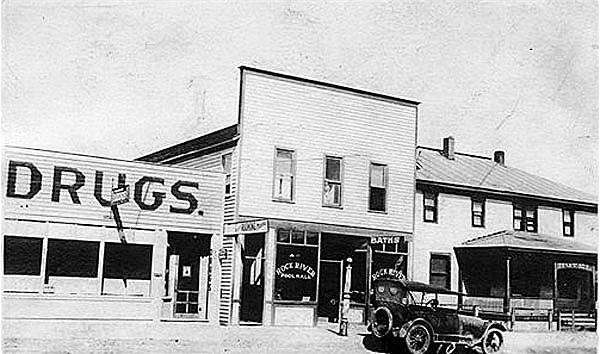
Rock River, 1921
To the left is Miller's Drug Store, in center is
the Rock River Pool Hall also provided rooms and baths, and to right is the hotel.
The pool hall building has now gone to rack and ruin, see subsequent page. Miller's is
gone. The hotel is now a private residence.
A sign of increased prosperity was the soda fountain installed in the Drugstore.
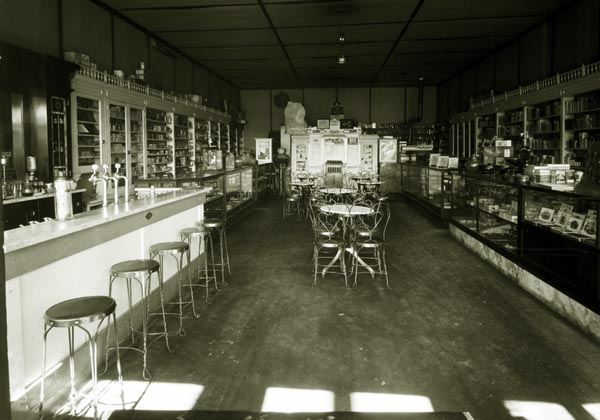
Soda Fountain in Drugstore.
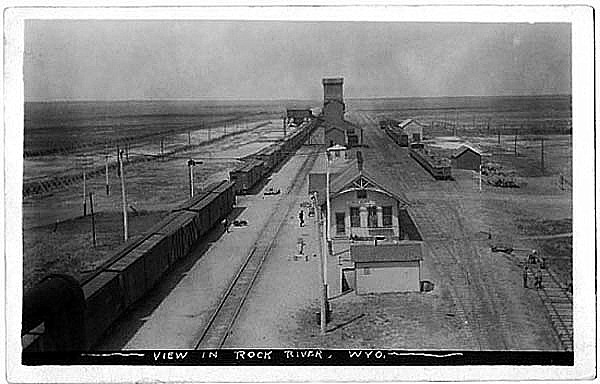
View of Depot, Rock River, from the water tank. Photo by Leslie C. John. Beyond the
depot, the tall structure is the coal chute.
Next: Rock River continued, failure of the Bank.
|