|
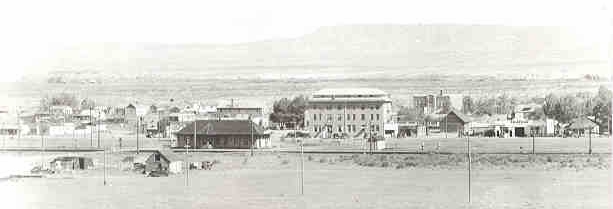
Medicine Bow, 1930's
The Virginian Hotel is in center, fronting on the
Lincoln Highway. The railway depot in the photo was constructed in 1913 after the original burned.
It was moved to its present location in 1954 and now houses a museum.
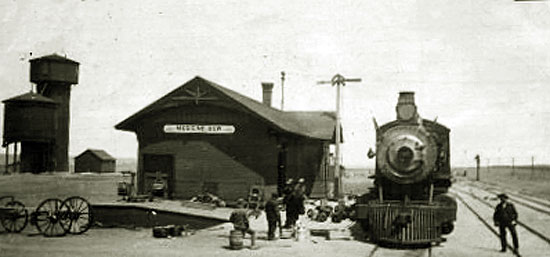
Medicine Bow railway depot, 1907
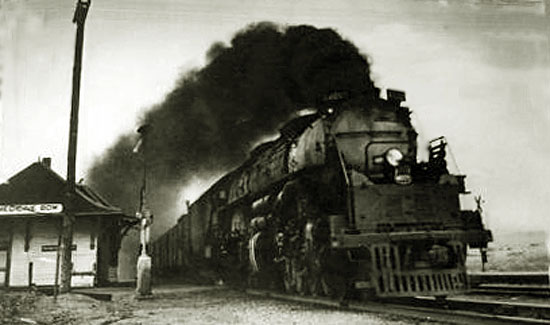
Union Pacific freight pulled by "Big Boy" locomotive passing through Medicine Bow, undated
The Big Boys had a 4-8-8-4 wheel configuration and were capable of pulling long freights at sustained
speeds of 60 m.p.h. The were in service during World War II. The last revenue train pulled by a
big Boy was in 1959. Of the original 25 locomotives built, eight remain in existence including one
in Cheyenne. The locomotives, as indicated by the smoke, burned low-grade coal from mines owned by the
railroad.
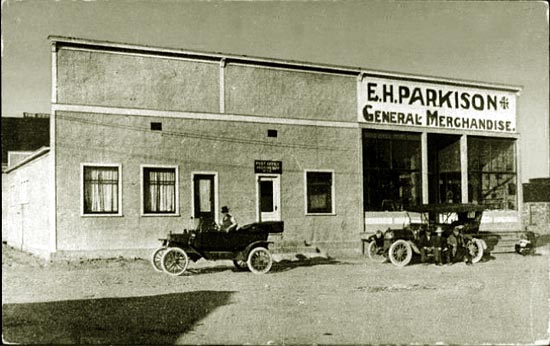
Parkison Mercantile, approx. 1912
Ed H. Parkison (1867-1940) owned general mercantile establishments in Encampment and Medicine Bow which sold
everything from mining equipment to groceries. In 1913 he expanded into Cheyenne purchasing Capitol Grocery. He also had an interest in Copper
mining in Encampment and with his brother, Webb H. "Parky" Parkison, dealt in gold mining stocks in
Goldfield, Nevada. His brother met an untimely end in 1909 at the hand of damsel known as "Bonita" who was an
habitue of a dance hall on the "Great White Way" of Goldfield.
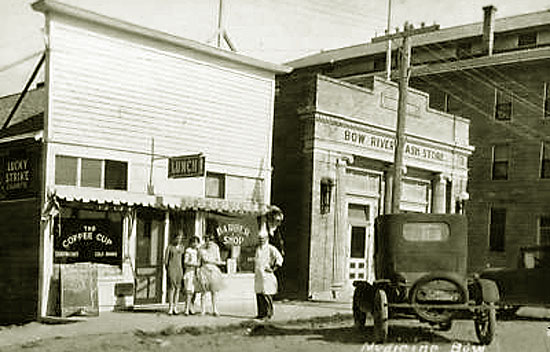
The Coffee Cup Cafe and the Bow River Cash Store, approx. 1920.
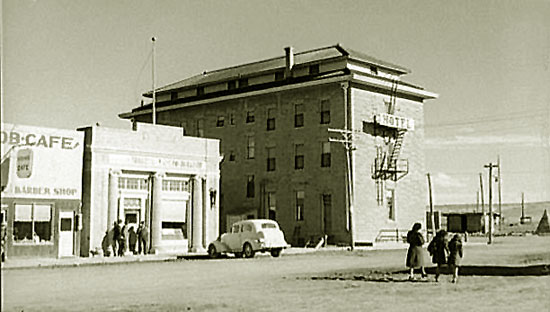
Cafe and store, Medicine Bow, 1940. Photo by Arthur Rothstein.
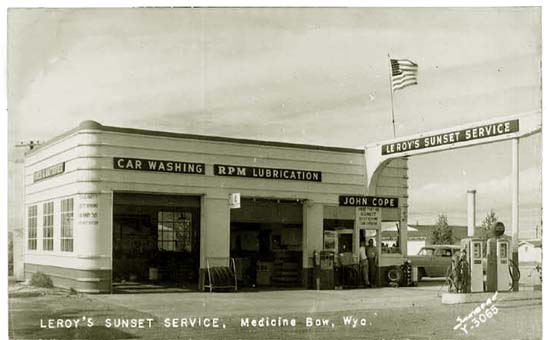
Seroy's Sunset Service, Medicine Bow. Photo by Wm. P. Sanborn, approx. 1952.
The sign above the door says,
"HERE THEY ARE
CLEANEST
RESTFOOMS
ON HWY 30."
With the construction of I-80, traffic was diverted from
Medicine Bow, but in the 1970's the town experienced growth with the advent of low suphur coal and attained
a population of 953 in 1980. The boom ended, however, and the population by 1990
had regressed to 380 and by 2008 an estimated 267.
Next Page, Fort Steele and Parco
|