|
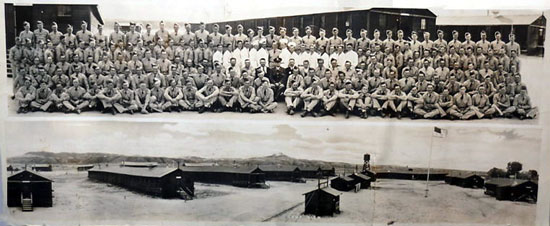
Heart Mountain Civilian Conservation Corps Camp, 1939.
In the 1930's to the west of Powell lay the Heart Mountain Civiian Conservation Corps Camp.
The Civilian Conservation Corps (CCC) was a New Deal Program intented to provide work for unemployed, unmarried young men.
They worked improving governmentally owned properties. They were provided housing and food and paid
$30.00 a month of which $25.00 had to be sent home to their familes.
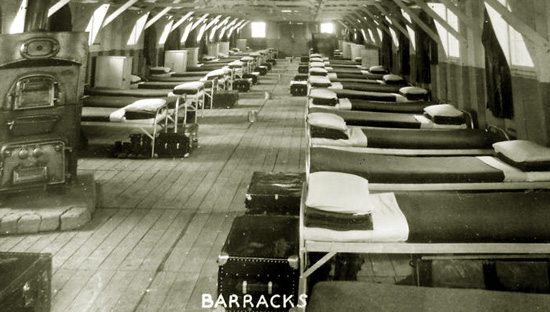
Interior Barracks, Heart Mountain Civilian Conservation Corps Camp, approx. 1939.
Camps similar to that at Heart Mountain
were constructed near Centennial, Yellowstone National Park, and Devils Tower National Monument .
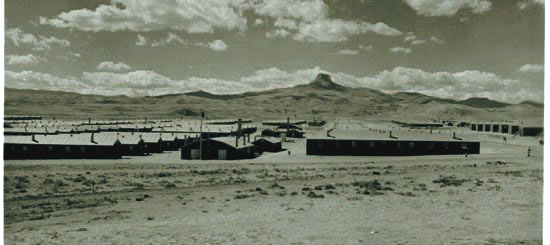
Heart Mountain Relocation Camp, Wyoming.
In 1942, President Franklin D. Roosevelt issued Executive Order 9066 which
excluded from coastal areas of the west coast persons of Japanese descent. It mattered not that an estimated two-thirds of the individuals
were born in the United States and under the Constitution were citizens. Nor did it matter that of that two-thirds over an estimated
70% had never even seen Japan and had been eductated as Americans. Thus, some 11,000 persons were settled in the camp constructed of tar paper
barracks. Additional building were moved to Heart Mountain from the Yellowstone CCC Camp to be used as chicken coops. Of the buildings moved from
Yellowstone, those that could not be used for the chickens were used at Heart Mountain to house the
elderly, for a tofu factory and as a grade school for children. It has been estimated that two-thirds of those relocated to various
camps in the interior west were, in fact, American citizens. Those relocated were required to sell their busnesses, homes,
automobiles, furniture and other personal possessions. Some personal possessions were stored in government warehouses in
San Francisco. Those shipped to Heart Mountain who managed to have some of their personal possessions shipped to
Park County were not permitted to claim and of their electrical appliances. In California, the
State Assembly passed a bill authorized the State to seize farm equipment of those shipped off to the camps. One of those sent to
Heart Mountain and who died there was Clarence Uno an American Citizen who had served in the American Expeditionary Force in
France during World War I. Following his death, he was given an American Legion Service and cremated wearing his
American Legion uniform.
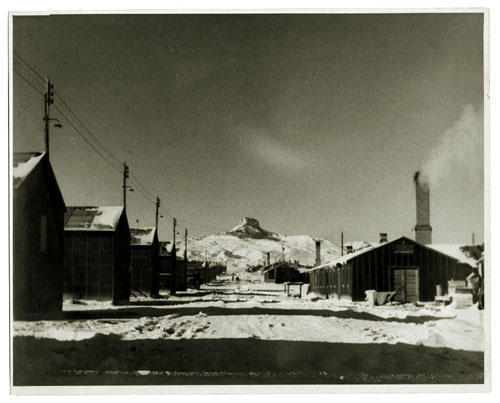
Heart Mountain Relocation Camp, Wyoming.
Conditions in the camp were miserable. Not withstanding the protests of the residents, the camp was surrounded by barbed wire fences with
guard towers. January, 1943 saw tempeatures as low as twenty-eight degrees below zero. In the late summer there were flies from a nearby
hog pen. There were so many flies, that a contest was conducted for children who could kill the most flies. Sicty-five thusand three hundred flies were killed
in a single week. Max Tachibana won the contest killing 40,000 flies.
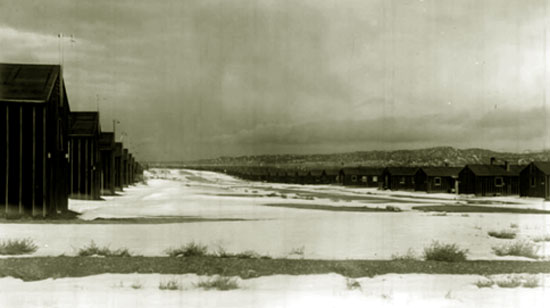
Heart Mountain Relocation Camp, winter.
The residents made the best of it and
under the leadership of Tats Acki
constructed a skating rink for the children.
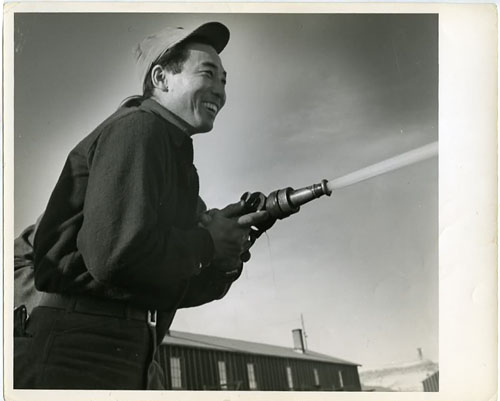
Flooding the skating rink, Heart Mountain Relocation Camp, 1943
The Director of the War Relocation Authority, Dillon S. Myer, defended the actions of his agency in
a national radio program by telling the audience that the relocation to camps was not like the Nazis or the Facists, it was, he said,
the work of WRA was to temporarily house
100,000 Japanese people who were evacuated from the
Pacific coast and to assist "elibible
evacuees to relocate in normal communities where they
can contribute in the war effort like other citizens and law-abiding
aliens."
Those relocated to the camps were not referred to as prisoners; they were "evacuees." The camp was hardly a normal
community. The "evacuees" were not permitted outside the gate without a pass which had a number of requirements to it.
Cody and Powell required that any evacuees have an escort. Passes were difficut to obtain and had to be applied for
in advance. Residents were told through their newspaper that they were better of living in "liberty" within the
barbed wire rather than having to face the economic conditions outside. Nevertheless, the evacuees attempted to
make somewhat of a normal community. A girl Scout troop and a boy scout troop was formed, a parent-teachers association was
formed, regular church services were conducted, and a YMCA was formed. Additionally some self governance within the camp was permitted.
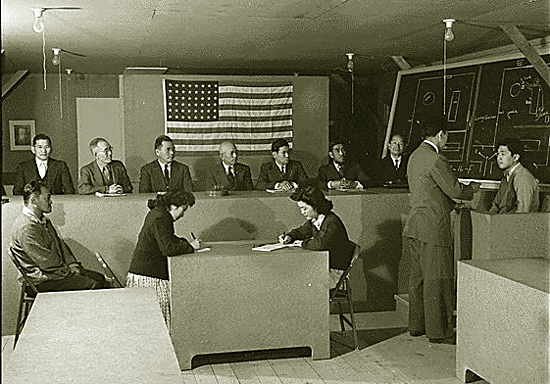
Court proceeding in Heart Mountain Relocation Camp.
The residents established a newspaper, the Heart Mountain Sentinel from which most of the information about camp life on this
page was taken. The paper was edited by Bill Hosokawa, formerly an editor
of the American style English lanquage Singapore Herald. Hosokawa was born in Washington State and was a journalism
graduate of the University of Washington. Unable to obtain employment as a journalist in the United
States he had taken the job in Singapore, but returned to the United States several weeks before the war in
the Pacific broke out. Thus, he escaped internment by the Japanese when Singapore fell. Instead, he was gathered
up with others in the Pacific Northwest and shipped to the camp at Heart Mountain. One method of escaping from
the camp was to obtain employment other than on the west coast. Hosokawa ultimately obtained a job with the
DesMoines Register. Later he was employed by the Denver Post from which he retired in 1984.
Hosokawa is the author of Nisei: The Quiet Americans (New York: W. Morrow, 1969). A high school was established in tar paper buildings moved from the CCC camp. The High School had a football team which played
other high schools in the area and on one occasion played the State Champion team, Natrona High School.
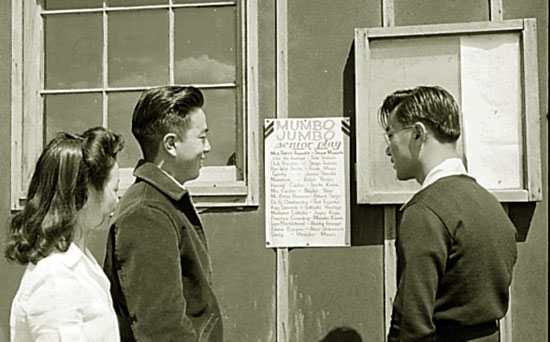
Students viewing poster for Senior Class play. L. to R.:
Janice Shiota, Teruo "Ted" Fujioka, Shogo Iwasaki. Fujioka was student body president and Iwaskaki
student body vice-president. War Relocation Authority photo by Bill Hosokawa courtesy of National Archives.
One of activities promoted by Fujioka was moving a flag pole from the CCC camp so that an
American flag could be flown in front of the school. At first, some of the residents from Hawaii formed a band, the Surfriders Hawaiian Band. The
band was disbanded due to the relocation of its members. An orchestra under the leadership of
George Igawa which provided music for dances and other activities.
Later in the war,
a USO was established for boys from Heart Mountain returning home on leave before shipping out for Europe. In 1943, the government
allowed American citizens of Japanese ancestry to enlist in the Army. From Heart Mountain several served on the Italian Fron. In July,
1944, Lt. Kei Tanahashi and Cpl Yoshiharu Aoyarna both of whom were killed in July. Three families each had three sons serving.
Many of those from the mainland were assigned to
the 442nd Regimental Combat Team. The 442nd was ultimately assigned to a unit from Hawaii composed also of
those of Japanese descent. One of thosen enlisting was Ted Fujioka.
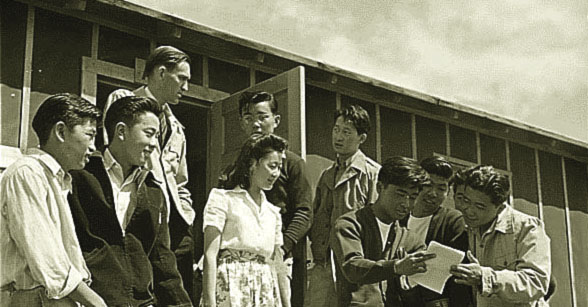
Students with Assistant Principal Ralph Forsythe.
War Relocation Authority photo by Bill Hosokawa courtesy of National Archives
On November 22, 1944, the flag in front of the school was lowered to half mast. Word was received that
Ted Fujioka was killed in action on October 26 in the battle for the liberation of Bruyeres in the Vosges Mountains of eastern
France. Hitler had issued orders that the town was not to fall. It was part of the essential German defenses in preventing
the American, British Commonwealth, and Free French forces from crossing the Rhine. Fighting before Bruyeres commenced on September 30 and lasted 19
days. During the battle a unit from Texas, known as the Lost Battalion, was surrounded by German forces. The 442nd fought their way through the German lines rescuing
the Texas men. The 442nd suffered 800 casualties in saving the Texans. Fujioka received a Bronze Star with
Oakleaf Cluster. In all, some 15 men from Heart Mountain Relocation Camp were killed in action in
France and Italy. Today, in Bruyeres Rue du 442eme Regiment Americain d'Infanterie commemorates the sacrifices
of the 442nd. Ted Fukioka's final resting place is in the Quequement American Military Cemetery near
Epinal, France.
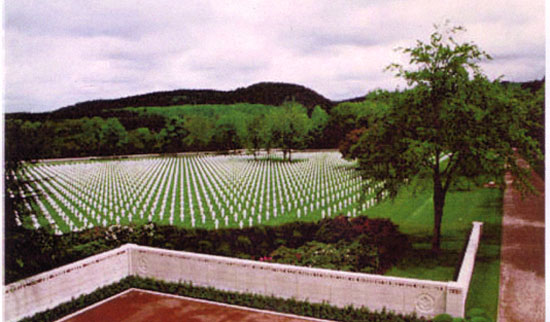
Quequement American Military Cemetery, Epinal, France.
Next page: Lovell.
|