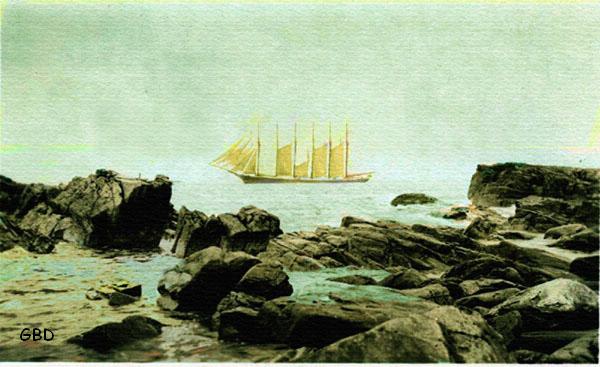
The Schooner Wyoming off the coast of Maine.
During the period 1907-1909, three wooden vessels came down the ways in
New England each of which had a distinct relationship with Wyoming. One was the longest wooden ship in the world. Another had to be abandoned off the
coast of Uruguay and was burned like a Viking long ship and finally dynamited to preclude it from being a
hazard to navigation. The third ended her days in a fishing fleet working out of
Pensacola, Florida.
The most famous of those vessels was the six-masted schooner Wyoming constructed
at the Percy & Small boatyard, Bath, Maine, in 1909. The ship was the longest wooden ship ever constructed, 329 feet long. Besides its
name, major investors were from Wyoming.
Two years earlier Governor Governor Byant B. Brooks invested in a five-masted schooner named in his honor, the Governor Brooks. Supposedly
Governor Brooks made private investments in four ships constructed by Percy and Small.
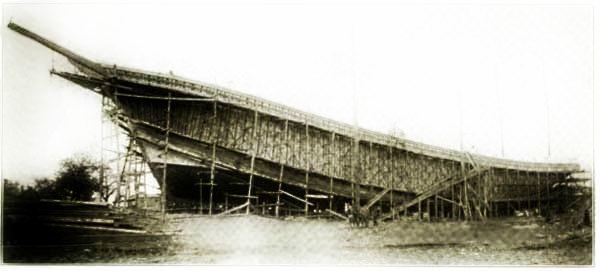
The Wyoming under construction, Bath,
Maine, showing the framing.
To preclude the frame from "hogging" [racking] in heavy seas, the ship's timbers were tied together with diagonal
iron straps visible in the above image.
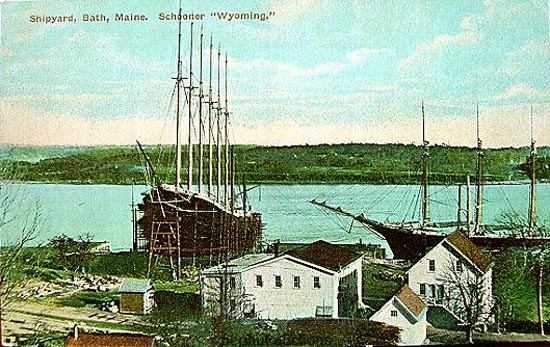
The Wyoming under construction, Bath,
Maine, 1909.
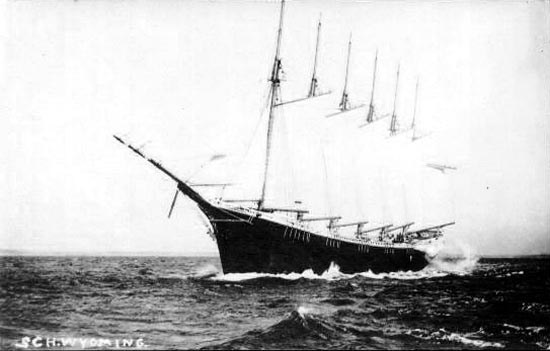
The Schooner Wyoming
At the ship's christening, she was sponsored by Lena Natrona Brooks (McCleary), the daughter of
Wyoming Governor Brooks.
Both the Goveror Brooks and the Wyoming were constructed for the purpose of
long distance transportion of coal. On the Wyoming's maiden
commercial run from Baltimore to Boston she carried 5,822 tons of soft coal.
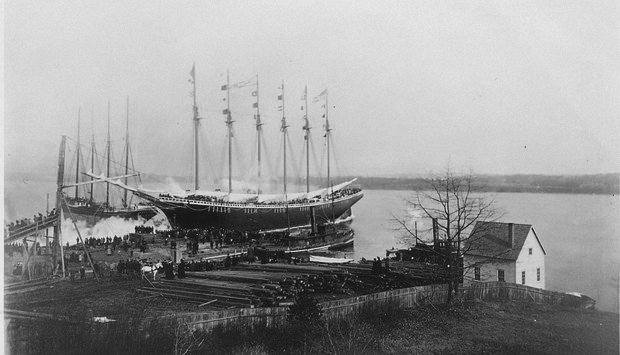
The launching of the Schooner Wyoming
At the time of the ships' construction there was still a need for bulk
cargo ships propelled by sail. Although most merchantmen were coal fired steamers, delivery of coal supplies to distant points was expensive.
Coal fired ships did not have a great range due to the bulk of coal. As an example,in the 1890's, the HMS Powerful and the HMS Trrible had the largest coal
bunkers afloat, but without replenishing coal along the way, neither ship could make it to China. The German Imperial Navy's Gefion at the time of the Boxer Rebellion
had the greatest
range of any ship in the German Imperial Navy, approximately 4,000 nautical miles. From Hamburg to Shanghai in a straight line is 4753 nautical miles. The distance was far greater around through the British
owned Gibralter, past Malta and through the Suez Canal. Britain had coaling stations in Gibralter, Malta, Alexandria and
Aden. Indeed, it may be said that the reason the Royal Navy ruled the waves was that Britannia ruled the coaling stations. No foreign fleet could venture forth without the risk of
not getting home. In showing his flag in China, the Kaiser had to rely on British owned coaling stations. At the end of the Spanish-American War troop ships returning American troops from the
Philippines had to re-coal in Japan. Similarly when President Theodore Roosevelt dispatched the
Great White Fleet, the Navy had to rely on some thirty British registered vessels to provide coal suffient to get the fleet from Hampton Roads to San Francisco. The Navy was able
to contract with only eight American Registered vessels. The American merchant marine had not yet recovered from its decimation during the Civil War.
At the time of the Spanish-American War,
the United States had no foreign coaling stations. Even after the United States took control of the
Philippines, and established its own coaling station there, it had to rely on
New Zealand and Australian coal and obtained much of its coal used on ship in the North Atlantic from South Wales (soft coal was not really suitable for
maritime use). Thus there was a demand for large sailing ships for long distance transportaion of coal.
Coaling stations had to be established along the various sea routes so that
the steam vessels could be re-coaled. Sail provided an inexpensive method of delivering coal to far flung ports. Sailing colliers such as the Wyominghad the
advantage of unlimited range and were inexpensive to operate.
The Wyoming was so equipped that it could be operated by
a minimal crew of thirteen. The Wyoming represented the highest development in the
construction of wooden sailing vessels. Hoisting of sails was accomplished using a gasoline powered
donkey engine. On board, members of the crew could communicate with each other with telephones. The
ship was fitted with wireless, steam heat, and hot and cold water. She cost $175,000 (in 1909 dollars) to construct and measured
3,730 tons. "Tons" when used with regard to a vessel refers to the volume of the ship not its weight. One ton equals
100 cubic feet of volume using a formula originally created in 1773. The total internal volume of a ship is its gross tonnage. Subtraction of that portion of
the ship not used for cargo will produce the net tonnage. The total weight of the vessel laden is the displacement measured in long
tons of 2240 lbs. The weight of the vessel is determined by subtracting from the displacement the difference in
displacement when the ship is fully unloaded. The Wyoming had 3730 gross tons, 3036 net tons, and 6004 tons deadweight. The purpose of
the measurement of tonnage was to determine port dues.
From its time of their launching until 1917, the ships regularly paid dividents to its investors so that by 1917, the investors had fully recovered
their inial investments. With the war, the Wyoming and the Governor Brooks and several other vessels managed by Percy and Small
were sold to France & Canada Steamship Line in New York. [Writer's note: There were two corporations named
France and Canada. One was incorporated in New York and the other in Quebec. The ships were sold to the
New York corporation.] The Wyoming brought twice what it originally cost to
build and equip. The Philadelphia Enquirer, Jan. 20,1922, put it at $425,000. During the war, the ships carried bulk cargo to Europe and elsewhere, indeed as far away as
East Africa. Following the war the Wyoming
sold for $36,000 along with the Governor Brooks and the Cora F. Cressey and other vessels originally constructed by Percy and Small.
They was put back in service carrying coal.
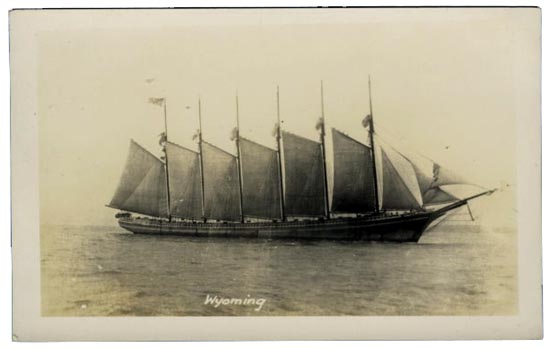
The Schooner Wyoming
With the Wyoming's great length, a problem developed. In heavy seas not withstanding the iron strapping, the ship's frame tended to hog or
buckle, loosening the planking. Thus, the ship generally required the use of pumps. In late 1924, the Wyoming proceeded from Boston to
Norfolk, Virginia, to pick up coal needed in St. John, New Brunswick, where there was a severe shortage of coal due to a strike in Canada.
Norfolk was one of the few ports in the United
States able to provide coal which came from northern Virginia and Pennsylvania.
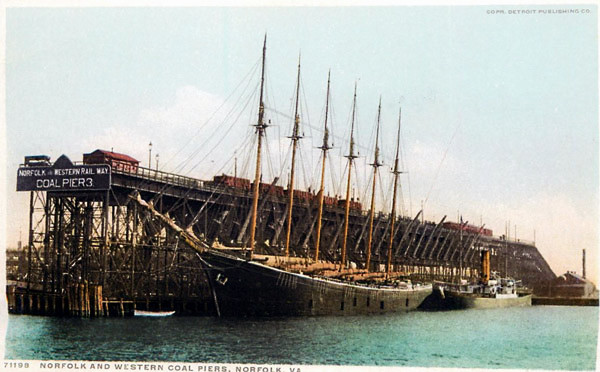
Unidentified six-masted schooner at the Norfolk & Western Railway coal pier 3, Elizabeth River, Norfolk, Virginia. Detroit Publishing Company
Phosphint image.
The schooner Governor Brooks also regularly took on coal at Norfolk.
From newpaper reports the Wyoming was employed carrying bulk loads of coal southward as far as Argentina and
carrying other bulk loads such as fertilizer and grain back. In December 1915, she
was carrying a load of linseed on a return from Argentina. One hundred miles Southeast of Hatteras she ran into six hours of hurricane force
winds in which her rudder head was sprung
and lost her sails. she had to be towed into a port in North Carolina.
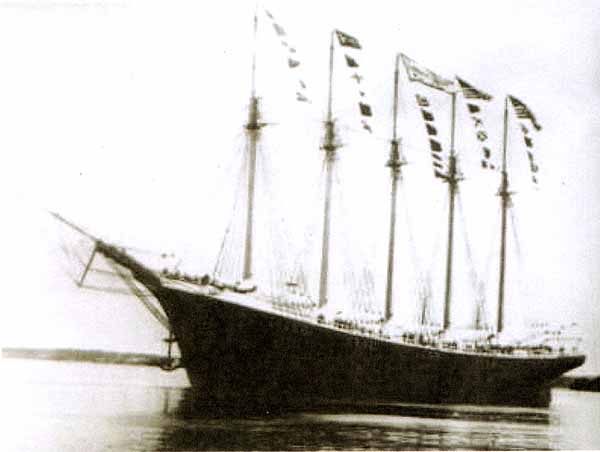
The Schooner Cora F. Cressey, 1902
The Governor Brooks cost $132,000 (in 1907 dollars). Investment in the ship were made in shares. Shares were purchased
by Governor Brooks, his ranching corporation B.B. Brooks Company, and his brother John.
Others from Wyoming who invested in the ship
included the Richardson Brothers of Cheyenne, John H. Fullerton from
Cheyenne; Harold Banner from
Glenrock; Patrick A. Sullivan from Casper;
and J. D. Woodruff from Fremont County.
The Richardson Brothers (Warren Richardson, Jr, Clarence Richardson and Emile Richardson) had constructed the
Tivoli Building and were involved in financing mortgages. All except Fullerton had interests in livestock (mainly sheep) and banks.
Fullerton was the general manager of the Inter-Ocean Hotel in Cheyenne.
The ship' s insignia was a red
"V - V" matching the governor's cattle brand. Due to the unusualness of the insignia, one spectator at the Launching allegedly
commented: "I never
saw it in a code book and suppose it
is some Masonic sign." There may have been a reason for such supposition, all of the investors from
Wyoming, were comparitively high-ranking members of the Masonic
fraternity (Scottish Rite). Brooks, himself, later became the Grand Master of the Grand Lodge of Wyoming.
With the success of the Governor Brooks, the list of investors in the Wyoming two years later grew and included in addition to the previous
ones such luminaries as brewers and
soda pop bottlers the Hofman Brothers, Amelia Kent (maiden name for Amelia Kent
Barber wife Amos Barber) and major landholders. All were politically savy
with the exception of Democratic Party stallwart Leopold Kabis whose wife Nellie appears on the list of
investors. In 1893, he figuratively relieved himself in his mess kit which resulted in his being censured by the state Senate.
The New York Times, Feb. 20, 1893 in a non-judgmental and unbiased
fashion explained:
In the State Senate last night the Republicans unseated a Democratic hold-over and
censured another member of the party. The gentleman ousted is James Kime of Fremont. The flimsy charge
hurled against him was that he was a postmaster. Kime resigned his Federal position Dec. 31, and, failing to get relieved, turned the office over to his
bondsmen. He had documentary evidence, but a statement from John Wanamaker said that he was still "legally" Postmaster. He will be returned by his people.
The member reprimanded wus Leopold Kabis of this town, a leading
German of the State. He was disgraced on trumped-up charges that he had
aided in an attempt to procure the absence of Kline from a joint session.
Kline was put out before this matter was taken up, and was not allowed
to speak on behalf of Kabis.
And what did Senator Kabis do to his fellow Democratic senator "Uncle Jimmy" Kime [See Larson, p. 288] to warrant such action.
H allegedly participated in bribing an
individual to give Senator Kime a poisoned wine cocktail. "Men of Wyoming" referred to kabis as an
"unadulterated and absolutely pure" Democrat. The Daily Sun, February 25, 1893, p.3 was less kind referring to him as
"pompus and thickpated.' Possbly in recompense for the infamy visited upon him,
Kabis was apppointed by Governor Osborne as Adjudant General. He was
an Odd Fellow and the first Exalted Ruler of Cheyenne Lodge No. 660 of the Elks.
General Kabis died in 1919.
Close to his death bed, he instructed Nellie to spread his ashes over the windswept prairies east of
Cheyenne. In compliance with his wishes. she did so. For her efforts she was sued by Emile Richardson and A. R. Johnston demanding that,
pursuant to Kabis' will, the ashes be turned over
to them so that he could be interred in the Elks Rest Cemetery and a $500 monument could be erected in his memory. Besides the ashes having already been
spread to the winds east of Cheyenne, there was another problem. There was no Elks
Cemetery. Judge Mentzer rules in favor Nellie. She did not have to go out to the
prairie and gather up her husband's ashes. See Wyoming State Tribune,
July 16, 1920., p. 1.
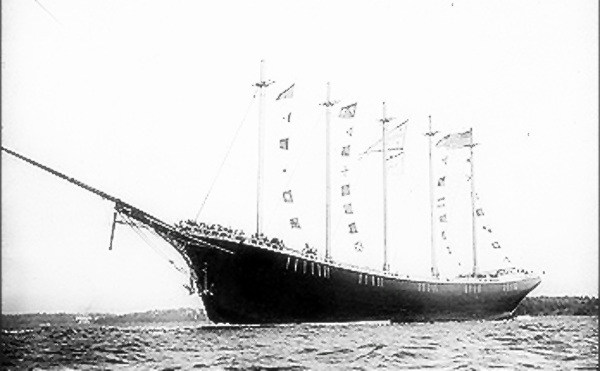
The SchoonerGovernor Brooks, 1907
In 1920 the Governor Brooks was carrying a load of
coal from Norfolk to Uraguay. As she crossed the equator, she ran into a storm which necessitated her putting into Rio de Janeiro for repairs. There another ship collided with her, extending the time for
repairs. The coal had to be off-loaded by hand. In port at the same time was the ill-fated five-masted Carrol A. Deering delivering a load of coal. On December 2, 1920, the Carrol A. Deering
cleared Rio de Janeiro. She never made it home. The fate of her crew is an unsolved mystery of the deep. It took another three months for the repairs to the Governor Brooks to be
effectuated. In March, she finally resumed her voyage to Montevideo. On the way, the leaks reappeared and finally the ship had to be abandoned. A British freighter discovered the abandoned
vessel and her crew. Because the Wyoming was a hazard to navigation, the British ship set the Governor Brooks on fire as if she were a Viking long ship.
But she refused to die and she finally
had to be dynamited.
As to the Wyoming, in 1924, perhaps several members of her crew had a premonition of disaster. On January 7,
one of the mates on the Wyoming disappeared.
Captain Charles Glaesel explained in a note:
To the U.S. Shipping Commissioner
Boston, Mass.
Gentlemen,
I hereby report the disappearance of John G Peters from the Schr. �Wyoming� of which I am Master. Peters came on board the Schooner 11 A.M. Jan. 7th, 1924
when the ship was tied up at Winnisimmet Ship Yard, Chelsea.
About 6 P.M., he went to his room and to bed.
Next morning the man could not be found on the vessel.
A note was found on his desk directing that his Watch and valuables be
turned over to Parties in Boston. The Note also read. Good Bye.
Watch, Money, Note and Papers were turned over to Police Headquarters,
Chelsea, Mass. His Clothes, Sailors Bag and Suit Case forwarded to your
office.
Yours truly,
Chas. Glaesel
Master
Schr. Wyoming
The ship arrived in Norfolk on February 20, 1924. On March 3, after taking on coal, the ship's cook, 23 year old
Soren M. Pederson, a former oil rigger from Texas, left the ship along with one othr ship mate.
The two were replaced. the ship with a crew of
13, left Norfolk bound for
St. John, New Brunswick, where there was a shortage of coal due to a strike.
On March 10, a nor'easter hit the coast of New England. The Wyoming
was seen at dusk that day by the Cora F. Cressey
off the Pollock Rip Lightship. The Cora F. Cressey was a near duplicate of the Governor Brooks launched from
Percy and Small in 1902. The Wyoming was apparently anchored in an effort to ride out the
storm. The area was the same, as noted below, in which the fishing schooner Washakie in 1915 lost
a number of its dories. The lightship, itself, in 36 hours of gale force winds was thrown on its beam ends
and shipped heavy seas notwithstanding that it was running its engine. The lightship was lost with all hands on
September 14, 1944.
Greenfield Daily Recorder on March 14, 1924, reported the names of the crew of the Wyoming presumed to be
lost:
Capt Charles Glaesel, Boston;
first mate Augustus Lundahl, Cambridge;
second mate, Orrin McIntyre, Boston;
engineer, Wiliam Allen, St. Jude,N.B;
seamen, Edwward Rollins, Cambridge;
John Lopez, Boston; John Medina, Norfold, Va;
Frank Smith, Huntsville,Mo.;
Jacob O. Gammon, Boston; Antonio Santos, Norfolk;
E. V. Covineau, Boston, and Pedro Borrios, Boston;
cook J. Peterson, Boston On March 16, the Portland Press Herald reported that several life belts from the Wyoming had been found.
Other reports came in that the name board and a 72 fts. section of a mast had washed ashore on the north
end of Nantucket. One other vessel was lost, a rum runner, name unknow. Seventy-nine years later the remains of the
great sailing ship were found. On November 8, 2003, the Cape Code Times reported that the remains of the
Wyoming had been found at a depth of 65-70 feet. The ship had broken midship. One of the members of the company searching
for the vessel speculated that with the heavy seas, the ship laden with a full load of coal had
hit bottom in a large trough breaking the keel.
The work of the seamen onboard the great coal schooners was a dirty one and hard one. In some ports the coal had to be unloaded by shovel. Each member of the crew participated.
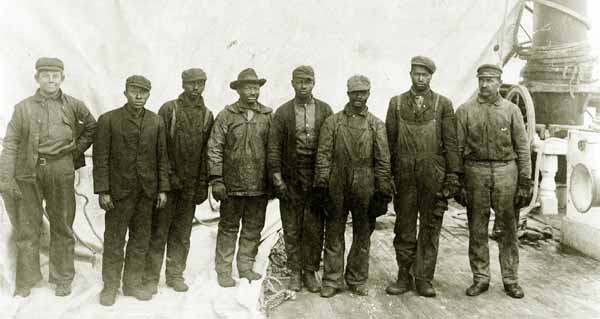
Seamen of the Wyoming, undated.
The Washakie, launched in October 1909, was constructed in the Richard T. Green shipyard in Chelsea for Captain Elias A. Malone.
Malone was a commission merchant in Boston. The vessel was
fitted out in Gloucester. The vessel was a two-masted "knockabout" schooner. She was 100 feet long, 21 ft. beam and 9 ft. 7 inches deep.
Knockabout schooners were originated by Thomas P. McManus of
Boston. They eliminated the necessity of a bowsprit by lengthening of the bow. The Washake
was used for long lines fishing. The vessel was regarded as the
final evolution of a fishing schooner. See "Portrait of Port Boston, 1852-1914,"
The fishing was conducted from dories. The expression "the fog bound coast of
New England," is not without meaning. A danger in fishing from dories is that in the fog the
dories could become separated from the mother ship.
In 1913,
the Washakie lost two dories, but the men were able swim ashore on Cape Cod somewhat worse for the wear.
In June, 1915 wire services reported:
LOST GLOUCESTER, Mass., June 5. - The fishing schooner Washakie, of Boston, put into this port today
in charge of the cook and one fisherman, the other twelve members of
the crew having heen lost in the fog, while fishing from dories on Sunday,
when thirty miles off Nantucket. The schooner's crew could not find the
fishermen in the dense fog.
The rest of the crew was rescued by men from two separate light ships.
Sometimes the crews lost in the fog would be picked up by a passing steamer. If the steamer was heading east, that might be
Queenstown [present day Cork] or Liverpool. But oft times, the fishermen
would never be heard from again. In 1916,the Washakie was sold to the Warren Fish Co. of Pensacola, Florida,
1920 and used for Grouper and Red Snapper fishing off the Campeche Banks in the
Gulf of Mexico. Andrew Fuller Warren (1842-1919), the founder of the fish
company, originally came from Massachusetts. The company he founded
continued to use excusively sail at least until the 1950's. Sail, of course, made sense inasmuch as
the fishing ground were approximately 700 miles from Pensacola. The company finally closed in 1959.
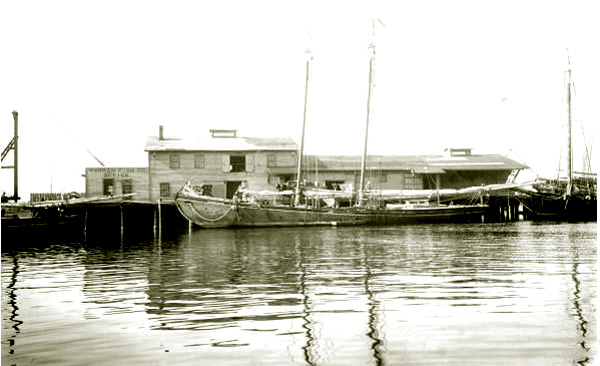
The Washakie, at the Baylen Street Wharf, Pensacola, Florida, approx. 1920. Photo courtsy of
the Florida Bureau of Archives.
The Warren Fish Co. owned the Baylen Street Wharf in downtown
Pensacola. In 1920 the company owned 18 fishing schooners the majority of which were constructed in New England, although about
five were constructed near Milton, Fla. Many of its fishermen were from New England. However, as pointed out by Jason Thomas Raupp in his
"Hook, Line, and Sinker, Historical and Archaeological Investigations of the Snapper Wreck (8SR1001) Masters Thesis University of West Florida, they were regarded
as "motley crews of nomads" drinking up their shares in the bars along Palafox Street or by frequentling other
facilities for lonely seamen on Liberty Street. Raupp quoted one captain: "The cheap wine they sell in those Palafox bars is a bigger
menace to the snapper industry than any hurricane." The years did not relieve the thirst of fishermen employed on Warren Fish Company vessels.
In Bass v. Warren Fish Company, 146 F. Supp 742 (1956), reversed on
other grounds 245 F. 2d 43 (5th Cir. 1957), the court noted as to the crew of another of the
company's boats, "The evidence indicates strongly that most of the crew, including plaintiff, that left on the Francis
Taylor were intoxicated when the vessel left port and remained in an
intoxicated condition until the vessel arrived at the fishing grounds
some five days later."
Next page: Back to the beginning, Fort Laramie
|