| Photos From Wyoming Tales and Trails This Page: Presidential visits continued, Theodore Roosevelt, Warren G. Harding; Thomas Moran. |
![]() |
|
|
|
About This Site |
|
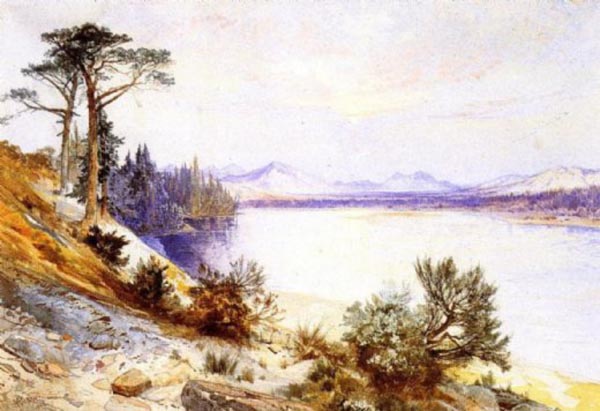
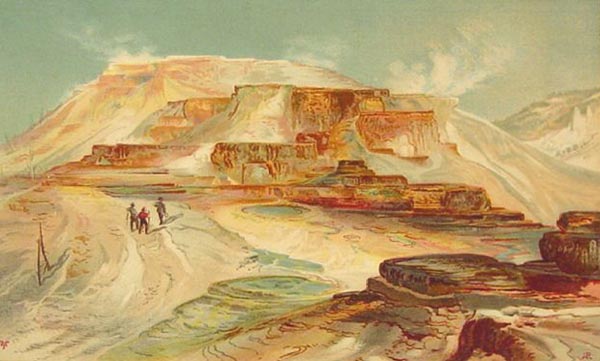
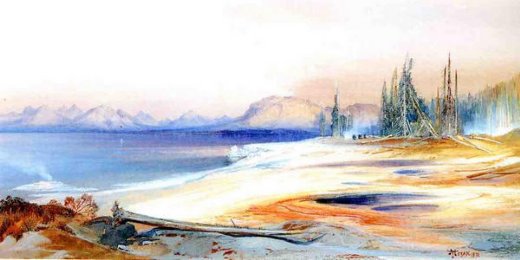
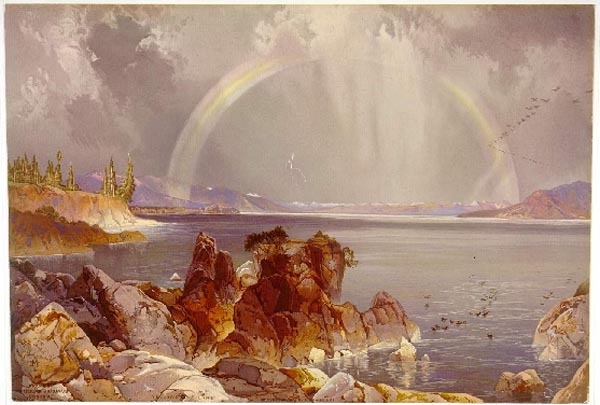
![]() "The Southern Arm of the Yellowstone Lake, Yellowstone National Park, Wyoming Territory," Chromolithograph of 1874 watercolor by Thomas Moran, published by Louis Prang & Co., 1875. In 1875-1876, Louis Prang (1824-1909), reproduced 15 different watercolors of Yellowstone painted by Thomas Moran. Prang was a native of what is how Poland and arrived in the United States in 1850. He is credited with, among other things, inventing the Christmas card.
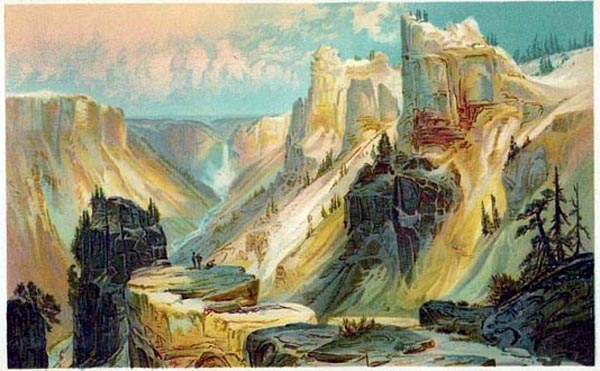
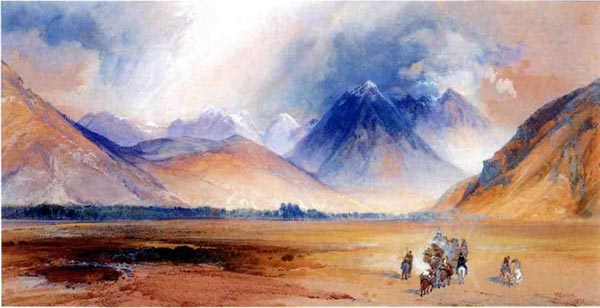
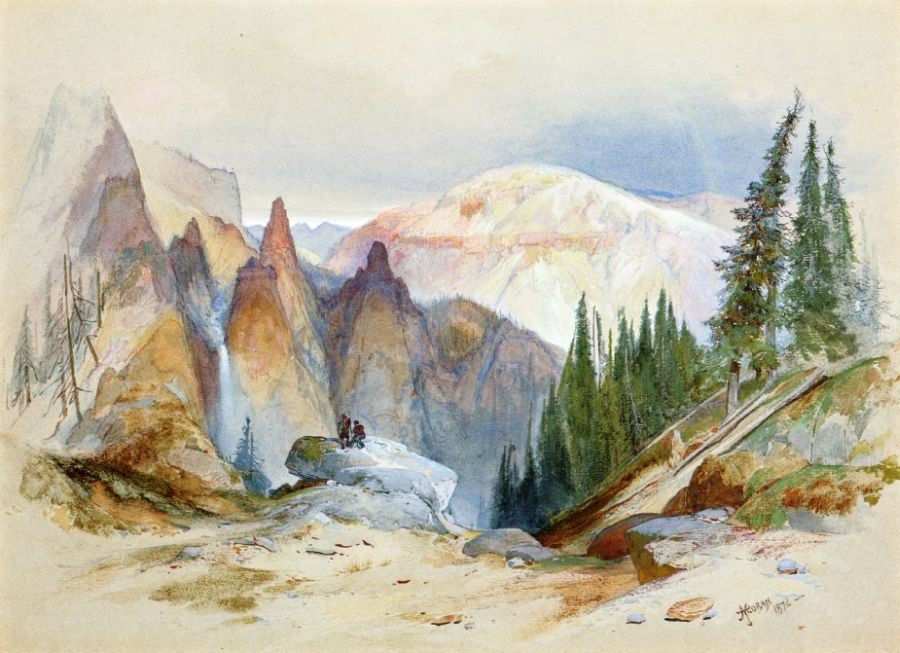
![]() Grand Canyon of the Yellowstone, Thomas Moran. On the expedition of 1871, Moran spent four days at the Upper Falls sketching and photographing. The subsequent paintings were made from those sketches and photographs.
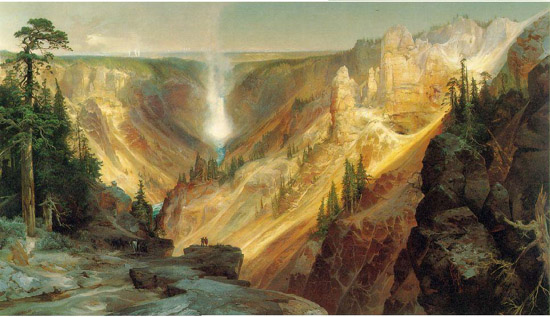
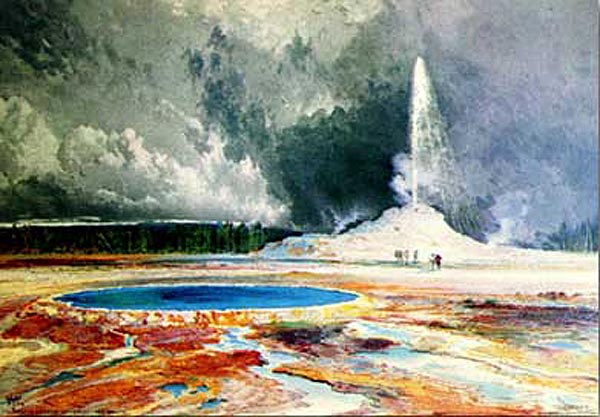
![]() Grand Canyon of the Yellowstone, Thomas Moran. Discussion of the formation of the canyon is on a subsequent page.
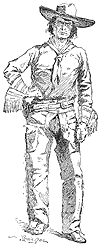
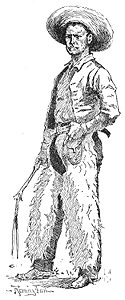
Brothers Elmer Underwood (1859-1947) and Bert Underwood (1862-1943) established a photography distribution business in Ottawa, Franklin County, Kansas, about 1882. As the business of selling stereoscopic photos grew, the moved to New York City where their company became the leading supplier of news photos to magazines and newspapers. The company relied on numerous freelance photographers to meet their demand. In addition to the sale of stereo views in boxed sets door-to-door, the company also sold postcards. Eventually, the company sold the stereo view business to the Keystone View Company and devoted its attention solely to news photos. Roosevelt took an early interest in the west and owned a ranch in Dakota Territory. In 1885 he published his Hunting Trips of a Ranchman which was reviewed by George Bird Grinnell in his Forest and Stream. In the review Grinnell commented about Roosevelt's "limited experience." The review got Roosevelt's immediate attention with Roosevelt demanding an audience with the intrepid Grinnell. Whatever happened at the interview, it led to a friendship between the two. Roosevelt was also, as a result of his connections to the west and Wyoming, a friend of Owen Wister and Frederic Remington whose sketches of cowboys from Roosevelt's book are used on the top of this page. Roosevelt, in fact, employed Remmington on the ranch in Dakota.
Prior to his trip to Wyoming, Roosevelt had expressed concern about the depredation of large game by mountain lions and had proposed that they be exterminated. In planning his trip he first thought about hunting mountain lion in the Park. On reflection, however, he decided that hunting in the Park would not be perceived very well, particularly in light of the Lacey Act, discussed on a subsequent page, which made the killing of animals in the Park illegal. Rather than bring a hunting guide as a part of his party, Roosevelt included the naturalist John Burroughs. Nevertheless, Roosevelt probably violated the Lacey Act when he caught a mouse which he believed might be a new species. The presidential mouse was dutiful sent off to Clinton Hart Merriam, chief of the U.S. Biological Survey and co-founder of the National Geographic Society. Dr. Merriam pronounced it not to be a new species, but one which had not been observed in Yellowstone before. Roosevelt, howver, may have discovered a new species. Dr. Merriam did not have available to him DNA testing which is now used to ascertain differences between subspecies. In January 1998, John Etchepare, president of the Warren Livestock Company, commented to the Cheyenne Rotary Club as to the possible presence in the state of Preble's meadow jumping mouse,
"I have never seen one in the 35 years I've spent on the lands owned by Warren Livestock, nor is it ever mentioned in ranch history. However, I just received reports on DNA testing done on a mouse now dead for seven years, and officials believe they have one suspect jumping mouse in Wyoming." It has been recognized that even experts have difficulty in telling the difference between the the western jumping mouse (Zapus princeps), the meadow jumping mouse (Zapus hudsonius), and one subspecies, the Preble's meadow jumping mouse (Zapus hudsonius preblei), using morphological characters. There is, however, a possible morphological difference, the Preble's meadow jumping mouse, on an average, has a slightly smaller cranial size and its molars are, on average, smaller. Thus it has been proposed that the presence of the Preble's mouse be determined using mitochondrial and nuclear markers amplified by polymerase chain reaction using DNA from tissue samples. Several months after Etchepare spoke, portions of Crow Creek, Chugwater Creek, Horse Creek, and Bed Tick Creek in Albany, Converse, Goshen, Laramie and Platte Counties, on May 13, 1998, were declared to be possible habitat for the mouse and entitled to special protection. No definitive study was done as to the presence of the Preble's mouse in these counties. The western and regular jumping mice are not endangered. E. A. Preble is also noted as the discoverer of the dwarf shrew (Sorex namus) near Estes Park. There is also a Merriam's shrew (Sorex Merriami, Dobson, 1890). [Writer's note: No relation.]
![]() President Harding feeding Max the Bear. Stereograph by Keystone View Company. On July 1, 1923, two months before his death, President Warren G. Harding, as a part of a whirlwind tour of the west, also visited the park. See photo above left. President Harding was accompamied by Secreary of Commerce Herbert Hoover and Secretary of the Interior Hubert Work. Newspaper clippings from the time indicated that the visit resulted in an increase of tourism to the Park.
Next Page, Yellowstone continued. |