| Photos From Wyoming Tales and Trails This Page: C. J. Belden photos continued., Belden in Florida. |
 |
|
| Photos From Wyoming Tales and Trails This Page: C. J. Belden photos continued., Belden in Florida. |
|
|
|
|
About This Site |
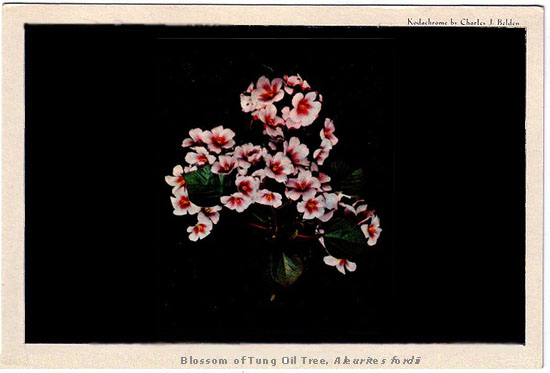 "Bloosoms of a Tung Oil Tree." Photo by Charles J. Belden. In 1943, Belden and Verna moved to North Redington Beach, Florida, near St. Petersburg. At the time, St. Petersburg had a reputation as being the "City of the Living Dead" where the elderly played suffleboard, sat on green benches and ate lunch at Webb's City, the "World's Most Unusual Drugstore." The drugstore advertised a western beef pot pie for forty-five cents.
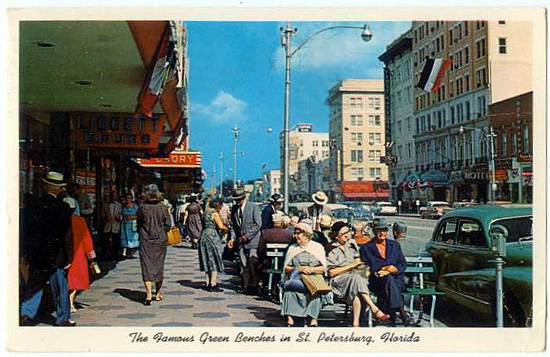 The Famous Green Benches in St. Petersburg, Florida, approx. 1957. Photo by Charles J. Belden (attributed). Writer's note: The reverse of the postcard does not identify the photographer. Attribution is based on the style of the margins and typestyle identical to other identified Belden Florida postcards. In 1961, the City began to remove or require the benches to be repainted in pastel colors in 1961. The city's Suncoast Advertising Club claimed that the repainting of the green benches would alter the ingage of St. Petersburg from that appealing to the elderly. The repainted benches would, according to the club, "become the symbol of "youth and progress." The last of the green benches was removed in 1969. As of 2011, one lone green bench survives on display in the St. Petersburg Museum of History.
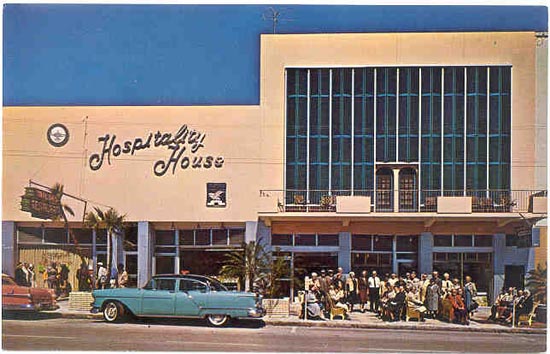 The elderly sitting on the newly repainted "symbols of youth" in front of a Retirement Hotel at 137 Central Ave., St. Petersburg, Fl, photo by Charles J. Belden. To jump start his work as a free lance photographer, Belden's introduction to St. Petersburg was to put on an exhibit of some of his photographs from the Pitchfork. He was introduced as the "Cowboy Photographer." The St. Petersburg Times described him:
 . . . . Newspaper photographs Verna and Charles Belden, 1949
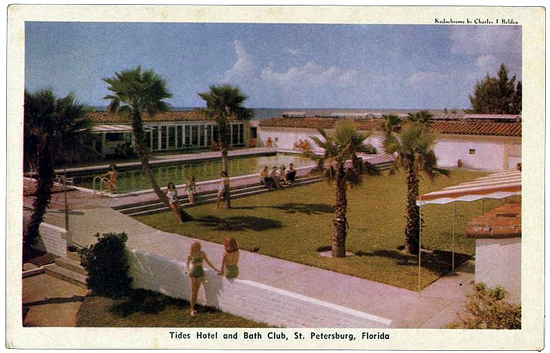 The Tides Hotel and Bath Club, Redington Beach, Fl, photo by Charles J. Belden.
In 1944 at the Tides Hotel, Dick Pope, promotor extraordinaire, was doing a short with Fox's Movietone News promoting Cypress Gardens which he owned. Pope was later to be known father of Florida Tourism. His guiding principle in the promotion of tourism and, more importantly Cypress Gardens, was guided by a principle he called "O.P.M," "Our Picture Material." It was also referred to at times as using "Other People's Money." Belden did the still promotional shots. The photos from the were primarily of bathing beauties from Pope's Cypress Garden attraction.
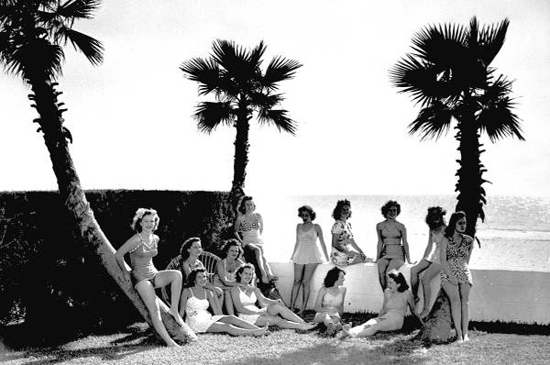 Cypress Garden Bathing Beauties at the Tides Hotel and Bath Club, Redington Beach, Fl, 1944. Photo by Charles J. Belden. The connection with Playford provided several opportunities to Belden for self promotion using Pope's O.P.M. principles. The 150 top aviation executives of the American aviation industry had formed an organization known as the Conquistadores del Cielo. It had been organized by Jack Frye, President of TWA. Annually it held a fiesta. In reality the fiesta was a hunting party. In 1947, the fiesta was held at the HF Bar Ranch near Buffalo, Wyoming. As a result of his ownership of Alaska Airlines, Playford was a member of the Conquistadoes. Hayford took Belden with him to take photos of Playford slaughtering antelope. Playford, indeed, won the tropy for the largest kill, 150 lbs. Thus, Playford's twin engine Beechcraft took off for Sheridan with Playford, the pilot, and Belden. A stop was made in St. Augutine to pick up two additional passengers, one of whom, W. I Drysdale, was the owner of a local alligator ranch. In Sheridan, Belden attended the local Rotary Club meeting at the Sheridan Inn. The guest was Miss Indian America. Belden got out his photographic equipment and took a photo of Miss Indian America and her entourage. The photo was a standard group shot with everyone lined up on the front portch of the Sheridan Inn. It was finally published seven years later as a part of a letter to the editor of the Rotarian. A year later, Belden had a second opportunity for self promotion when he was able to post in the lobby of Playford's First National Bank a mural consisting of four sepia-toned Florida photographs, one of the Tides Hotel, an arial photo of the Vinoy Park Hotel in downtown St. Petersburg, a photo of an orange packing plant, and a photograph of Brahma cattle on a ranch near Ocala.
Next Page, Charles Belden in Florida, continued |

