Cattle Trails

From Wyoming Tales and Trails

This Page: Cattle trailing and roundups continued.


Big Horn Basin Black Hills Bone Wars Brands Buffalo Cambria Casper Cattle Drives Centennial Cheyenne Chugwater Cody Deadwood Stage Douglas Dubois Encampment Evanston Ft. Bridger Ft. Fetterman Ft. Laramie Ft. Russell Frontier Days Ghost Towns Gillette G. River F. V. Hayden Tom Horn Jackson Johnson County War Kemmerer Lander Laramie Lincoln Highway Lusk Meeteetse Medicine Bow N. Platte Valley Oil Camps Overland Stage Pacific Railroad Rawlins Rock Springs Rudefeha Mine Sheepherding Sheridan Shoshoni Superior Thermopolis USS Wyoming Wild Bunch Yellowstone

Home
Table of Contents
About This Site


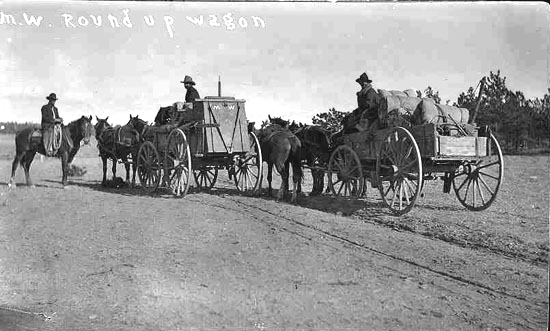
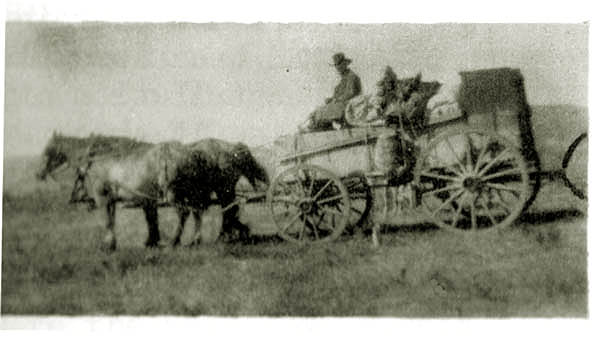
Chuck and hoodlum wagons, M W roundup, 1911

In addition to the chuckwagons, outfits would have a "hoodlum" wagon which would carry bedrolls and other gear. As noted on the previous page the M W was located on Stockade Creek south in Weston County.


Mess on Roundup, 1890, photo by J. Grabill

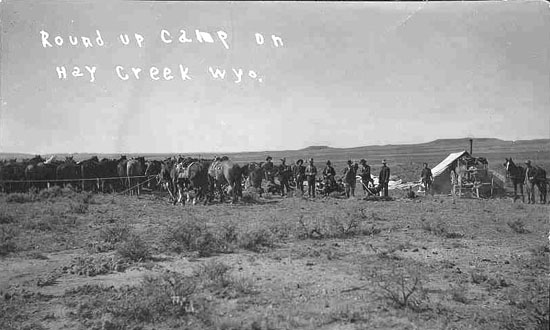
Compare with roundup camp photos on preceding pages and with next photo. Cowboys often could be a rough lot. John Clay noted:

[I]f you wish to be ridden over, stamped upon, get a cowboy to do it, and more especially the brand we employed in those days in the Sweetwater region. They were the real simon-pure, devil-may-care, roistering, gambling, immoral, revolver-heeled, brazen, light-fingered lot, and yet a dash of bravado among them that was attractive to the stranger. They had no respect for a man and little for a woman. Yet they were good workers. Many of them had individually good instincts. "In the herd" they were mean, and to hesitate with them meant losing. If they bluffed you, good-by to any discipline.


Dinner while on roundup, 1890, photo by J. Grabill.


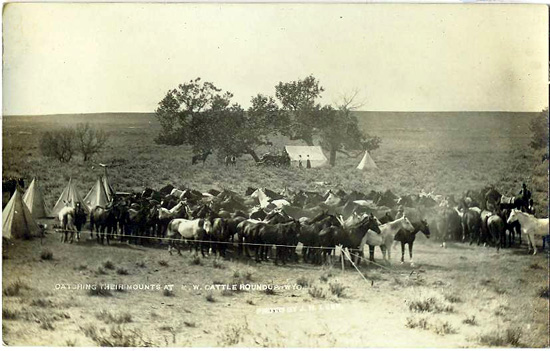
Roundup Camp, Warren Livestock Company, near Cheyenne, 1898, photo by Joseph Stimson. Another view of same scene below.

The Warren Live Stock Company was incorporated in 1883 and capitalized at $500,000.00 (1883 dollars). It is one of the few of the former giant corporately owned cattle companies to continue to survive.

Frequently older photographs would be colorized at a later time for postcards. Such is the above. For information as to J. E. Stimson see Cheyenne III. The following commentary was written by the roundup foreman in the photograph, Ashley Gleason, in 1921. Left to right:

"William Fry, photographer, northern New Mexico; L. T. Bennett, busily engaged in cutting a tough beefsteak, Fort Duckane, Utah; Perry Williams, Cheyenne; Charles Phelps, Casper; Lon Roach, now state law enforcement official; Roy Baxter, government pack master; Bob Van Horn, son of commanding officer at Fort Russell; Dick Dummet, A.P.O. rep; was such a poor rep was sent home with his string, and gladly were the neck tie horses gathered for him; Pete Anderson, didn't want to hide his face with a cup, but his eagerness to get the sugar settlings, was caught in the act. Pete was as good a day jingler as any, even though he was a Swede. He was a physical wreck following the Spanish-American War; Joe Benjamine [sic] wanted to be sure of getting in, so took to the top of the mess box; Guy McNurlen, a wonderful buster, he has fought many a wild bronk at Frontier Days; Bill Hosack, Granite Canyon, Wyo., he is wearing among the first angora schaps [sic] introduced into this country; Ed Clark, Virginia Dale, Wyo; Joe Detrick, has probably attained greater wealth than any one of the bunch. He left riding because he couldn't stick with them. He began mining and later accumulated much wealth; Ashley L. Gleason, in 1921 was foreman for the Fiddleback Co., wool growers Douglas, Wyo; George Johnson now in California."

[writer's note: "Sugar settlings" were the sweet grounds from Arbuckle's coffee used on a round-up. Arbuckle's coffee beans were coated with an egg white and sugar glaze which precluded the beans from going rancid on the trail. Thus, the coffee was also naturally sweet.]


Another view Warren Livestock Company Roundup Camp, 1898, photo by J. E. Stimson

Joe Benjamin is still on top of the mess box. The others have shifted position somewhat.

Although as indicated on the preceding page, life on the trail or on roundup may have been hard, dangerous, dirty, and boring, occasionally cowboys would, as illustrated by the bottom two photos, amuse themselves by rounding up other types of animals. Acting Governor Amos W. Barber recounted a favorite antic of cowboys dealing with rattlesnakes:

A still more dangerous practice, and one which I have frequently seen, is a method of playing with the rattlesnake for the delectation of the cow boy at the expense of a "tenderfoot." It is well known that unless a snake is coiled, or held by the tail or body, or placed at length in a hole or crevice so narrow that by rendering its length sinuous a certain amount of support is given, it cannot strike. On this theory a mounted cow boy first puts a rattler to flight, then pushes his pony in pursuit, stoops from the saddle, seizes it by the tail, gives a quick upward jerk, and, swinging it so rapidly around his head that it is impossible for it to strike, sets off in pursuit of whoever has exhibited most terror at the sight of the reptile. When within fair distance he hurls the snake at the unfortunate victim, in the full assurance that even should it strike him it cannot bury its fangs in his flesh, since it is impossible for it to coil till it reaches the ground. This is a jest of which I have frequently been the victim, nor have I yet learned to appreciate it with unalloyed mirth.
[ Barber, Amos W., "The Treatment of Rattlenake Bite by Permanganate of Potassium Based on Nine Successful Cases," Scientific American Supplement No. 841, Feb. 13, 1892.]

Other fun could be had with rattlesnakes. One cowboy, Fred Tucker, working on the Painter Brothers Ranch in Weld County, Colorado, wrote a series of letters to Mittie Richardson who lived near Horse Creek. The letters described his day-to-day activities. One letter described some fun with the cook, spelling and punctuation as in original:

Roggen Colo
Sept 1, 1903

My Dearest Mittie

I now take the pleasure of writing you a few lines to let you know that I am getting along well we have moved to the ranch today. I am quite glad to be back again. And get some milk to drink and be in my old bed again I caught a coyote across the track and I got another rattle snake in a load of hay yesterday morning. It was a nice one it had 8 rattles on it. I took it and skinned it any [and] filled the hide with sand put it in a place that the cook had made to keep meat better etc. cool and killed another on the ground. It took it and put it in the cooks bed put the head under the pillow he was telling us that he was awfully scared of snakes Mr. Painter told him that snakes sometimes crawled in a bed to get a place to sleep and he told us that he was going to build a place to sleep or sleep in the wagon rack that night so after noon we all went to work and about 2:30 oclock the cook spied the sanke in the bed he got a pitch fork and stood off about 10 feet from the bed and watched the snake to see where he would go when he saw me he says oh Fred by God here is a snake in my bed it is that long and he says come and kill it I told him I could not leave my team to get Mr. Painter to kill it and he did Mr. Painter let on that he did not know any thing about the snake until he got to the snake when he found out the snake was dead he was all right until supper time came and he found the stuffed snake in his cellar hole he was wild again but we had a good joke on the old soldier I laughed more over that than any fun I had in a long time the old man was so sober about it and said no more of that bed for him the boys have the skin in the bunk house now and thay are playing cards now I have to go to a sheep ranch in the norning to get a sheep I wish you could go with me the people around here are mostly dutch I saw 5 empty beer kegs at Roggen one morning so I suppose that had a big time some place. Well I have to close for this time with love and a lot of kisses I remain your ever loving friend Fred X X X X X X X X X X X


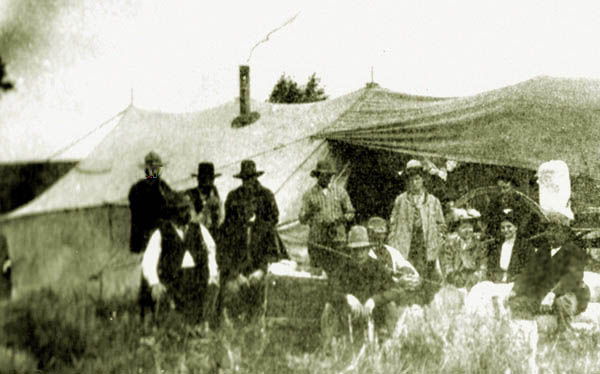
Dinner on Roundup, northern Wyoming, 1902.

A tenderfoot might easily become the unwitting butt of the jokes. One such tenderfoot from New York participated in a roundup near Madora, Dakota Territory. The tenderfoot had some peculiar habits: he wore glasses, had a toothbrush, regularly shaved, didn't drink, and never cursed. The boys gave him an unbroken bronc. At first the horse was gentle until he reached the edge of a chasm. There, the horse turned into a "sunfisher;" that is, a horse that jumps in end-to-end turns, always in the same direction so that the rider will become dizzy. The tenderfoot held hung on for dear life. But by that afternoon, the tenderfoot was using the horse to tend the cattle. Later the boys sent the tenderfoot off on a wild goose chase for some alleged antelope about five miles back. The joke was on the boys. He came back with two antelope. Thus, the tenderfoot was accepted. Later, the tenderfoot wrote:

There was a good deal of rough horse-play, and, as with any other gathering of men or boys of high animal spirits, the horse-play sometimes became very rough indeed; and as the men usually carried revolvers, and as there were occasionally one or two noted gun-fighters among them, there was now and then a shooting affray. A man who was a coward or who shirked his work had a bad time, of course ; a man could not afford to let himself be bullied or treated as a butt; and, on the other hand, if he was "looking for a fight," he was certain to find it.Theodore Roosevelt, Autobiography, 1913.


Roping a Buffalo, 1890, photo by J. Grabill.

Theodore Roosevelt in his 1893 Hunting the Grisly and Other Sketches noted:

Cowboys delight in nothing so much as the chance to show their skill as riders and ropers; and they always try to ride down and rope any wild animal they come across in favorable ground and close enough up. If a party of them meets a bear in the open they have great fun; and the struggle between the shouting, galloping, rough-riders and their shaggy quarry is full of wild excitement and not unaccompanied by danger. The bear often throws the noose from his head so rapidly that it is a difficult matter to catch him; and his frequent charges scatter his tormentors in every direction while the horses become wild with fright over the roaring, bristling beast--for horses seem to dread a bear more than any other animal. If the bear cannot reach cover, however, his fate is sealed. Sooner or later, the noose tightens over one leg, or perchance over the neck and fore-paw, and as the rope straightens with a "plunk," the horse braces itself desperately and the bear tumbles over. Whether he regains his feet or not the cowboy keeps the rope taut; soon another noose tightens over a leg, and the bear is speedily rendered helpless.

I have known of these feats being performed several times in northern Wyoming, although never in the immediate neighborhood of my ranch. Mr. Archibald Roger's cowhands have in this manner caught several bears, on or near his ranch on the Gray Bull, which flows into the Bighorn; and those of Mr. G. B. Grinnell have also occasionally done so. Any set of moderately good ropers and riders, who are accustomed to back one another up and act together, can accomplish the feat if they have smooth ground and plenty of room. It is, however, indeed a feat of skill and daring for a single man; and yet I have known of more than one instance in which it has been accomplished by some reckless knight of the rope and the saddle. One such occurred in 1887 on the Flathead Reservation, the hero being a half-breed; and another in 1890 at the mouth of the Bighorn, where a cowboy roped, bound, and killed a large bear single-handed.

Such antics as depicted above and below were frowned upon by some companies. The XIT in its rules of conduct for employees provided: "Employees are not allowed to run mustang, antelope or any kind of game on the Company's horses."


Roping a gray wolf, 1887, photo by J. Grabill

Of course there may have been a motive for roping wolves and coyote other than fun. A small ranch might have one or two full-tme hands, otherwise the small ranchers relied on seasonal crews that were paid by the day, typically $1.25 a day. A full-time hand might receive $30.00 a month, but that pay would be greater than those paid by the day. The waddie, paid by the day, was not paid for days he couldn’t work due to rain or snow. To supplement income, bounties might be collected for killing coyotes, bobcats and wolves. Wyoming paid $1.50 for coyote, $5.00 for a wolf, and $1.00 for a bobcat. Colorado paid $20.00 for a wolf. After the pelt was displayed to the Clerk of the Court, ears and paws cut off and given to the clerk, and the necessary affidavit filed, the hunter was then free to sell the pelt and receive additional income. At the time, the coyote hide might bring from $1.00 to $2.00 in Chicago.

Next Page, Brands and Branding.