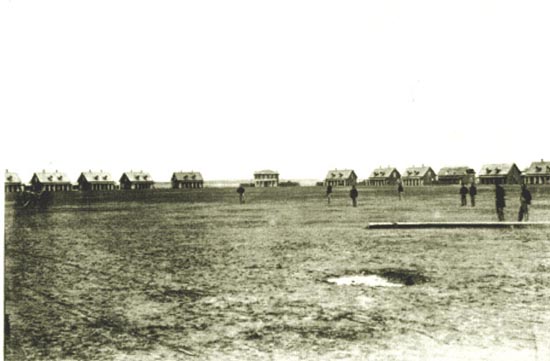
Fort D. A. Russell, 1868. Officers' Row in the distance. The center two-story building is the
Commanding
Officer's quarters. Photo by Alexander Gardner
For much of its existence, even as late as the 1920's, Fort D. A. Russell (now Warren Air Force Base), northwest of
Cheyenne on Crow Creek, was a cavalry post. As discussed with regard to the Union
Pacific Railroad, during the Civil War the Northern Congress passed legislation providing for the
construction of a railroad connecting California with the east. There was a realization
that the construction would require protection from the Indians. The legislation, therefore,
provided for the President to establish a fort near the intersection of the
railroad with the Front Range. Thus, on July 4, 1867, Fort D. A. Russell was established near a place called
"Crow Creek Crossing," now Cheyenne. The site of the fort was selected by Gen. C. C. Augur. Augur was one of the
Union Commanders at the seige of Port Hudson, Louisiana, discussed below with regard to
Francis E. Warren, after whom the fort was later re-named.
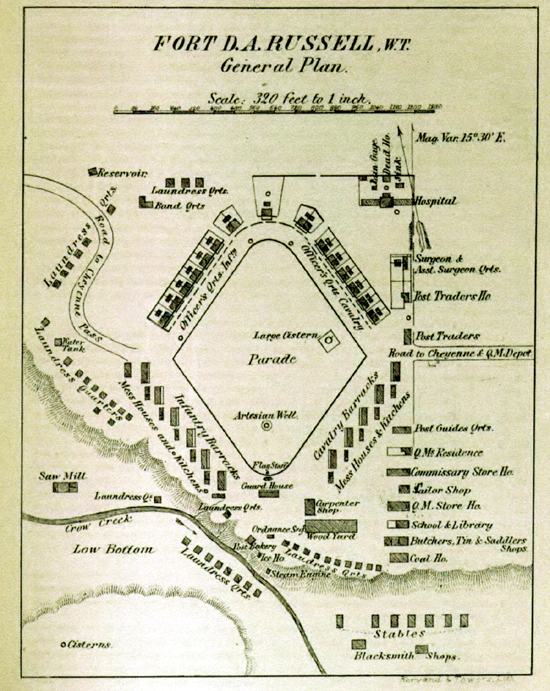
Plan of Fort D. A. Russell, 1888, prior to reconstruction
The initial fort was never stockaded, but always on an open plan. Its initial commander was Col. (Brevet Major General Volunteers, Brevet Brig. Gen. Regular Army)
John D. Stevenson. The first structures
consisted of log cabins for the enlisted men. During the first winter, officers remained bivouacked in tents. Other forts
established for the protection of the railroad included Fort Sanders south of
present day Laramie, Fort Fred Steele where the railroad crosses the Platte, and
Fort Bridger originally acquired by the military as a part of the Mormon War. The need for such forts was critical. Gen. Augur noted in an
1867 report, the fort was necessitated for protection of the railroad, but that the
overland mail stages required guards at their stations between Julesburg and Denver and between Forts Sanders and Bridger. Guards were required
to accompany coaches as parts of the routes. The telegraph line also required guards at some of
the stations and men assigned to repair the lines required escourts. The surveyor-general of Nebraska was also making demands for escorts for
some of his surveying parties. He noted that that his command was broken up and "scattered, as it were, over this country, a necessity
very destructive in its results upon the discipline and instruction of both officers and men."
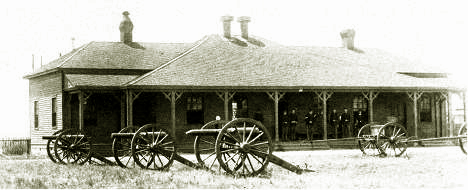
Men on porch of unidentified building (possibly the post hospital), Fort D. A. Russell.
The initial buildings were crudely constructed of board and batton.The barracks were insulated with adobe in the walls, but the area
around the eaves were open from the shrinking of the lumber. Thus, one surgeon, in an
1870 report noted that the ventilation was "amply sufficient." The enlisted men's bunks were
were equipped with mattresses filled with hay, two men per bunk. Each barracks had its own seperate
kitchen constructed of logs. The officers quarters were larger but had no plumbing. To keep out the
cold, the rooms were lined with tarpapper which was then wallpapered. In the hospital, it was necessary to line the
ceilings with tarpaper. The building were shakey and, thus, in the wind plaster could not be used as it would be
constantly falling down.
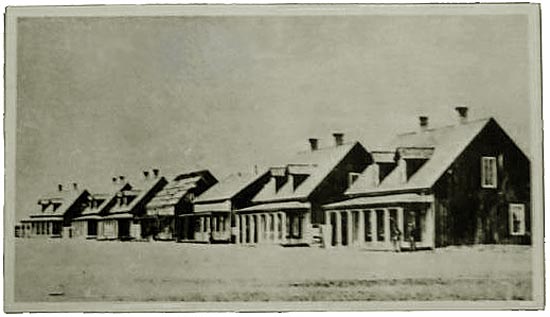
Officers' Row, 1868.
Initial construction, in addition to being poor, was slow. The quartermaster employed men on salary to assist in the construction.
Enlisted men were also utilized even though they had no construction experience. The salaried men were slow, seemingly extending the
lenght of their employment through the winter. Desertion was rampant. Clayton K. S. Chun, U.S. Army; the Plains Indian Wars, 1865-1891, Osprey Publishing, 2004,
estimated that approximately 1/3rd of all enlistments ended "in some form of desertion. He noted that out of
255,000 enlistments during the period, there were in excess of 88,000 desertions. Indeed, in one expedition out of the fort,
some 65 men deserted by the time the troop readed Lodge Pole Creek, taking government horses and weapons with them. Although some deserted were caught,
it was easy to change one's name, and obtain employment on the railroad or elsewhere for substantially more pay. Other reasons were given by the military,
the troops were not fighting Inidans but, instead sat around bored or were used for non-military puposes such as
carpenters and masons.
The ease with which one could change one's name is, perhaps, illustrated by a
French immigrant who enlisted in the army, was stationed at Fort D. A. Russell, deserted in 1870 and went to the
bright lights of Denver, Adolphe Fran�ois G�rard. In Denver, under his new name of Louis Dupuy, he gained employment as
a correspondent for the Rocky Mountain News reported from the mining camps. He took a job as a miner, was injured, and
acquired a bakery in Georgetown. The bakery was expanded into the Hotel de Paris, famous throughout the Rocky Mountain West for its
French restaurant. His secret was never revealed until after his death.
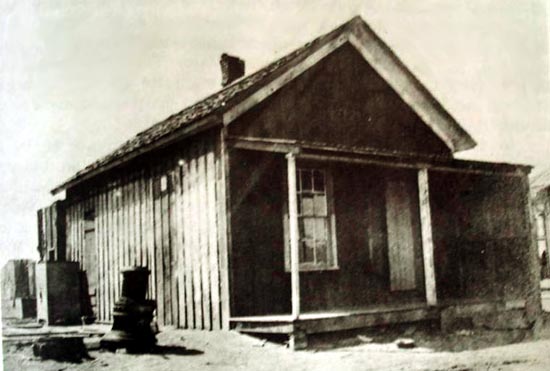
Fort D. A. Russell, building used for launderesses or as a married men's quarters.
The married men's and launderess's quarters were, as illustrated in the above photo, also of board and batton, equally leaky and lined with
tarpaper. The building in the photo cost $196.00 to build.
The commander of one western fort blamed desertion on "opportunities for indulgence in dissapation." He argued, "Men who dissipate all night do not feel much like
attending to duty in the morning." Certainly from its founding Cheyenne provided an opportunity for
dissapation. In 1870, as an example, one newspaper complained about a "house of loose architecture." By 1900, there were at least 15 such houses mostly on
the west end of town, convenient to the fort. Indeed, the convenience was made easier by the presence of the street railway which charged only a nickle for the
ride into town. Before the street railway, on post were "launderesses." At D. A. Russell in 1877, there were some 24 launderesses.
Five were married. Of the reminder, 17 had children. In 1912, the city began to crack down on the
cheap parlor houses by increasing the monthly fines.
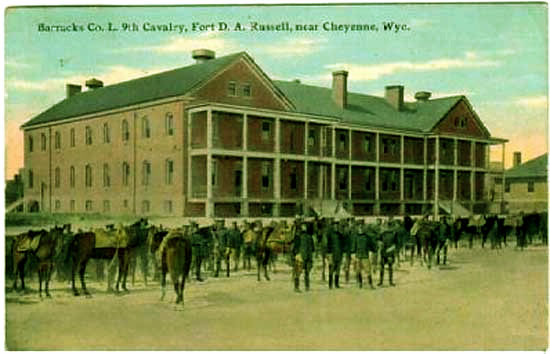
Barracks, Troop L, 9th Cavalry, approx. 1909.
In 1884, the fort was designated as a permanent installation. The advantage of the fort was that it was on major railroads and
midway between the Canadian and Mexican borders. Thus, there began a program of
reconstruction of the fort as depicted in the remaining photos.
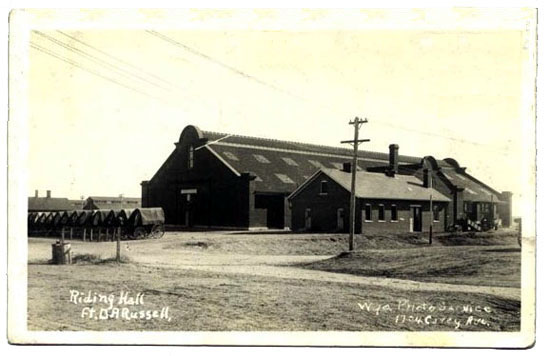
Riding Hall with supply wagons parked in front.
The fort was named after
Brig. Gen. [Brevet Major General] David Alan Russell, who was killed at the
Battle of Opequon Creek near Winchester, Va., on Sept. 19, 1864. His Confederate opposite, Major Gen. Robert
E. Rhodes, was killed in the same battle. As a note, Union forces named battles after
adjacent creeks, while Confederate forces named the battles after nearby towns, i. e.
First Manassas and Second Manassas were named by the Confederates after the nearby
town of Manassas, Virginia, and are the same battles as First Bull Run and Second Bull Run named by the
Union after the nearby creek. Accordingly, some sources refer to Russell as being killed at
Winchester.
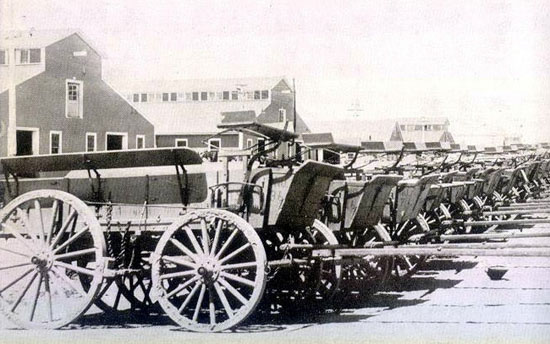
Supply Wagons for 315th Cavalry.
The 315th was organized in 1917 and was disbanded during World War II. With the fort's central location midway between the Canadian and Mexican borders and halfway between
the two coasts on a railroad, the fort rapidly became a central supply point for the
military in the central United States.
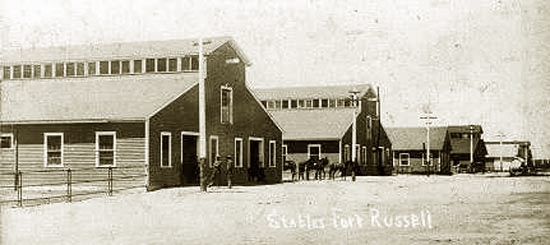
Stables, Fort Russell, undated.
In 1884, the fort was made a permanent installation. The following year
a program of building the structures depicted on this page began. In 1886, the 9th Cavalry of
"Buffalo Soldiers" was asigned to the post. The fort at one time became the
largest cavalry post in the country. Cavalry remained at the fort until 1927.
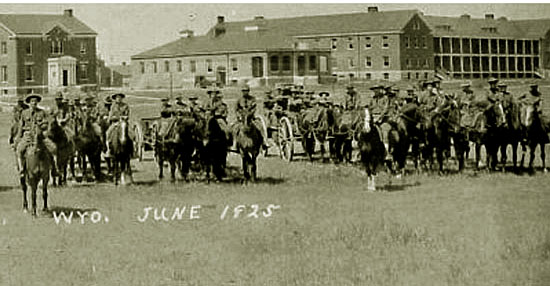
Cavalry, Ft. D. A. Russell, 1925. Photo by J. Shimitz.
Next page: Fort D. A. Russell continued.
|