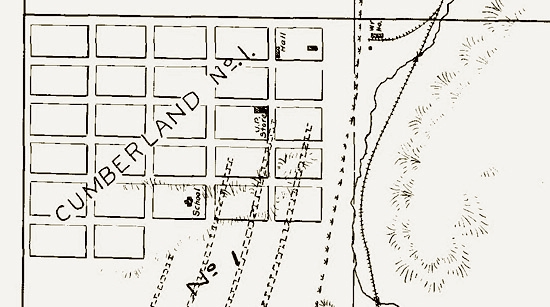
Plat of Cumberland No. 1, 1903. All images
of Cumberland on this page
courtesy of Anadarko Petroleum Corporation.
In addition to schools, a public hall, and the company store, Cumberland had two churches consisting of
a Mormon Meeting House and a Catholic Church.
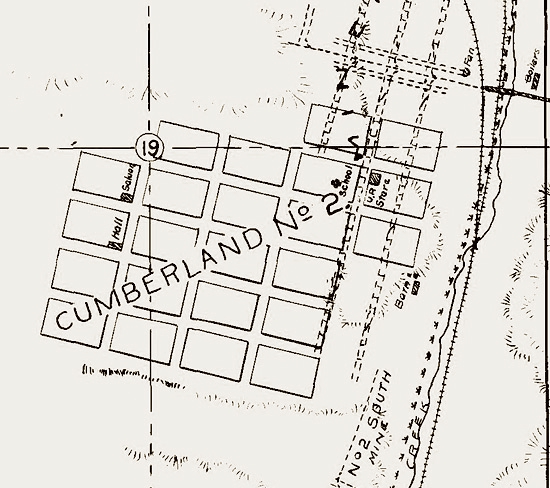
Plat of Cumberland No. 2, 1903.
There were as many as 25 mines in the Cumberland area. Today, all that is left are the remains of the
Ziller Ranch, a saloon in Cumberland Gap, and the Cumberland Cemetery to the north of where Cumberland
No. 2 was located.
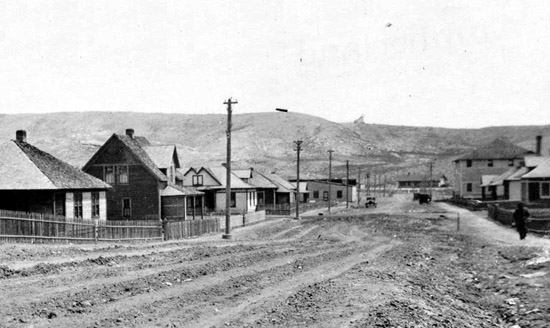
Cumberland (believed Cumberland No. 1) looking east. Company
Store on right. Approx 1929.
Note from the plats that the Company provided schools and public halls. Different coal companies had different attitudes relating
to the quality of amenities provided the employees and the attitude towards the
open towns. Thus, as observed on a subsequent page, the Union Pacific Coal Company actually provided
utility service to White City, adjacent to the Company-owned town of Superior. Miners in Union Pacific towns were
represented by the United Mine Workers who, as noted on a previous page, were established in Wyoming in the
1890's. Other companies, particularly the Colorado
Fuel and Iron Company discussed below, controlled by John D. Rockefeller, Jr. in southern Colorado, were less beneficent.
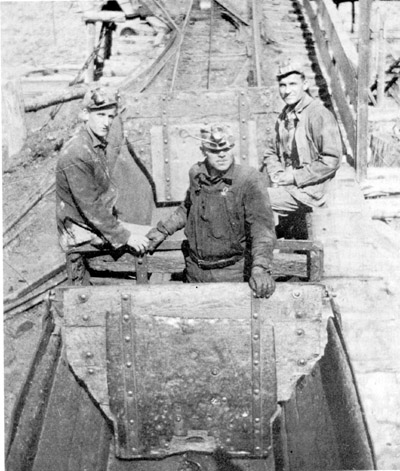
Cumberland Miners
The presence of coal in the Cumberland area
was known as early as 1843 when it was discovered on Brevet Captain John C. Fremont's second expedition (1843-1844). Fremond in his
1845 Report of the Exploring Expeditin to the Rocky Mountains in the
Year 1842, and to Oregon and North California in the Years 1843-44 described the area and finding coal in what is
believed to be Cumberland Gap, in August 1843:
19th.
-- Desirous to avoid every delay not absolutely necessary, I sent on
[Kit] Carson in advance to Fort Hall this morning, to make arrangements for a small
supply of provisions. A few miles from our encampment, the road entered a
high ridge, which the trappers called the "little mountain," connecting
the Utah with the Wind Biver chain; and in one of the hills near which we
passed I remarked strata of a conglomerate formation, fragments of which
were scattered over the surface. We crossed a ridge of this conglomerate,
the road passing near a grove of low cedar, and descending upon one of the
heads of Ham's fork, called Muddy, where we made our mid-day halt. In the
river hills at this place, I discovered strata of fossiliferous rock,
having an oolitic structure, which, in connection with the neighboring
strata, authorize us to believe that here, on the west side of the Rocky
mountains, we find repeated the
modern formations of Great Britain and Europe, which have hitherto been
wanting to complete the system of North American geology.
In the afternoon we continued our road, and searching among the hills a
few miles up the stream, and on the same bank, I discovered, among the
alternate beds of coal and clay, a stratum of white indurated clay,
containing very clear and beautiful impressions of vegetable remains.
This was the most interesting fossil locality I had met in the country,
and I deeply regretted that time did not permit me to remain a day or two
in the vicinity; but I could not anticipate the delays to which I might be
exposed in the course of our journey -- or, rather, I knew that they were
many and inevitable; and after remaining here only about an hour, I hurried
off, loaded with as many specimens as I could conveniently carry.
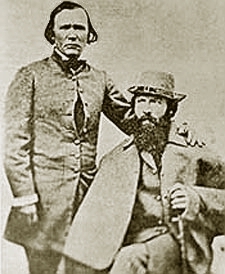
Kit Carson and John C. Fremont
Coal made its appearance occasionally in the hills during the afternoon,
and was displayed in rabbit burrows in a kind of gap, through which we
passed over some high hills, and we descended to make our encampment on
the same stream, where we found but very poor grass. In the evening a fine
cow, with her calf, which had strayed off from some emigrant party, was
found several miles from the road, and brought into camp; and as she gave
an abundance of milk, we enjoyed tonight an excellent cup of coffee. We
traveled to-day 28 miles, and, as has been usual since crossing the Green
river, the road has been very dusty, and the weather smoky and oppressively
hot. Artemisia was characteristic among the few plants.
20th.
-- We continued to travel up the creek by a very gradual ascent and a
very excellent grassy road, passing on the way several small forks of the
stream. The hills here are higher, presenting escarpments of party-colored
and apparently clay rocks, purple, dark-red, and yellow, containing strata
of sandstone and limestone with shells, with a bed of cemented pebbles,
the whole overlaid by beds of limestone. The alternation of red and yellow
gives a bright appearance to the hills, one of which was called by our
people the Rainbow hill, and the character of the country became more
agreeable, and
traveling far more pleasant, as now we found timber and very good grass.
Gradually ascending, we reached the lower level of a bed of white
limestone, lying upon a white clay, on the upper line of which the
whole road is abundantly supplied with beautiful cool springs, gushing
out a foot in breadth and several inches deep, directly from the hill-side.
Writer's note: Mountain men Kit Carson and Thomas "Broken Hand" Fitzpatrick acted as guides
on the expedition. The expedition included 67 mules and horses and one mountain howitzer.
The howitzer was taken over the objection of the Topographic Corps who feared that
its presence in Mexican and British Territories might indicate that the
journey was not strictly for scientific purposes. It may be that the Topographic
Corps' objections were not relayed to Fremont by Fremont's wife, the daughter of
Missouri Senator Thomas Hart Benton. The Expedition was also armed with breech loading rifles, at a
time when standard weapons were muzzel loading. The howitzer was abandoned in the snows of
Nevada. For more on Fremont, see Lander.
Fitzpatrick (1799-1854) was born in Ireland and at age 17 ran away to sea ending up in
New Orleans. He made his way to St. Louis and was a part of the original Ashley Expedition
(See Rendezvous). He later served as guide to
Father DeSmet's journey to Oregon during which DeSmet held Mass at the 1840
Rendezvous near present-day Daniel. Fitzpatrick also served as a scout for Gen. Kearney. Fitzpatrick became
known as "Broken Hand" to the Indians after he lost two fingers of his left
hand when a musket exploded. He is interred in an unmarked grave in Washington, D.C.
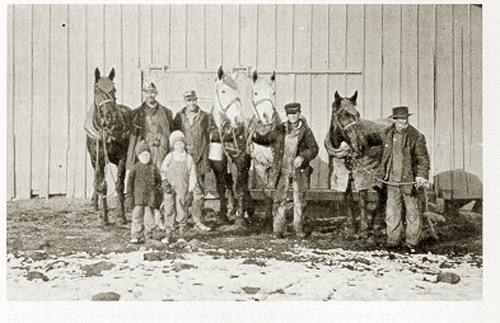
Unidentified persons, Cumberland.
Many of the miners in Cumberland - Diamondville - Kemmerer area were from Italy and the Austro-Hungarian
Empire. Indeed, at one time, Cumberland had one of the largest Slovene communities in Wyoming. Many came to Wyoming and
Utah from southern Colorado following the "Ludlow Massacre."

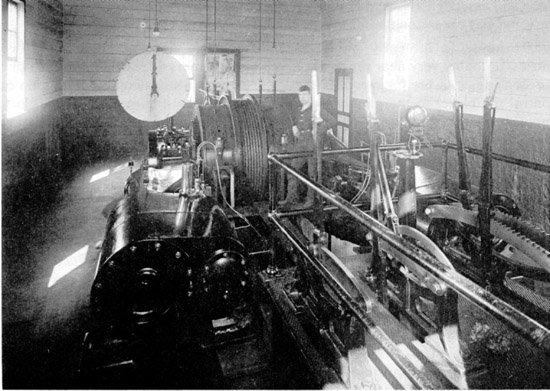
Hoist Room, Cumberland.
Beginning in the 1890's, the United Mine Workers began to organize the mining camps of
Southern Colorado and Northern New Mexico. Conditions in the mines owned by Colorado Fuel and Iron Company ("C. F. & I.") were abysmal. In Wyoming the
C. F. & I owned the Sunrise iron ore mine near Hartville, not involved in the strike.
The miners were paid by tonnage mined. The Company would cheat in the scales. Notwithstanding that payment of wages in
Company scrip redeemable only at the Company Store was illegal, Colorado mines persisted in the practice. The rental of the
company houses returned to the Company 6 to 8% on investment. Workers were not paid for time expended
in shoring up the galleries or installing tram track ("Dead work"). The cost of black powder using in the mining
of the face was deducted from their pay as was the cost of blacksmithing on the
tools. A series of unsuccessful strikes hit the Colorado and New Mexico mines. Miners struck in Gallup, N. Mex. in 1900;
and in Colorado in 1903, 1904, and 1910. On September 23, 1913, over 12,000 miners in sourthern
Colorado went on strike. The demands were simple. Many of the demands were already required by Colorado law which was ignored by C. F. & I.
:
Recognition of the U.M.W.;
A 10% increase in tonnage rates to equal those of miners in Wyoming;
Election of their own weighmen to weigh the tonnage;
Payment for "dead work;"
An eight-hour day;
The right to trade at other than the Company store and to reside where they chose;
Enforcement of Colorado mining laws (Colorado had twice the fatality rate as the
rest of the Country) and abolishment of a system of private security utilized by the
Company.
In response, the miners were evicted from the Company-owned houses and C. F. & I, brought in a
private security firm who utilized an armored car affixed with a
machine gun. On October 17, 1913, the car, known as the "Death Special," was used at
Forbes, Colorado, to spray with bullets a tent city in which the miners and their families were
dwelling. One tent was found to have 148 bullet holes. One miner was killed and a child was shot.
As if to prove the Union's concern about mine safety, on October 22 at 3:00 p.m., an explosion in a Phelps-Dodge Mine in
Dawson, N. Mex. killed 261 miners. A tongue of flame shot out 100 feet from the mine mouth. The force of the
explosion shook houses two miles away. Subsequent investigation revealed that dynamite used in violation of
Bureau of Mines standards set off an explosion of coal dust. The Bureau also recommended that
dust be kept down with a water spray and rock dust. Neither had been done. Ten years later another 120 were killed in Dawson.
Again water sprays were not used. In 1950, Phelps Dodge closed the town and evicted all of the residents on 30 days
notice. The town was razed and nothing remains except the cemetery.
The strike continued. The governor of Colorado, at the
request of the Company, called out the Colorado National Guard. Company "guards" were sworn into the
Colorado National Guard. Eighteen miles north of Trinidad at Ludlow, the Union established a tent town occupied by over 900. On
April 20, 1914, the town was attacked by the
National Guard who burned the town down. In the smoldering ruins 23 miners and children were found dead.
Some had taken refuge in a hole later known as the
"death pit." Mother Jones, the famous turn of the century reformist, traveled to Trinidad
where she was arrested and held
incommunicato by the Colorado Guard. Mother Jones in her autobiography described the events at Ludlow:
On the 19th of April, 1914, machine guns, used on the strikers in the
Paint Creek strike, were placed in position above the tent colony of
Ludlow. Major Pat Hamrock and Lieutenant K. E. Linderfelt were in charge
of the militia, the majority of whom were, company gun-men sworn in as
soldiers.
Early in the morning soldiers approached the colony with a demand
from headquarters that Louis Tikas, leader of the Greeks, surrender
two Italians. Tikas demanded a warrant for their arrest. They had none.
Tikas refused to surrender them. The soldiers returned to quarters.
A signal bomb was fired. Then another. Immediately the machine guns
began spraying the flimsy tent colony, the only home the wretched families
of the miners had, riddling it with bullets. Like iron rain, bullets'
upon men, women and children.
The women and children fled to the hills. Others tarried. The men
defended their home with their guns. All day long the firing continued.
Men fell dead, their faces to the ground. Women dropped. The little Snyder
boy was shot through the head, trying to save his kitten. A child carrying
water to his dying mother was killed.
By five o'clock in the afternoon, the miners had no more food, nor
water, nor ammunition. They had to retreat with their wives and little
ones into the hills. Louis Tikas was riddled with shots while he tried to
lead women and children to safety. They perished with him.
Night came. A raw wind blew down the canyons where men, women and
children shivered and wept. Then a blaze lighted the sky. The soldiers,
drunk with blood and with the liquor they had looted from the saloon, set
fire to the tents of Ludlow with oil-soaked torches. The tents, all the
poor furnishings, the clothes and bedding of the miners' families burned.
Coils of barbed wire were stuffed into the well, the miners' only water
supply.
After it was over, the wretched people crept back to bury their
dead. In a dugout under a burned tent, the charred bodies of eleven
little children and two women were found-unrecognizable. Everything
lay in ruins. The wires of bed springs writhed on the ground as if they,
too, had tried to flee the horror. Oil and fire and guns had robbed men
and women and children of their homes and slaughtered tiny babies and
defenseless women. Done by order of Lieutenant Linderfelt, a savage, brutal
executor of the will of the Colorado Fuel and Iron Company.

Red Cross workers searching ruins of Ludlow tent
colony, April 23, 1914.
Among those who came to support the miners after the disaster was Margaret Tobin (Mrs. J. J.) Brown.
[Writer's note: Mrs. Brown is now commonly referred to as "Molly Brown." She is noted for her efforts on behalf of
those impoverished by the death of breadwinners in the sinking of the Royal Mail Ship Titanic. Before leaving the
Carpathia she had raised $10,000 on their behalf. There is no indication that during her
lifetime she was referred to as "Molly." The name apparently originated with the
Denver Post following her death.]
The strike continued on into 1915 and finally ended with Congressional Investigations at which
Rockefeller was required to testify. He denied there was any massacre. The strike fizzled out with the miners
either going back to work or moving as many did to Utah and Wyoming and taking employment in mines owned by
the Union Pacific Coal Company. In Colorado, the UMW did not gain recognition until the
1930's. Instead, Rockefeller's company organized a Company dominated union. Thus, in one sense, the strike was a
failure for the miners. For Rockefeller, the massacre was a disaster. He was faced with almost universal condemnation.
Harper's Weekly ran an editorial cartoon depicting Rockefeller as a vulture hanging over the devastation of Ludlow.
The cartoon bore the caption "Success."
To overcome the public infamy that his heavy-handedness and perceived wickedness in bringing down the
strike had wrought, Rockefeller employed Ivy L. Lee, publicist for the Pennsylvania Railroad, to rehabilitate his image with public philanthropy.
But in another and larger sense, it brought needed reforms to
the Colorado mining fields and brought to Wyoming many of the families who today continue
to reside in the state. Rockefeller's newly found philanthropy brought to Wyoming the
Teton National Park and resulted in Sunrise being made into a model town. Although Sunrise was an
iron ore mining camp, it was similar to many of the Coal Camps.
On Memorial Day 1918 in the shadows of the Sangre de Cristo Mountains
near the site of the death pit, the United Mine Workers dedicated a memorial
to some of those killed at Ludlow. On the memorial is a plaque:
VICTIMS OF
LUDLOW MASSACRE
APRIL 20, 1914
LOUIS TIKAS, AGE 30 YRS.
JAMES FYLER, AGE 43 YRS.
JOHN BARTOLOTTI, AGE 45 YRS.
CHARLIE COSTA, AGE 31 YRS.
FEDELINA COSTA, AGE 27 YRS.
ONAFRIO COSTA, AGE 6 YRS.
LUCY COSTA, AGE 4 YRS.
FRANK RUBINO, AGE 23 YRS.
PATRIA VALDEZ, AGE 37 YRS.
EULALA VALDEZ, AGE 8 YRS.
MARY VALDEZ, AGE 7 YRS.
ELVIRA VALDEZ, AGE 3 MO.
JOE PETRUCCI, AGE 4 1/2 YRS.
LUCY PERTUCCI, AGE 2 1/2 YRS.
WILLIAM SNYDER, JR., AGE 11 YRS.
RODGERLO PEDREGONE, AGE 6 YRS.
CLORIVA PEDREGONE, AGE 4 YRS.
|
Sometime on May 7 or May 8, 2003, the Memorial was vandalized. Heads of statues of miners
were broken off and removed. Other damage occurred.

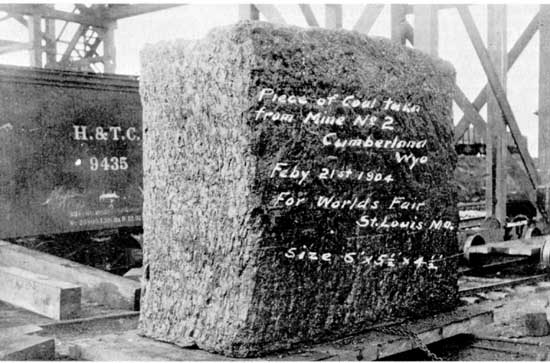
Block of coal from Cumberland displayed at
1904 St. Louis Worlds Fair.
In 1997, the Colorado Supreme Court cited the events at Ludlow in support of the general proposition
that a man's home, no matter how humble, even a tent, is free from warrentless search. See
People v. Schefer, 946 P. 2d 938 (Colo. 1997).
Music this page:
We're Coming, Colorado
(Sung to the tune of Battle Cry of Freedom)
Words by Frank J. Hayes
I.
We will win the fight today, boys,
We'll win the fight today,
Shouting the battle cry of union;
We will rally from the coal mines,
We'll battle to the end,
Shouting the battle cry of union.
CHORUS:
The union forever, hurrah, boys, hurrah!
Down with the Baldwins, up with the law;
For we're coming, Colorado, we're coming all the way,
Shouting the battle cry of union.
II
We have fought them here for years, boys,
We'll fight them in the end,
Shouting the battle cry of union.
We have fought them in the North,
Now we'll fight them in the South,
Shouting the battle cry of union.
REPEAT CHORUS
III
We are fighting for our rights, boys,
We are fighting for our homes,
Shouting the battle cry of union;
Men have died to win the struggle;
They've died to set us free,
Shouting the battle cry of union.
REPEAT CHORUS
Writer's notes: Baldwin's, the Baldwin Felts
Detective Agency, hired by C. F. & I. to
break the strike. Frank J. Hayes, Vice President of the United Mine Workers, later President.
Next Page: Superior.
|