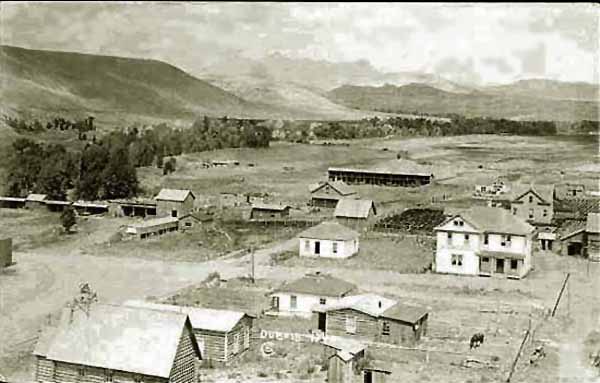
Stringer Hotel, Dubois, approx. 1915
The hotel (the two-story building with porch on the right) was constructed by in 1913 by Albert and Oscar Stringer who arrived in the area
from Oklahoma in 1901. Albert and Oscar ran the hotel until World War II. Their mother, Nettie, did the cooking. The log structure on the lower
left in the above and next photos is St. Thomas Episcopal Church. In 1920 a second hotel, the Ramshorn was constructed by Charles Shippen.
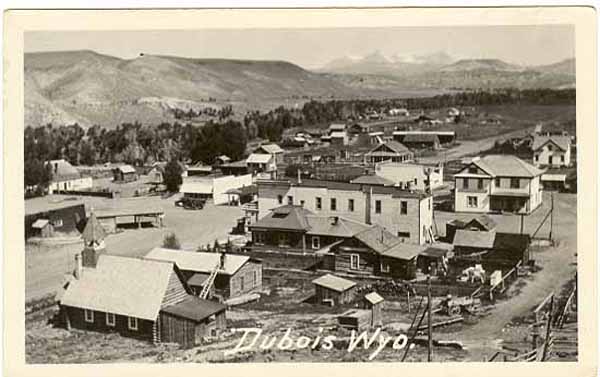
Dubois, 1925
The long two story building in the photo is the Ramshorn hotel constructed in 1920 by Charles E. Shippen (c. 1857-1928) The Ramshorn had twelve rooms and
was regarded as more upscale than the Stringer. The Ramshorn boasted one bathtub for each two rooms and a full
bath for the use of all guests. On weekends dances were held at the hotel. The Stringer had a reputation as being a bit underheated in the winter.
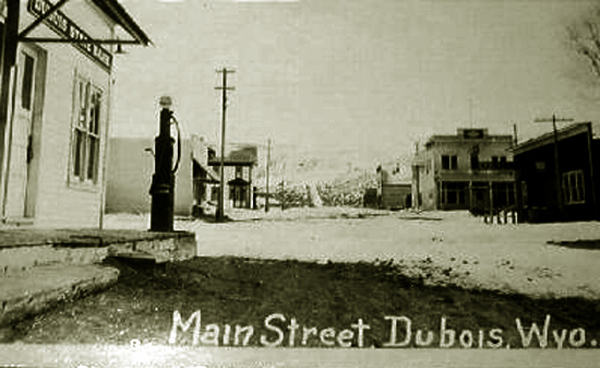
Dubois, 1925
On the left, is the Dubois State Bank operated by George Y. Hays. The bank was formed in 1918 by the shareholders of
the Dubois Mercantile Company and competed with the earlier Amoretti, Welty, Heimer bank.
The Dubois State Bank was housed in the same building as the Mercantle, accounting for the gas pump. The Merchantile Company was organized in 1912 to compete with
the Welty Store. The bank failed in 1933. The two-story building further down the street on the right is the Ramshorn Hotel.
The hotel burned in 1935. Subsequently, the Stringer Hotel adopted the Ramshorn name.
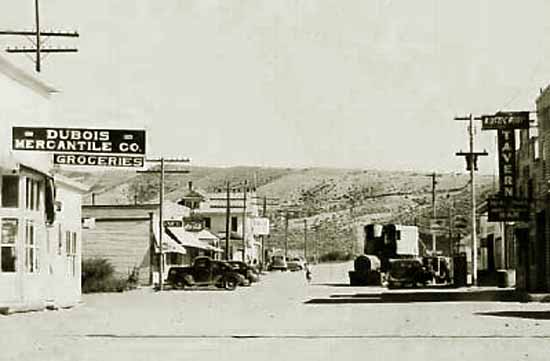
Dubois Mercantile Company on the left, Rustic Pine Tavern on the right, approx. 1939
The Dubois Mercantile Company opened in 1913. Following World War II, the Wyoming Tie and Timber
Company aquired the store. It was managed for the next nine years by Tony Dolenc, the former manager of the
company store at its tie camp. The store was later sold and was closed. As later discussed, the tie hacks were noted for their
prodigious thirst. Across the street, as seen in
the photo, is the Rustic Pine Tavern which was constructed in 1919.
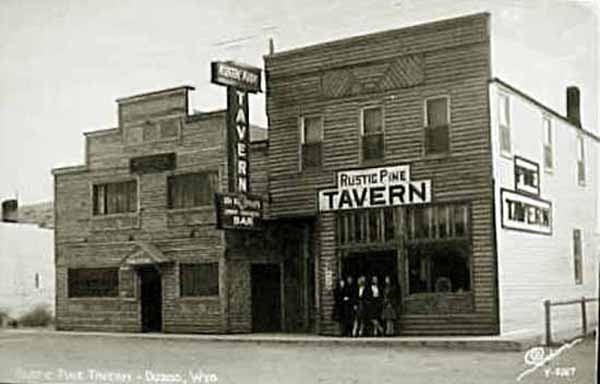
Rustic Pine Tavern, Dubois, approx. 1939
The Rustic Pine was constructed in 1919.
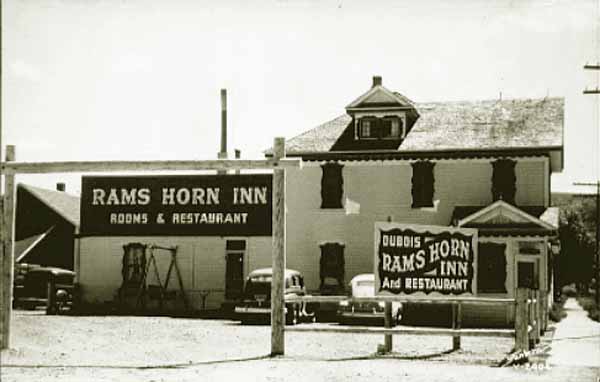
The Stringer, renamed as the Ramshorn Inn, approx. 1947.
The Ramshorn is still in business as a bar and retuarant.
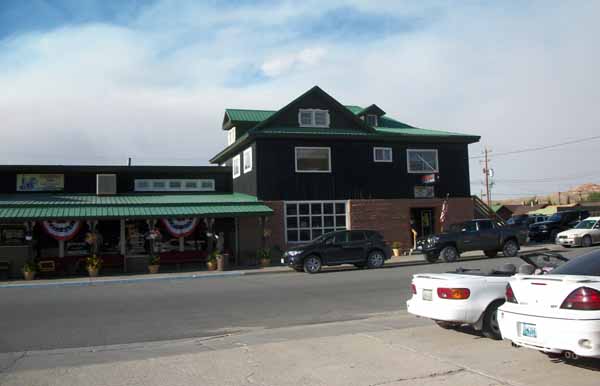
The Stringer, renamed as the Ramshorn Inn, 2013. Photo by Geoff Dobson.
The hotel and Ramshorn Ave. in Dubois took their
names from Ramshorn Peak which was popular with hunters.
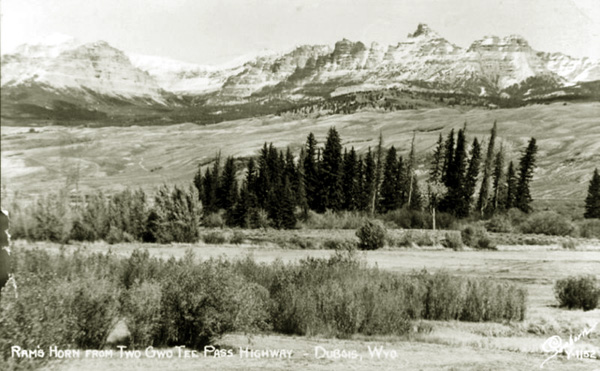
Ramshorn Peak, 1930s. Photo by William P. Sanborn.
The Church was organized by
the Reverend John Roberts from Fort Washakie. The lots for the church were donated
by Dr. F. H. Welty in 1910. The logs were donated by the Wyoming Tie and Timber Company.
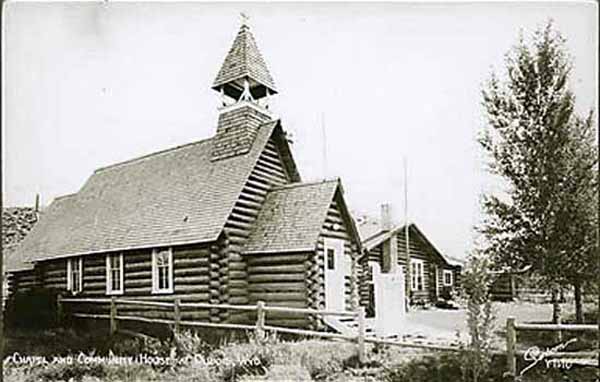
St. Thomas Episcopal Church. Photo by Wm. P. Sanborn
Next Page: Dubois continued.
|

