|
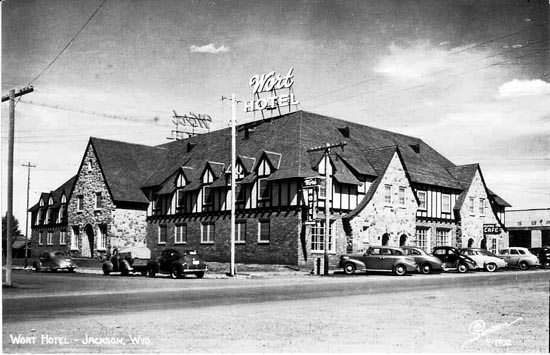
Wort Hotel, approx. 1941.
The growth of Jackson can, perhaps, be traced to the opening of the Wort Hotel in 1941 and the
Jackson Hole Lodge to customers in 1942. The Wort hotel, at the corner of West Broadway and Glenwood,
was built by Jackson natives John Wort (1902-1992) and Jesse L. Wort (1903-1987) who constructed
the hotel on lots their father, liveryman Charles James Wort, purchased in 1915. Charles
Wort settled in the area in 1893 and was a half brother of Stephen Leek.
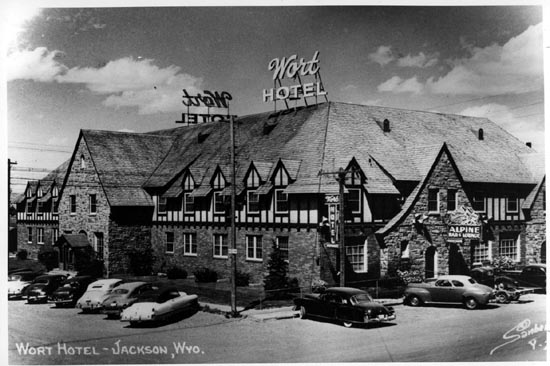
Wort Hotel, approx. 1950. Photo courtesy Wort Hotel Collection.
As previously noted, gambling has been illegal in Wyoming since
1901 The prohibition was largely ignored in communities such as Jackson. In addition to
the Cowboy Bar,
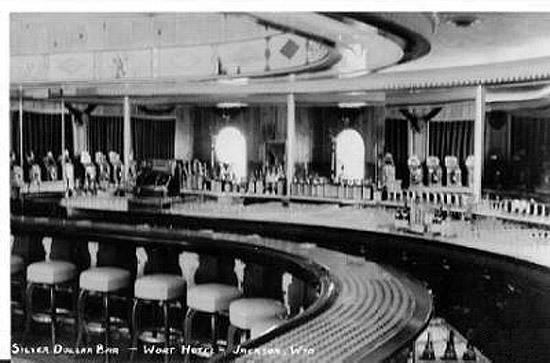
the Wort Hotel, featured one-armed bandits when it first opened. The slots, poker, craps roulette, and blackjack were
all located in a room just off the Silver Dollar Bar.
Slot Machines reflected in backbar mirror, Wort Hotel, approx. 1955.
The serpentine bar in the photograph, inlaid with 2,032 silver dollars, was constructed in 1950. on the afternoon of
August 5, 1980 an electrcal transformer for the rooftop sign set fire to a bird's nest. The fire spread from the nest
to the roof of the hotel. The fire caused extensive damage to the second floor of the hotel. Because the hotel was now open to the elements, rather than removing the coins the
bar was cut apart and stored in the vault of the Jackson State Bank until the hotel was restored.
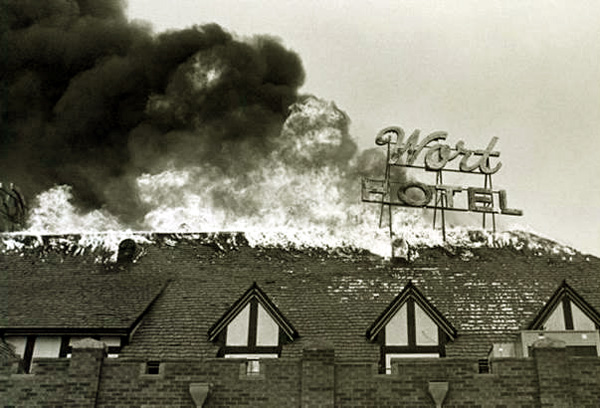
Fire on roof of Wort Hotel, August 5, 1980.
The hotel reopened in June of 1981. Several changes have been made. Off the Silver Dollar Bar was a showroom. The area is now
occupied by a souvenier shop. Over the years many famous including the Sons of the Pioneers, Willie Nelson (at the time an unknown), and Roy clark.
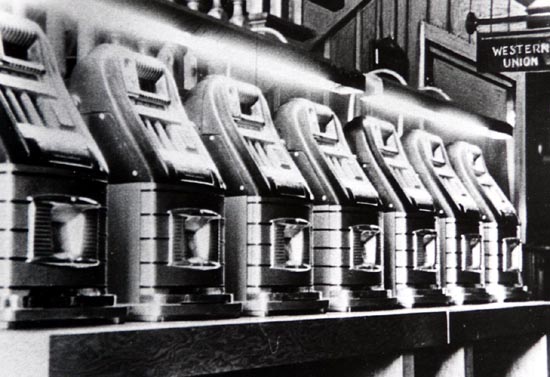
Slot Machines, Wort Hotel, approx. 1950. Photo courtesy Wort Hotel Collection.
Beginning about 1951, the winds of enforcement of the gambling
laws began to blow westward out of Cheyenne. On occasion word would be
received about a projected raid and slot machines and other gambling gear would be secreted in
the hotel manager Steve Bartek's cellar, only to be returned when the peril was over.
In 1955, however, Governor Milward Simpson cracked down on the flouting of the law in Jackson. Thus, the gambling in the
Wort Hotel was moved to a room in the basement locally referred to as the "Snake Pit" where one had to know a secret password to get in.
One Sheriff Olin O. Emery (1901-1993) told a newspaper repoter that there wasn't any gambling to his knowledge.
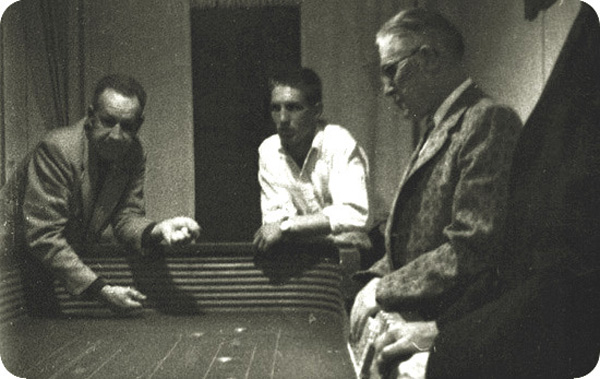
Hidden Camera view of a Game of Craps, Jackson, Wyoming, September 1956.
In August 1956, the proverbial substance hit the ceiling fan. In light of the
denial, one Saturday in August 1956, Bill Stewart managing editor of the Cody Enterprise, with the approval of paper's general manager Keith Baird,
came into town bearing his
camera. He was allegedly taken to an alley, manhandled, his camera taken from him and the film burned by an indiviudal claiming to be a
deputy sheriff. Sheriff Emery denied that the individual was one of his men. The question of gambling in Jackson was picked up by
a national magazine which referred to Jackson as a "family-style Las Vegas." To top it off, the owner of the Enterprise Paul Stork
directed Baird to fire Stewart. No reason was given for the dismissal. Baird durifuly followed
orders and then himself resigned in protest. The Denver Post picked up on the story. When asked by a reporter for the Deseret News why Steward was fired,
Stork answered, "It's none of your damned business." John Wort told the News that gambling was "small time."
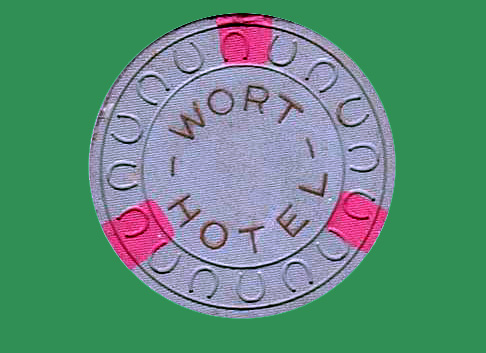 $100 chip. $100 chip.
In light of the image to the left, the gambling was not necessarily penny ante.
The Deseret News then got into the act and sent in a reporter with a hidden camera. Displayed in the
Page 10 of the September 10, 1956, featured a series of photographs showing men playing craps, slot machines, and persons playing cards.
Copies of the photographs were given to Wyoming Attorney General George Guy and promised
Sheriff Emery that he would be given copies. In light of the heat coming from Cheyenne, Sheriff Emery raided the place where the pictures were taken, seized a craps table and
a blackjack table, and arrested
V. O. sharkey for illegal gambling. Sharkey plead guilty and was released on a $1,000 bond. Sharkey was identified by
Sheriff Emery as a "guide."
But Governor Simpson meant it. when advised by the Deseret News of the continuaton of gambling in Jackson, the Governor was furious. He requested that
Attorney General Guy bring impeachment proceedings against the sheriff. The Attorney General's office brought a civil action against the sheriff alleging
misfeasance in office which would give the Governor the ability to suspend the sheriff. Proceeding were brought to revoke or suspend the
liquor licenses of the Wort Hotel, the Million Dollar Cowboy Bar, the R J Bar, and the Log Cabin Bar. The R J Bar and the Log Cabin Bar
were both located on the south side of Broadway. the R J, operated by LeRoy Jensen from 1945 to 1984, was in the middle of the block across from the
town square. The Log Cabin closed in 1963. It was located in the same building at the southeast corner of Cache and Broadway where the Rancher Bar and Abi Garaman's Ranch Shop and the
Coldwater Creek were later located.
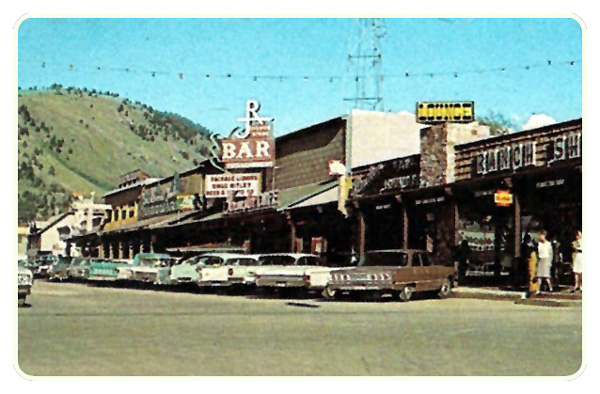
South side of Broadway, approx. 1963. The R J Bar is at the left in the photo. The Log Cabin Bar is to its right.
A compromise was made so that the residents of Jackson would not go thirsty.
The license of the hotel and R J.'s were suspended from the end of the New Year's eve parties until February 14 and the licenses of
the Million Dollar Cowboy Bar and the Log Cabin bar were suspended from February 14 until March 31, 1957.
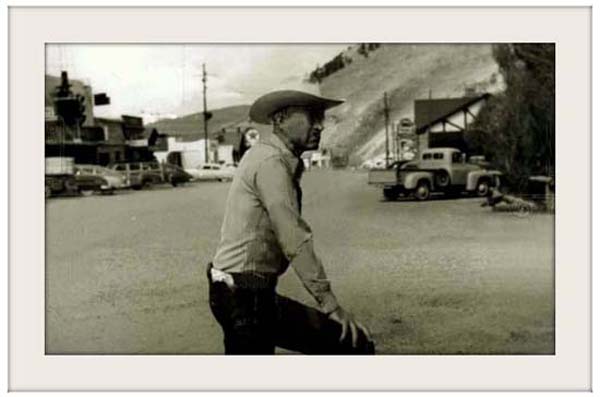
Sheriff Olin Emery, undated.
Note the pearl gripped revolver in the Sheriff's holster. The revolver brings to mind rumors which swirled about the Sheriff's father-in-law,
Robert Henry "Bert" Charter (1873-1939) who had owned a ranch out at Spring Gulch. Charter arrived in Jackson's Hole in 1916 from Pinedale where he previously had a
ranch. There he had engaged in the freighting business between Rock Springs and Pinedale. The freighting business had apparently ended after he was
seriously injured when run over by one of his wagons.
In 1898 during the Gold Rush, Charter and a companion went to Alaska prospecting
for gold. He returing to Wyoming after about two years. Before going to Alaska, Bert had spent several years in the Baggs, Dixon and Brown's Hole area working as a cowboy for, among others,
Ora Haley's Two-Bar outfit and for a while tending bar.
Thus, rumors arose that he had been a "fringe member of the Wild Bunch and had participated by helping in the
relays of fresh horses following the Telluride and Pleasant Valley robberies. The rumors seeming were based in part on the fact that he
purchased the ranch at Spring Gulch with cash.
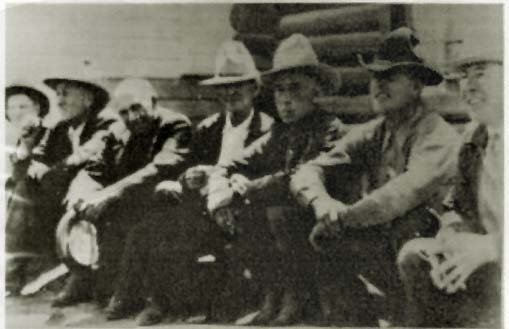
Bert Charter, fourth from left. Immediately to left of Charter leaning forward is Will Simpson.
If Charter had participated in the Telluride robbery, he would have been only 12 years old and newly arrived from Iowa. Sheriff Emery denied that his
fathr-in-law had ever been an outlaw. In 1939, Bert Charter died from pneumonia following surgery in
a Rochester, Minnesota, hospital. Services were conducted in the Jackson American Legion Hall.
During World War II, Bert's son Boyd served in the Pacific. While he was away, Bert's widow gave Bert's
pearl gripped Colt to Emery. The single-action 38/40 Army Revolver, Serial Number 151179, provides some collaboration of a connection to the Wild Bunch. The
Colt, according to factory records, was shipped to Roberts, Willis & Taylor Company, Sherman, Texas, on June 15, 1893.
Various legends seemingly originating with the Charter family had the Colt as having been specially ordered by Thomas "Black Jack" Ketchum or
stolen by him in a train robbery in Texas. After Tom's botched execution in
Clayton, New Mexico, (the rope was too long and Tom was decapitated.
See The Hanging of Tom Ketchum), the revolver allegedly came
into the possession of George Musgrave who gave it to
Bert Charter as security for a $150.00 loan. The timing, however, seems to be somewhat off. Tom lost his head to
Sheriff Garcia's miscalculation of the length of the rope after Bert had left for Alaska. Alternatively,
it has been suggested that the revolver was given by Tom Ketchum to either Butch Cassidy or the Sundance Kid and then in turn came into
the possession of Bert. No one in fact knows how the Colt made its way from Texas to Spring Gulch. After Boyd returned from the
war, Boyd demanded the gun. Allegedly after threat of a legal shootout, Sheriff Emery turned the
gun over to Boyd. How the gun came into Bert's possession remains, however, an unsolved mystery.
Following the big stink over gambling in Jackson and threats by the Attorney General, Sheriff Emery resigned.
It should be observed that Sheriff Emery's attitude toward gambling was no different than many small town
sheriffs throughout the United States. The writer is reminded of the story of the small town sheriff in
another state (names not given to protect the guilty) who was walking by a fraternal lodge. It was summer time
and hot. From the open windows came the distinct sounds of slot machines. A little old lady, seeing the
Sheriff said, "Sheriff, there is illegal gambling going on in there." "How do you know," replied the sheriff.
"Listen, Sheriff," she said, "Don't you hear it." "No, ma'am, I don't hear anything." "Step up on the lawn, Sheriff, and you
can hear it." she said. "Ma'am, there's no gambling going on in there, and if you step on the lawn, you will be
arrested for trespass," the Sheriff rejoined.
All good things must come to an end and the sheriff was ultimately required to raid the lodge. Of course,
the Lodge received advance word, and members scurried in to remove the offending equipment which they carried out
to a Chevrolet station wagon at the curb. But unfortunately, the
Chevrolet had developed a flat tire. The machines were covered with sheets just as the deputies arrived. One of
the deputies helped change the tire. The raid was then conducted and nothing found.
In a small town in Georgia, a young cub reporter, later a columnist for the Baker County Standard, "Poke McHenry," heard that there had been
a burglary of the local American Legion at which the club's slot machines had been stolen. Calling the
sheriff to confirm that there had been a burglary. Poke forgot to mention what had been
supposedly stolen. Poke was told there was NO burglary of the legion and if he
reported the theft of the slot machines, Poke would be in deep trouble.
The hue and cry that tourism and growth in Jackson would end without gambling, proved not to be
true.
Next Page: Cache Street continued.
|