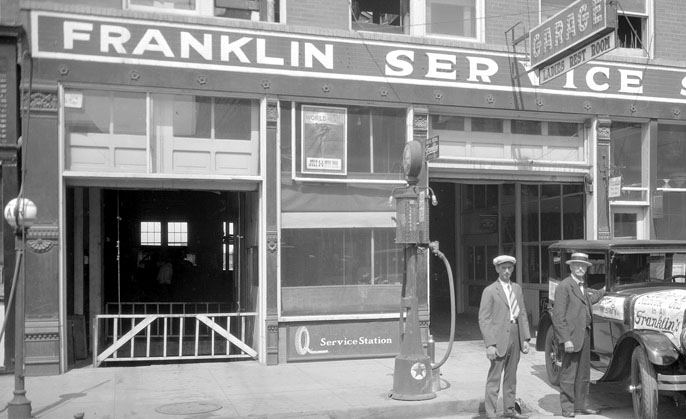
Lovejoy Novelty Works, 412-414 S. Second Street, Laramie.
For discussion and photos of Laramie, see Laramie.
Note: under the "Garage" sign is another sign, "Ladies Rest Room."
Prior to the end of World War I, the principal
places for obtaining gasoline were automobile dealers and hardware stores each with hand
operated pumps in front. In Laramie the Lovejoy Novelty Works, owned by Elmer Lovejoy was
one such place. Lovejoy as indicated by the sign was an agent for Franklin. He was
also an agent for Studebaker. Guide books to the Lincoln Highway could also be obtained from Lovejoy.
Another garage that had special facilities for ladies was the Oldsmobile and Reo dealer Bath Motor Co., locatedat the intersection
of 3rd and Custer. Bath advertised that it had Ladies' Rest Rooms with Cictrola, Bath, Latest Magazines, Easy Chairs and Lounge..
Indeed, until after World War II several auto dealers continued to sell gasoline. Another auto agency was the Laramie Auto Company.
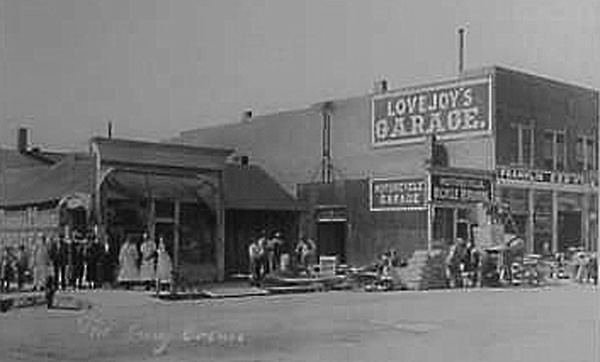
End wall of Lovejoy Novelty Works, showing Lovejoy's bicycle shop and an adjacent grocery store.
.
By the early 1920's Besides Lovejoy and Bath, other prominent dealers were Laramie Auto Co. (Ford) at
419-421 S. 2nd Street, Frazer's Garage (Dodge Brothers) at 206 S. 2nd Street, Oakland Garage (Oakland) at 309 2nd Street, Will Goodale Garage
(Hudson and Essex) at 212-14 Grand Ave, and the West Side Garage (Saxon Six, Paige, Jordan and Scripps-Booth cars)
at 312 S.Cedar Street.
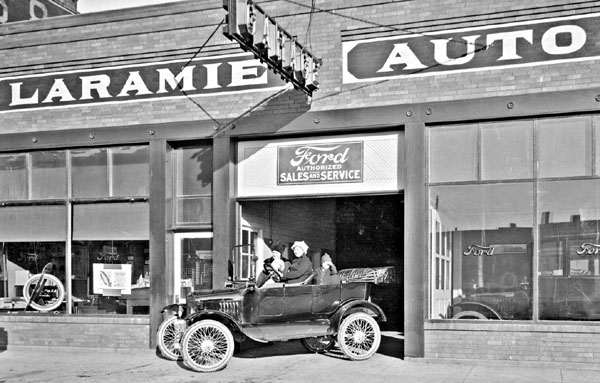
Lady taking delivery of new 1917 Ford Model T Touring Car.
.
The car cost $360.00. It marked the declining era of brass. The only brass on the car
was the radiator filler and the hubcaps. New for 1917, the radiator was finished in black
enamel and the car came equipped with an electic horn activated by a button on the steering column below the
steering wheel. Through the showroom window may be seen a four-door, seven passenger Model T Town Car which cost $595.00.
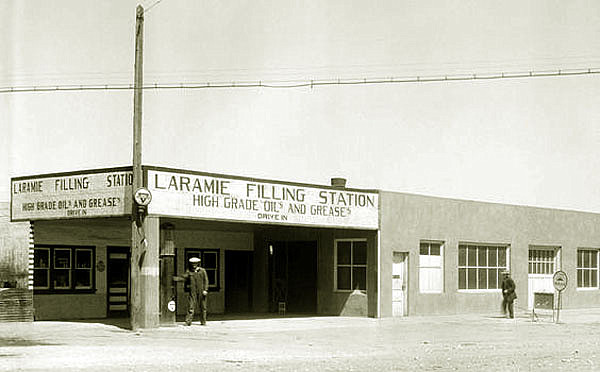
West Side Garage, approx. 1930.
.
By the time of the above photograph the manufacture of mmost of the cars sold by the West Side Garage had been discontinued. Scripps-Booth controlled by Chevrolet was discontinued in 1922 and
Saxon in 1923. Paige was acquired by the Graham Brothers in 1927 and the use of the name
was discontinued in 1930. Following World War II, Graham-Paige built Frazier cars for a short period of time before its automotive
assets were acquired by Kaiser-Frazier which in turn later became part of American Motors and subsequently Chrysler.
The non-automotive part of
Graham-Paige changed its name to Madison Square Garden Corporation and is now a part of Viacom. Jordan
discontinued production in 1931 when its manufacture of a small luxury car flopped.
In the early 1920's on the Lincoln Highway the danger of running out of fuel was real. The 1918 Lincoln Highway Association, "Complete Official Guide" warned,
"Don't wait until your gasoline is almost gone before filling
up. There might be a delay, or it might not be obtainable at the
next point you figured on. Always fill your tank at every point
gasoline can be secured, no matter how little you have used from
your previous supply."
A writer for the Engineering News-Record, Vol 89, No. 6, p 234, 1922, ran out of gas
returning from a visit to a new "dipping tank" installed by Senator Warren, learned the
hard way. He wrote: For cross-country cruising one needs more than a sense of direction. A tar-bucket memory as to the formation of prairie-dog villages and sage-brush clumps is a much better guide. There is a limit to the number of miles
per gas-tank measure one may drive even a Dodge on so good a road
as the disintegrated gravel of Sherman Hill. When the last ounce of gas
had been drawn through the carburetor Mr. Warrington comforted me with
the remark that statistics indicated that a car passed over this portion
of the Lincoln Highway every 22 minutes. Thirty minutes after this
observation a young rancher armed to the teeth against road robbers
pulled up behind us and cautiously made friends. Ultimately, however,
he generously drained a gallon of gasoline from his flivver tank into
a milk can top which he poured successfully into our tank through a
funnel improvised out of an Engineering News-Record envelope.
After crossing Spring Creek, one proceeded west along Grand Ave several miles into Laramie. Near the University of Wyommng, Grand Avenue
was a graded residential street. In Laramie, according to the 1916 Official Road Guide to the Lincoln
Highway, one had a choice of routes west. One could continue on the Lincoln Highway west on
Grand Avenue and at the Connor Hotel, turn north on 3rd Street, thence proceed north across the Laramie River near
Bosler, 18 miles to the northwest. Alternatively, one could take an 18-mile shorter, more direct, route
to Elk Mountain. The only difficulty with the more direct route was that one would have to open [and close]
32 gates along the way.
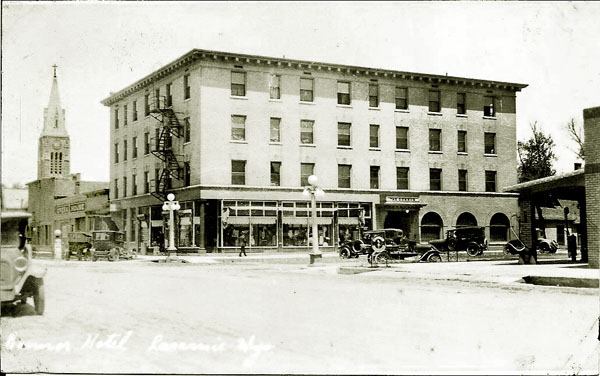
Hotel Connor, Northeast corner of Grand Ave.and Third Street, approx 1922.
To the left of the hotel is the Opera House with a sign on front. See next photo. The brick canopy on the right side of
the photo of the Connor Hotel is that of
an Aero service station. Later it became a Texaco Station. The steeple is that of
St. Matthews Episcopal Cathedral.
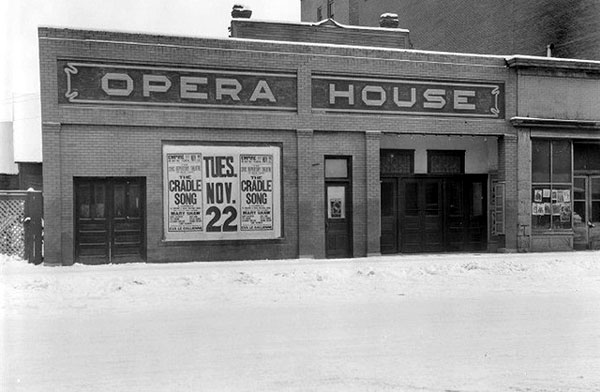
Root's Opera House, undated.
The tall building on the right of the Opera House is the Connor Hotel.
Prior to 1920 3rd Street was primarily residential.
Following the end of World War I and improvements to the
Lincoln Highway,increased traffic made Laramie an ideal
spot to fill up on gasoline. In 1916, according to the Lincoln Highway Association Guide, there were
only three garages in Laramie and not all necessarily sold gasoline. Indeed, between Laramie and Rawlins, according to the Guide, there were
only three garages, one each in Bosler, Rock River, and Medicine Bow. By 1920, gas stations began to be built.
In 1920, the first modern filling or service station was the "University Filling Station" owned by
Hammond and Rebhausen opened at 100 S. 3rd Street.
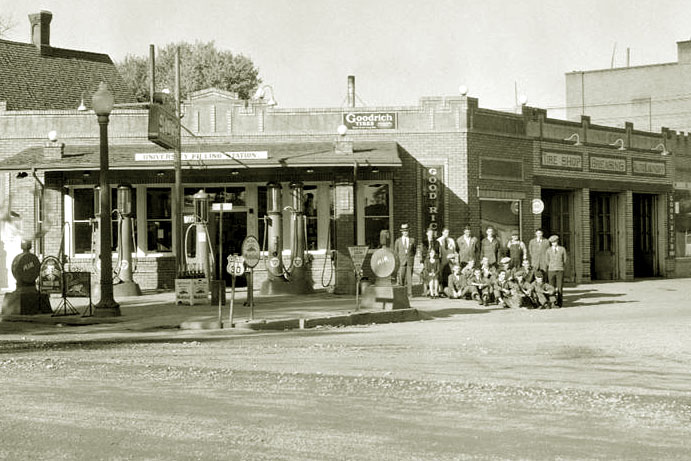
University Filling Station operated by
Oscar Hammond
Initially, the station sold "Powerine" gasoline and "Autokrat" oils and greases marketing by an arm of
the Denver Powerine Company. Powerine marketed petroleum
products refined by others including Parco. As a brand it ultimately following 1945 became a part of Enco/Exxon. It "Bearcat" logo ultimately
transmorphed, according to some, into "Tony the Tiger."
Note the "US 30" sign on the corner which can help date the photo.
By 1922,Wood's Coal and Oil Company opened a station across the street from the University Station at the corner of
University and 3rd.
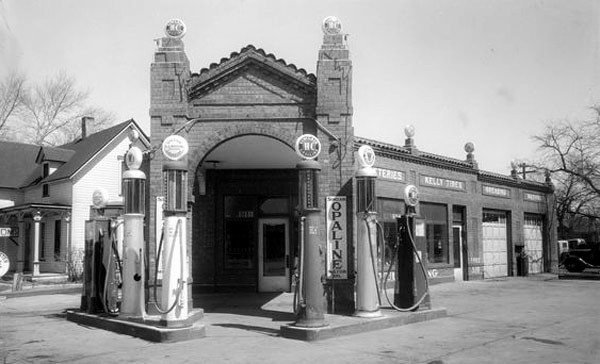
Wood's Coal and Oil filling Station.
Note the Opaline sign. Opaline was a brand name for its oil and lubrication grease.Sinclair acquired the brand mame when it
bought the Cudahy Refining Co. of Kansas.
Other oil compannies opened stations in Laramie including "Aero" at 5th and Grand, "Chief" at 3rd and Ivenson, and a "Calso" station.
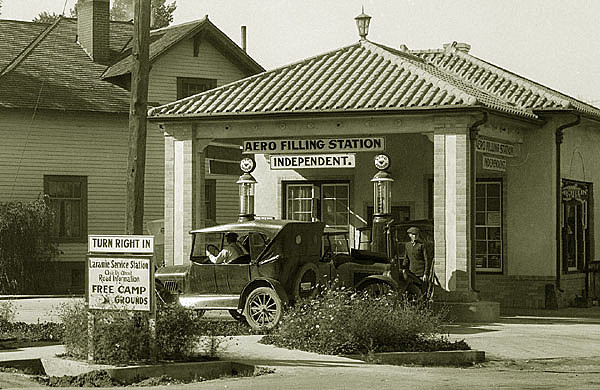
Attendant checking oil at Aero Service Station, SW corner of 5th and Grand, approx 1924.
.
As in Cheyenne, Casper and Cody the City offered free camp grounds for tourists. The sign
gave directions to the campgrounds. Behind the station there was a grease rack.
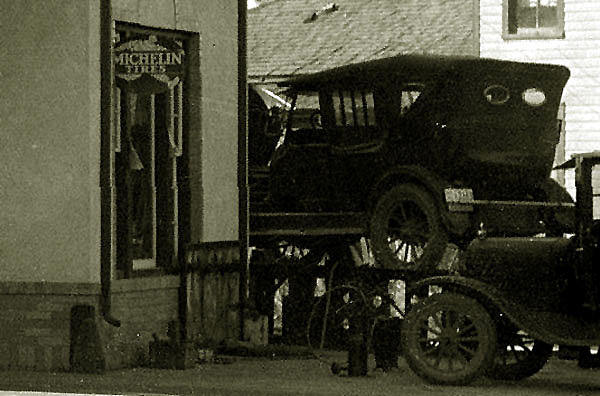
Grease Rack behind Aero Station. Approx. 1924.
Aero Oil Company was primarily a distrbutor of gasoline. Leslie A. Miller (1886-1970) was president of
Aero. He later served as
governor of the state from 1933 to 1939. In 1927, Miller sold his interest in the company. Two years later he founded
the Chief Oil Company.
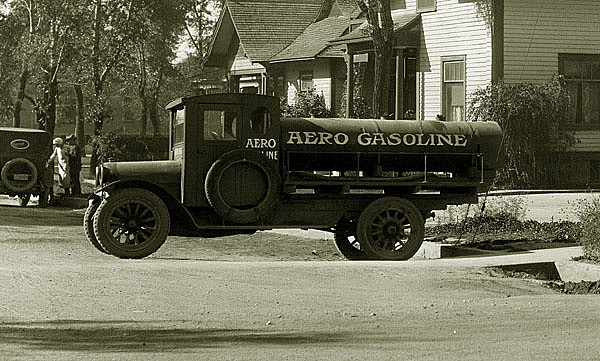
Aero Gasoline Tank Truck at Aero Station. approx 1924.
The Aero gas station building depicted above has not been razed. It has been converted into a tanning parlor.
Several automobile dealers continued to sell gasoline up until World War II.
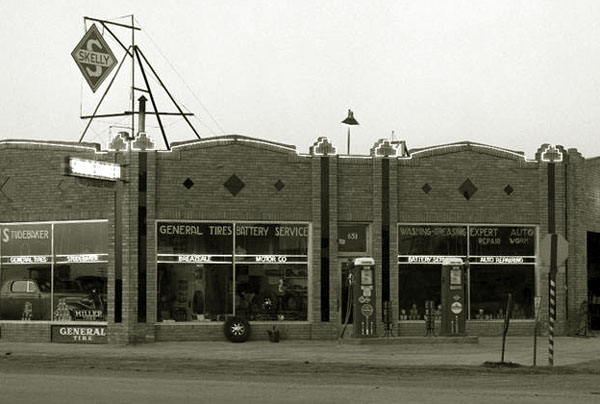
Breazeal Motor Company, 651 N. 3rd Street, approx 1939.
Breazeal sold Studebaker, Willys and International Harvester. Later it became
Bovee Motor Company. Today the 3rd Street side is a carpet emporium. On the Flint Street side there were
service bays. Several now house a take-out and delivery pizza store.
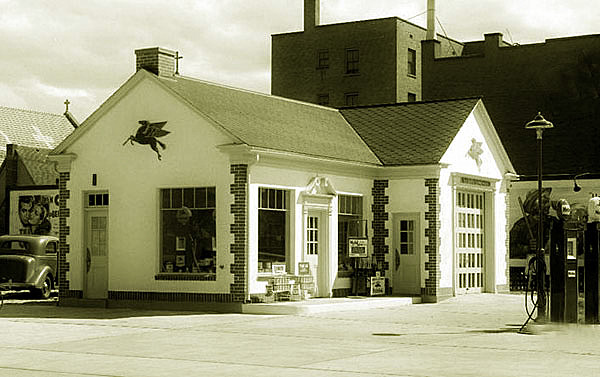
Socony-Vacuum Station, 201 S. 3rd Street, approx 1936.
The station is now gone. Its site as of 2018 is occupied by Les' Auto Repair.
Next: Bosler and Rock River.
|