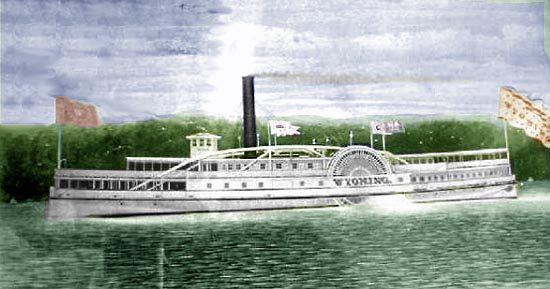
The Hudson River sidewheel steamer Wyoming
In addition to naval ships, tankers, schooners, and fishing smacks named "Wyoming" there were
Great Lake steamers and a Missouri River steamer named Wyoming. As indicated on the previous page, there have been a number of civilian ships named Wyoming. The above image is that
of a Hudson River sidewheel steamer Wyoming owned by Joseph Cornell, brother of Thomas Cornell of the famed Cornell Steamboat
Company, owner of the Mary Powell. The vessel was named after a county in Northern New York, east of
Buffalo.
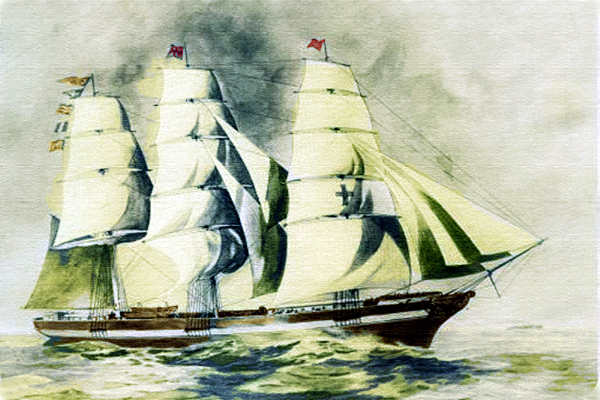
The Cope LIne Packet Ship Wyoming, underway appox. 1845
The Cope lIne was founded by Thomas P. Cope in 1821 of Philadelphia. The Wyoming was constrcted in 1845 By John Vaughan & Sons of Philadelphia.
The Cope line ran packet ships between Liverpool and Philadelphia from 1841 until the 1870's. because of the extra distance and the time required to come up
Deleware Bay he had a monopoly in Philadelphia, it being more convenient and faster to sail for passengers to
go into New York. The line normally ran five ships. The crossings usually took 18 to 60 days. One of the ships would leave the stage at
Liverpool on the 20th of each month. A monthly schedule was also maintained out of Philadelphia leaving on the 5th of each month. Thus, the need for five ships to maintain
schedules. After its construction, the Wyoming was re-rigged as a bark. Other ships in the line included the Algonquin, launched April 9,1823; the Lancaster,
Monongahela, Susquehannah, Shenandoah,
Saranac, The Thomas P. Cope and Tonawanda.
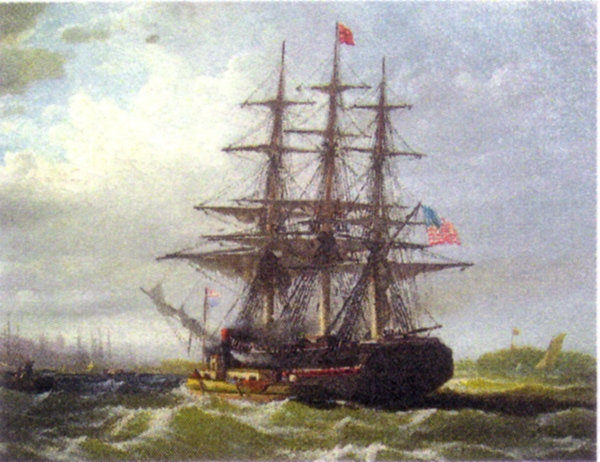
The Thomas P. Cope approaching Philadelphia, painting by Thomas Moran, 1860/
Although the Wyoming was named after an area of Pennsylvania, the Cope Line has some
significance to the State of Wyoming. Not only did some members of the Latter Day Saints travel to America the Cope Line,
but,it is likely that since Cope was the only line running into Philadelphia, that Thomas Moonlight, later Territorial Governor of
Wyoming, worked his way before the mast to the United States on one of Cope's ships.
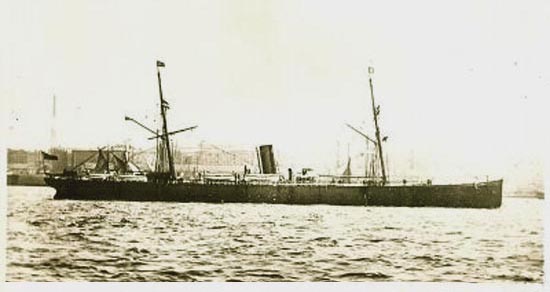
The British flag, brig-rigged screw steamer Wyoming
The S.S. Wyoming was constructed in 1870 by Palmer's Shipbuilding & Iron Co., Ltd, for the Liverpool & Great Western Steamship Company, popularly known
as the "Guion Line" after its founder Stephen Guion. The Company's ships were named after American
western states and territories and included in addition to the Wyoming, the Colorado, the
Nebraska, the Nevada, the Idaho, the Wisconsin, the Montana and the Dakota. Later, the Company became
famous for its "greyhounds of the sea," the Alaska, Arizona and the Oregon. The latter two held the
"Blue Ribbon."
The Wyoming was 3729 tons and 600 horsepower. Its fastest time westbound, Liverpool to New York was nine days seven hours, and eastbound
eight days six hours. Fares were advertised as $80.00 gold for a cabin and $30.00 currency for steerage.
Although, British flagged, the Company was primarily owned by Americans. The ships were primarily in the emigrant trade from Liverpool to New York. Liverpool was
a primary port of emigration for emigrants saling from the continent of Europe. The emigrants would go by ship from the continent to ports such as Hull at
the confluence of the Humber and the Hull and then proceed by emigrant train to Liverpool. Liverpool at the time was the
headquarters for some of the major lines including Cunard and the White Star Line. The trains consisted of only third class carriages with wooden seats into which the
emigrants would be crowded. At liverpool they would embark from the landing stages at the Princes and
George Docks for the voyage to America. With the construction of newer docks in Southhampton after the turn of the century, passenger service from Liverpool fell off. The docks have been converted into
trendy housing, restuarants and a museum with exhibits of the old slave trade, and the maritime history of the port, and the R.M.S. Titanic. Following Guion's death in
1885, the Company began to lose money. The fleet was ultimately liquidated and by 1894 the line had ceased
operations. The
Wyoming was sold for scrap in 1893.
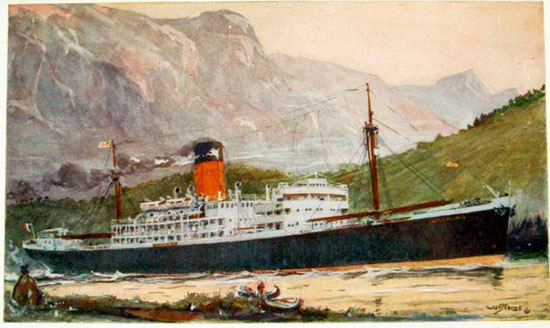
The Wyoming on the French Line's Pacific Coast-to-France Passenger and
Freight Service, 1935
The French Line Wyoming, owned by Compagnie Générale Transatlantique, the French Line, went into
service in 1930. With the French surrender to Germany during World War II, the Wyoming fell into British hands and
was operated by Thos. & Jas. Harrison, Ltd.
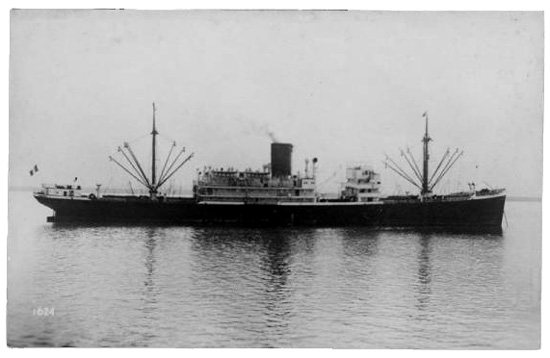
The Wyoming in the service of Thos. & Jas. Harrison, Ltd.
The Wyoming was torpedoed by U-524 on March 15, 1943. All hands and passengers were rescued.
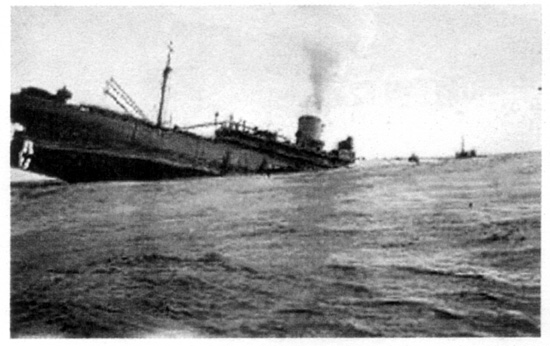
The sinking of the Wyoming, 15 March 1943.
The U-524, on its first sortie into the Atlantic, was in turn sunk by depth
charges dropped by a Liberator aircraft seven days later.
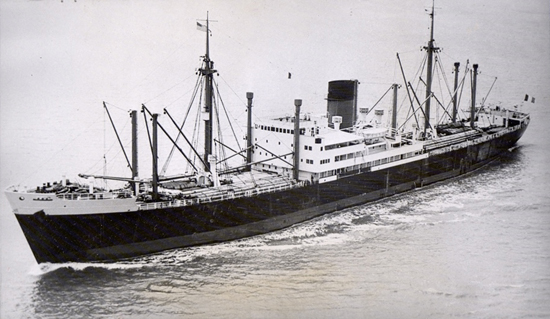
The French LIne Wyoming, 1949
Following World War II the French Line replaced the Wyoming with a new ship launched in
1948. It was later sold to Japan and renamed the Seifu Maru.
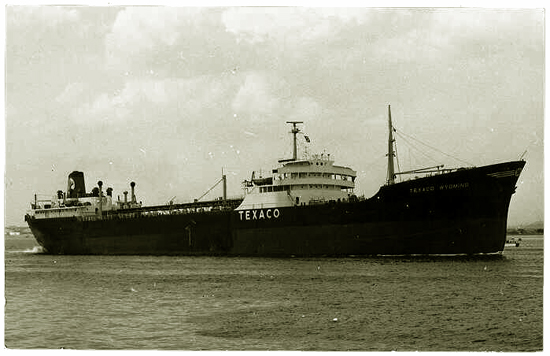
The Texaco Wyoming.
The Texaco Wyoming was constructed in 1943 by the Sun Shipbuilding and Drydock Co. of Chester, Pennsylvania. She was
originally named the Buena Vista and was renamed in 1950 as the Wyoming and in 1961
as the Texaco Wyoming. In 1972 she was renamed the Sea Lady.
Music this Page: The Leaving of Liverpool
courtesy of
Horse Creek Cowboy
Farewell to Prince's Landing Stage
River Mersey, fare thee well
I am bound for California
A place I know right well
Chorus:
So fare thee well, my own true love
When I return united we will be
It's not the leaving of Liverpool that's grieving me
But my darling when I think of thee
I'm bound off for California
By the way of stormy Cape Horn
And I'm bound to write you a letter, love
When I am homeward bound
Repeat Chorus
I have signed on a Yankee Clipper ship
Davy Crockett is her name
And Burgess is the Captain of her
And they say she's a floating Hell
Repeat Chorus
I have shipped with Burgess once before
And I think I know him well
If a man's a seaman, he can get along
If not, then he's sure in Hell
Repeat Chorus
Farewell to lower Frederick Street
Ensign Terrace and Park Lane
For I think it will be a long, long time
Before I see you again
Repeat Chorus
Oh the sun is on the harbour, love
And I wish I could remain
For I know it will be a long, long time
Till I see you again
Repeat Chorus
Writer's notes: The above song is one of two versions. An older version
dating to the Gold Rush will be found at Oregon Trail
. This version can be dated as between 1860 when John Burgess took
command of the David Crockett, one of the fastest of the "California Clipper Ships," and
1874 when Captain John Burgess was allegedly swept overboard off of Argentina. The ship's departure
from California was delayed by five days when the crew mutinied. With the loss
of the captain, the first mate, John Anderson, assumed command and was able to bring the ship into Liverpool from
San Francisco in only 107 days. Anderson remained in command for the next nine years.
Next page: The Riverboats and Great Lake Steamers named Wyoming.
|