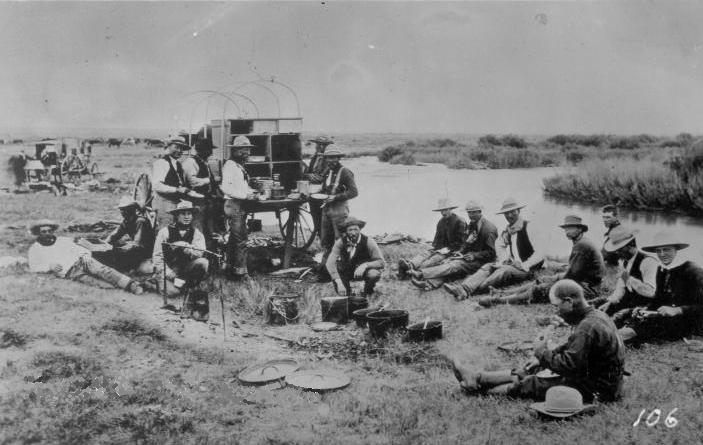
Roundup Camp, Wyoming, 1880's
The flat brimmed hats some of the
cowboys are wearing is the Stetson "Boss of the Plains" hat originated in 1865 and sold for $5.00. By
1900 it was sold by Sears Robuck and Company for $4.50 plus postage. Shaping of the brim and crown
was done by the owner. As noted with regard the discussion of Cheyenne, the
chuckwagon was invented by Charles Goodnight. Brands included Studebaker, South Bend, Owensburrow, McCormick-Deering and Weber. McCormick-Deering in
1907 changed its name to International Harvester and continued to supply wagons until the 1940's.
After 1936 all of the International wagons were manufactured by Keller Manufacturing Company which discontinued
production in 1943 and converted to the manufacture of furniture. Studebaker also built a heavier
wagon known as the "roundup wagon" more suited to roundups but not as well suited to
trail drives as the lighter
chuckwagon. On large drives an additional wagon known as a "hoodlum wagon" was
used for carrying bed rolls and personal gear.
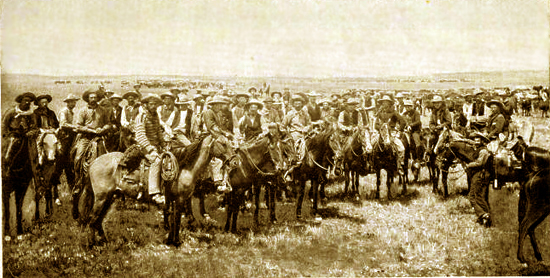
Cowboys on round-up approx. 1892. Photo by C. D. Kirkland.
In the 1880's on the northern Great Plains of Wyoming, Montana and Dakota Territory, ranchmen for the most part relied on open range and did not own
the lands upon which the cattle grazed. A few such as the Swan Land and Cattle Company Ltd might own or lease large tracts, but they were in the minority.
Most owned only a few acres immediately surrounding the home ranch. Some such as Dakota ranchman Theodore Roosevelt owned none at all. He was essentially a squatter
on government or railroad land. After the cattle arrived on the northern plains they were put owt to graze on the open range. Thus, an essential
part of the ranchman's year were the two general roundups conducted cooperatively by all stockmen in an area, a Spring Roundup to gather calves for branding and the fall roundup to gather
steers for shipment to Omaha or Chicago. After formation of the Wyoming Stockgrowers Association and the Montana Stockgrowers Association, the
roundups were conducted under their auspices. Of the two roundups, the Spring was the more important. The fall roundup was merely, as phrased by Emerson Hough, the harvesting of the
crop which had been allocated in the Spring Roundup.
A roundup district would be designated with the
roundup to be conducted under the leadership of a commissioner designated at an annual meeting of the stockgrowers. The commissioner was sometimes referred to as the "Roundup Boss."
At the annual meeting the districts would be designated, the date and place of commencement for each of the roundup. In 1899, the State was divided into thirty districts. Districts Nos. 1 and 2 were designated as follows:
No. 1
Commencing July 12 at Whittaker home ranch, thence up Laramie river to Laramie City, then to NL ranch, thence through the hills to head of Sabille, working all pastures as far west as Cheyenne and Northern rialroad to Iron Mountain
station and following down Sabille to Jones' ranch; thence to Blue Grass springs, thence to McGill's bridge, finishing at Sabille springs.
Commissioner--John Whitaker.
No. 2
Commencing at the Adamson ranch June 1, working Horse creek, Bear creek, Fox creek, Lone Tree, Big Willows, Little Willows, J. Pens, Rock ranch,TH ranch, up to Fort Laramie; Cherry
creek, Box Elder, Burr dams, Bordeaux, M. Chugwater, Whitcomb, LL, Richard Pens, Hunton creek, Dead Head, Jones' ranch, winding up at Henke ranch, at Pine hill.
Commissioner--Al. Bowie
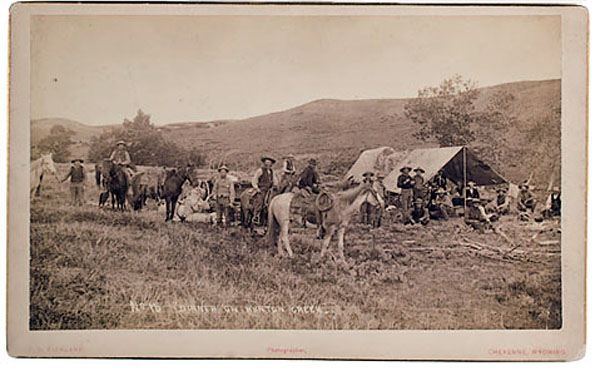
Cowcamp on Hunton Creek, Photo by C. D. Kirkland.
Dakota Ranchman T. Rooseelt described the hustle and bustle at the place of commencement of a roundup:
At the meeting-place there is usually a delay of a day or two to let every one come in; and the
plain on which the encampment is made becomes a scene of great bustle and turmoil. The heavy
four-horse wagons jolt in from different quarters, the horse-wranglers rushing madly to and
fro in the endeavor to keep the different saddle-bands from mingling, while the " riders," or
cowboys, with each wagon jog along in a body. The representatives from outside districts
ride in singly or by twos and threes, every man driving before him his own horses, one of them
loaded with his bedding. Each wagon wheels out of the way into some camping-place not too near
the others, the bedding is tossed out on the ground, and then every one is left to do what he
wishes, while the different wagon bosses, or foremen, seek out the captain of the round-up to
learn what his plans are.Roundup, Vol. 35 Century Illustrated Monthly, 1888, p. 849.
Jack Flagg, a cowboy who had worked for the Bar C, described the gathering on the first day of the Spring 1883 roundup. On May 20 some 40 men with 1,400 head of horses were
present at the mouth of Crazy Woman. "The signt," Jack observed, "was a beatutiful one. fFor two miles along the river the wagons were camped, in order to afford room for the different bunches of horses to graze without
becoming mixed." Jack continued:
[E]very man rode his best horse, and each one vied with the other in the splendor of his rig. Shouts of laughter could be heard now and then, as some tenderfoot would be thrown
from his bucking horse, and such exclamations as stay with him! Jump off! Spur him in the eye! would be yelled at some poor fellow who would be striving
with tooth and to nail to stick on the unmanagable steed. Oscar H. "Jack" Flagg:
A review of the Cattle Business in Johnson County, Wyoming, since 1882, Buffalo Bulletin May 5, 1892
For discussion of Jack Flagg, see Johnson County War.
Some districts and roundup would cover hundreds of miles. The No. 8 Roundup for 1899 was described:
No. 8.
Commence May 25 at Hat creek store, then to OW ranch and down the Old Woman to the mouth, working Young Woman and the
head of Buck creek on the down, thence up Lance creek to U-L ranch, up Lance creek to head, cross to Hearney Meadows, from there to
Twenty Mile; thence to head of Lightning creek to Beaver dams, up Box creek to head, across to Dry creek, down Dry creek and across to Fiddle, back crossing of
the Cheyenne River, up the Cheyenne river to DV pens on Park creek, then to flats
at head of Wind river; thence down Antelope and Sand creeks, working them and their tributaries to
Cheyenne River, and down Cheyenne river to 4W ranch.
Commissioner--J. O. Chambers
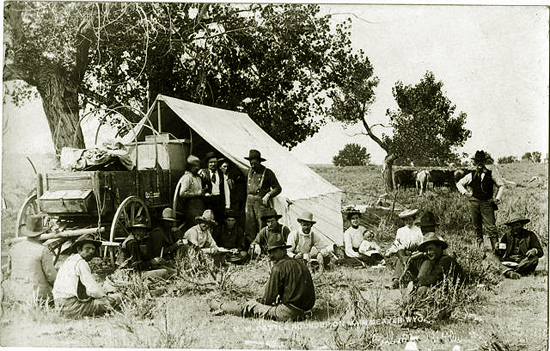
O W Wagon on the Beaver, undated
The various stockmen would gather with their men and their wagons at the desginated time and place.
The first order of business was establishment of a cowcamp. Emerson Hough explained:
After the assembling of the clans, a sort of semi-military organization was effected under the control of the round-up boss.
There might not be very many tents in evidence�the cow puncher�s bed, a pair of blankets
or so, a quilt, and the ever useful � tarpie ���would serve him in many places and in most
weathers. Sometimes the cook had a tent, and sometimes he worked in the open air. The butler�s pantry was the tail-gate of the
chuck wagon. The cookstove was a trench in the ground, the fuel was perhaps bois des vacbes, the table was the sandy
floor of the plain. A man might eat standing or sitting as he liked. It was etiquette for him to get his own plate,
cup and knife, and to return them after use. There was little lost motion and small red tape. To the onlooker a round-up might resemble a lark or a
picnic. For the men making it, it was strictly business. Recreation Magazine, "The Roundup," August 1912.
Writer's note: bois des vacbes, Wood of the Cows, i. e. cow chips.
Each of the crews participating in the general roundup was usually referred to as a "wagon." Thus there might be an N Bar N wagon, a Two Bar wagon, and an O W. Wagon.
A wagon from one brand might be accompanied by a "Rep" from another brand to ensure that the Rep's employer's cattle were also
properly separated, an early form of "Trust but Verify." Other participants in the general
roundup included tellers to tally the count and brand inspectors assigned by the Stockgrowers Association.
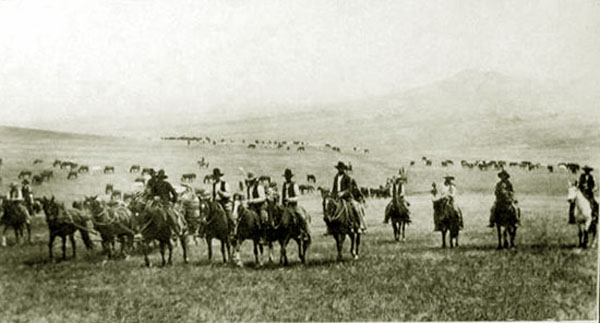
Going to Roundup, Photo by L. A. Huffman
Pursuant to the direction of the Roundup Boss,
the different crews or wagons would be assigned areas in which all cattle regardless of brand would be rounded up.
In the assigned areas the respective wagon bosses would direct pairs of cowboys to different portions of the assigned area, a process called
"scattering." Each drainage, draw, and arroyo would be investigated, swept clean of cattle and driven to a central location and bunched into herds.
Calves would be cut out from the herds according to brands and would be branded based upon the brand of the mother.
Thus it was essential that the Spring Roundup be conducted after the calves were born but before they were weaned. The cutting out process was
hard on the horses. Thus a large cavey of horses was required. The cavey was pastured at night under the watchful eye of a "night hawk." During the day when horses had to be changed
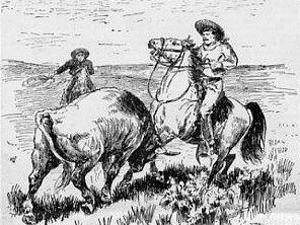
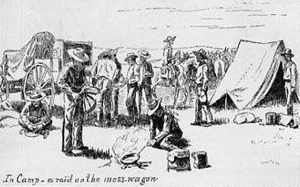
frequently the horses would be kept in a rope corral. The process is indicated by the following set of woodcuts:
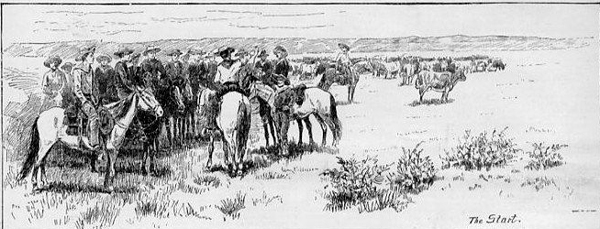
"The Start"
 .
. 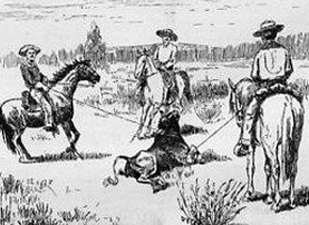
Left, "The Rebel," Right, "Vanquished"
 .
. 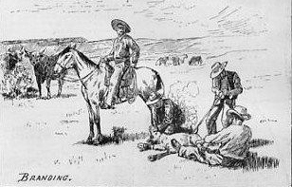
Left, "In Camp, A Raid on the Mess Wagon," Right, "Branding"
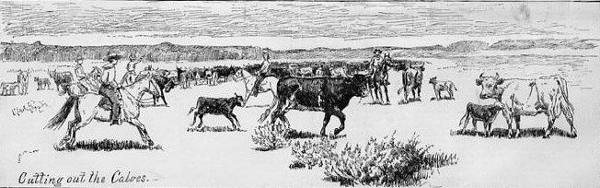
"Cutting Out Calves"
Dependent upon the size and geography of the
district, the cowcamp might merely consist of a mess wagon out in the open as described by Hough with cooking done in dutch overns suspended over an
open fire. Where the geography of the roundup district was such that the
the cowcamp did not need to be frequently moved, the mess might be more elaborate with a mess tent housing an actual stove.
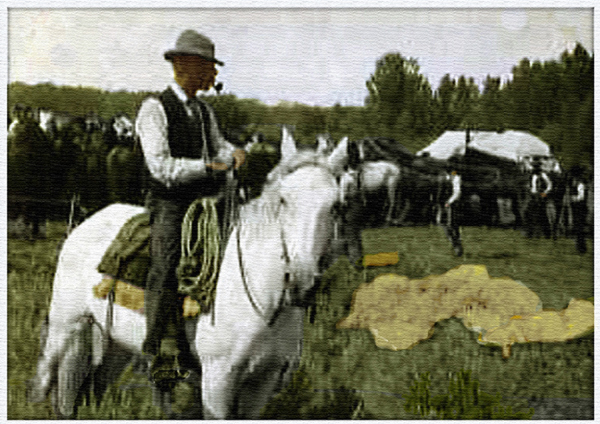
Cowcamp Yellowstone Roundup, art work by G. B. Dobson based on an old stereograph.
Music this page, The Big Corral. Not all cowboy songs date to the 19th
Century. The Big Corral was written by Romaine Lowdermilk in 1922 and
based on the gospel tune Press Along to Glory Land.
The Big Corral
(Verse)
That chuckwagon brute from the cattle chute.
Press along to the Big Corral.
He should be branded on the snoot.
Press along to the Big Corral
(Chorus)
Press along cowboy, press along,
Press along with a cowboy yell.
Press along with a noise, big noise,
Press along to the Big Corral.
(Verse)
Well, early in the mornin' 'bout -- half past four.
Press along to the Big Corral.
You'll hear him open his face to roar.
Press along to the Big Corral.
(Repeat Chorus)
(Verse)
The wrangler's out a-combing the hills.
Press along to the Big Corral.
So jump in your britches and grease up your gills.
Press along to the Big Corral.
(Repeat Chorus)
(Verse)
That chuck we get ain't fit to eat.
Press along to the Big Corral.
There's rocks in the beans and sand in the meat.
Press along to the Big Corral.
Next Page, Roundups continued.
|