Cody Road

From Wyoming Tales and Trails

Continued from previous page, this page: Aron "Tex" Holm, Ned Frost, Fred Richard.


Big Horn Basin Black Hills Bone Wars Buffalo Cambria Casper Cattle Drives Centennial Cheyenne Chugwater Cody Custer Deadwood Stage Douglas Dubois Encampment Evanston Ft. Bridger Ft. Fetterman Ft. Laramie Ft. Russell Frontier Days Ghost Towns Gillette G. River F. V. Hayden Tom Horn Jackson Johnson County War Kemmerer Lander Laramie Lincoln Highway Lusk Meeteetse Medicine Bow N. Platte Valley Oil Camps Overland Stage Rawlins Rock Springs Rudefeha Mine Sheepherding Sheridan Shoshoni Superior Thermopolis Union Pacific USS Wyoming Wheatland Wild Bunch Yellowstone

Home
Table of Contents
About This Site


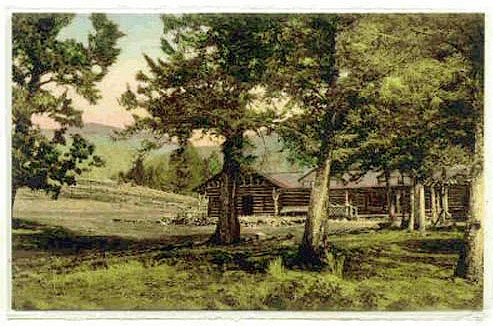
Holm Lodge, Cody Road

Col. Cody was not the first to utilize the what was to become the Cody Road as a means of access to bring tourists into the Park. A short distance east of the Pahaska Lodge was the Holm Lodge operated by Aron "Tex" Holm. Holm constructed the Lodge in 1898 and commenced carrying tourists from Cody on camping expeditions into Yellowstone.


Photo Montage, Holm Lodges, 1912.

In 1903, Holm formed the Holm Transportation Co. which provided transportation to Yellowstone by stagecoach and later by motorbus. By 1912 Holm operated two other permanent lodges within Yellowstone.
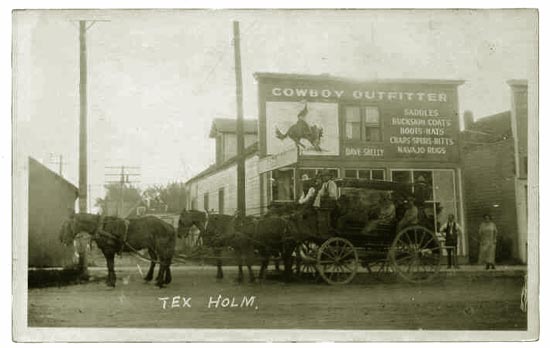
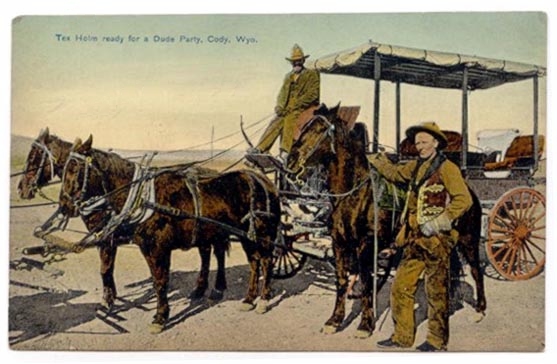

Tex Holm.

In 1914, the original lodge building on the Cody Road burned and the remnants of the facility were sold to J. W. "Billy" Howell who reconstructed the lodge facilites.
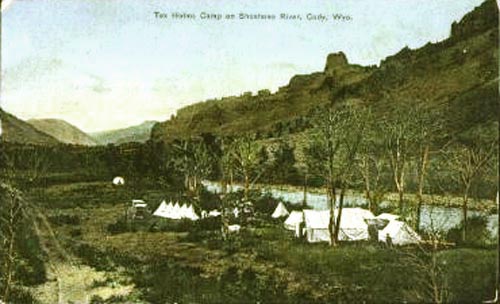

Tex Holm's Camp along the Shonshone.

Howell's main lodge building burned on March 19, 2004. Holm also provided camping expeditions into Jackson Hole and the Sunlight Basin. At the end of the 1916 season, the National Park Service consolidated all concessionaire services within the Park and Holm discontinued all of his operations in the Park.
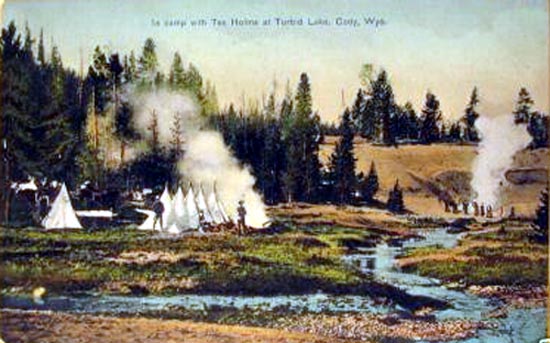

Tex Holm's Camp at Turbid Lake in Yellowstone.

Turbid Lake is located near the northeast corner of Lake Yellowstone, south of Pelican Creek. The lake is a crater formed approximately 8,000 years ago by a hydrothermal explosion; that is an explosion of steam and boiling water. It is believed that as the weight of glacers was relieved by their retreat some 15,000 years ago, steam and boiling water which had been corked up much as soda pop, exploded forming some 6 to 10 craters within Yellowstone. No release of magma was associated with the explosions. Similar conditions are believed to possibly exist beneath Lake Yellowstone.
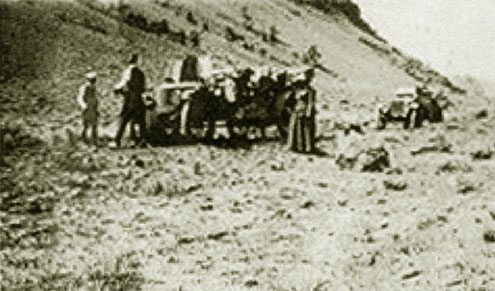

Frost and Richard Company Camp.

Ned Frost and Fred J. Richard also established a camping business about 1909. Their headquarters was about 20 miles west of Cody. Both were noted guides. Richard acted as the hunting guide of the Prince Albert of Monaco in his 1913 visit to the area. Frost acted as a guide for Saxton Pope author of the 1923 Hunting with Bow and Arrow. In 1917, Frost was guiding a group in Yellowstone. At the campfire he told the campers that there was no danger from grizzly bears. That night, a grizzly invaded the tent which Frost was sharing with a horse wrangler named Jones and mauled both. Both survived. The year before in 1916, Richard with a cook named Jones was mauled by a grizzly. For the remainder of his life, Frost had a dislike for grizzlies and reportedly killed about 500 of them.

It has been rumored in the Cody area that Ned Frost and Fred Richard following Col. Cody's death and funeral sneaked into Olinger's Mortuary and switched the unclaimed body of a cowboy for that of Col. Cody. They then allegedly returned Col. Cody's body to Cedar Mountain.


On the Trail with S. W. Aldrich.

Samuel "Sam" W. Aldrich, a stockman, was also an early guide into Yellowstone. Caroline Lockhart satarized Sam as having spurs that could be mistaken for "phonygraph records." Miss Lockhart, herself, however, wore spurs into her newspaper office. His ranch was located about 20 miles west of Cody on the South Fork of the Shoshone. Another early guide was Joseph Jones.


Joe Jones pack team. Photo by F. J. Hiscock.

Next Page: Cody Road Continued.