| Photos From Wyoming Tales and Trails This page: Black Hills, Devil's Tower National Monument, George Hopkins. |
 |
|
| Photos From Wyoming Tales and Trails This page: Black Hills, Devil's Tower National Monument, George Hopkins. |
|
|
|
|
About This Site |
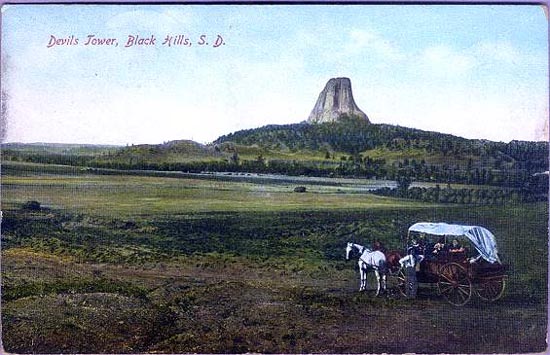 Devil's Tower, 1910. Not withstanding the caption on the postcard, the Devil's Tower is located within Wyoming about 21 miles north of Sundance. The Black Hills of Wyoming commence at the Belle Fourche River about 23 miles east of Gillette at Moorcroft. To the early explorers the Black Hills, the Paha Sapa of the native Americans, extended from the Dakotas south to Ft. Laramie. They take their name from the dark color of the trees as seen from afar. Now the term Black Hills refers to the northeast corner of Wyoming in Crook and Weston Counties east of the Belle Fourche River and the western part of South Dakota. Although in the popular mind, the Black Hills are usually associated with South Dakota, Rapid City, Deadwood and Sturgis [the holy Mecca of the Harley-Davidson], the Wyoming portion has to a great extent been bypassed. The big rodeo in the Black Hills is in Belle Fourche. Mount Rushmore is more famous that the Devils Tower. Deadwood was more famous for its gold mining. Little gold was ever mined in the Wyoming section of the Black Hills. Instead, the minerals from the Wyoming portion of the Black Hills was predominently coal and Bentonite. Because of a lack of transportation and isolation, even timbering was predominently on the South Dakota side. Its primary cities in Wyoming are Newcastle, Moorcroft, and Sundance. Its most famous landmarks, however, are the Devils Tower National Monument and the Vore Buffalo Jump east of Sundance..
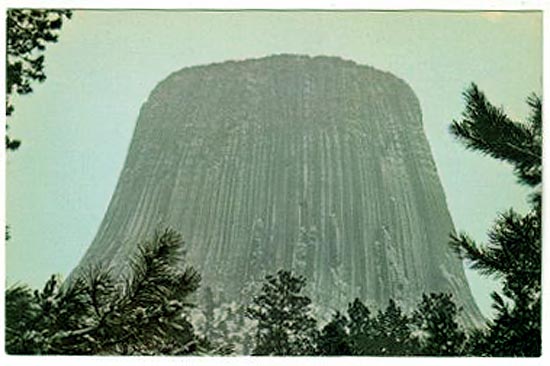 Devil's Tower
For information on John Grabill see Cattle II. Although, the Black Hills were reputedly the first area of Wyoming to be explored, it was also the last. Joseph and Francois Verendrye, French-Canadians, explored portions of Montana and Northeastern Wyoming as early as 1743. Because of Indian threats the Black Hills were not explored until much later than the rest of Wyoming. Early expeditions, however, included those of G. K. Warren in 1857, W. F. Raynold's expedition of 1859 and that of George A. Custer of 1874. This is not to say that no European explorers ventured into the area until then. As indicated on Fur Trapping, Sir St. George Gore's expedition of 1855 ended abruptly near present day Sundance. Valentine T. McGillycuddy, a surgeon and topographer assigned to the 1875 Jenney-Newton Expedition in the Black Hills, reported the finding of the ruins of a cabin indicating the presence of trappers in the area from an earlier era. There were, however, no descriptions of the tower by white explorers until that of Henry Newton (1845-1877); of the U.S. Geological Expedition of 1875. The name "Devils Tower" was given to the tower by Col. Richard I Dodge, commander of the military escort for the expedition, who contended that the Indians referred to it as the "Bad God's Tower." The Reverend Peter Rosen, a Roman Catholic missionary to the Black Hills, indicated in his 1905 book, Ph-Ha-SA-Pa or the Black Hills of South Dakota, that the Native-Americans called the tower O-Kee_Hee-De-Paha; that the term Mateo Tepee was more properly given to the Bear Lodge district surrounding the tower. According to Father Rosen, the tower was the home of Okeebeede. Others believed that it was the home of Toon-kan, or Inyan, the stone god. Others believed that the stone god dwelt to the southwest in Inyan Kaya. The 1875 expedition, led by geologists Walter Proctor Jenny (1845-1921), after whom the Jenny Stockade near Newcastle is named, and Newton, confirmed the presence of gold in the Black Hills first reported by the 1874 Custer Expedition The Tower, a vertically-jointed volcanic intrusion (the center core of a volcano that cooled before reaching the surface), rises 1,200 feet above the Belle Fourche River. It was first climbed as a part a a Fourth of July celebration in 1893 by Willard Ripley and William Rogers. It was first proposed for protection in 1892 by Frances E. Warren who introduced a bill in the U.S. Senate to make it a National Park. In 1906, Wyoming congressman Frank W. Mondell of Newcastle introduced a bill in the House of Representatives to make it a national monument. On September 24, 1906, President T. Roosevelt made it the nation's first national monument.
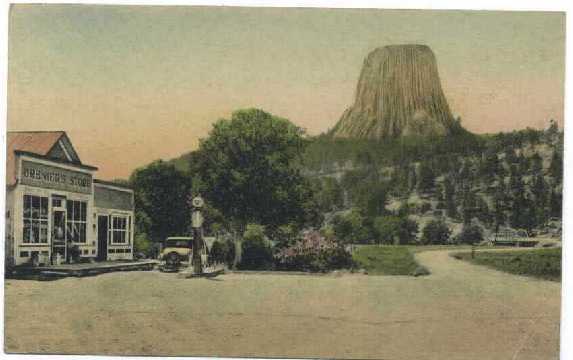 Grenier's Store, 1930's Grenier's Store was located near the east entrance to the Monument. Beginning in 1925, the store maintained a registry for visitors to the Monument.
 George Hopkins marooned on Devils Tower, 1941. In October 1941, Devil's Tower made the national news when on October 1, 1941, a stunt parachutist, George Hopkins, parachuted to the top of the tower. The jump was made pursuant to a $50.00 bet with Earl Brockelsby, the owner of the "Reptile Gardens" in Rapid City. The Reptile Gardens featured Rattleshankes including a pet rattlesnake that Brockelsby kept in his hat and allowed tourists to pet. The first word that something was about to happen was Sunday, September 28 that a telephone call to the Sundance Times that something unusual was going on at the Monument. The newspaper editor drove to the monument and found Hopkins and an airplance. She was told that because permission had not been obtained from the National Park Service monument superintendent Newell Joyner, the paper should not inform anyone until the stunt had been completed. Because of a broken wheel, the plance, however, could not complete the stunt that day. Allegedly, jump by the five-foot four inch, 115 lb. Hopkins would provide needed publicity for a Rapid City Junior Chamber of Commerce parachute event scheduled for October 12 in which Hopkins was to be featured. Hopkins had planned to come down using a 1/2 inch, 1000 ft. rope which he planned to tie to a Ford axle to be driven into the rocks with a sledge hammer. Fortunately, the drop of the rope, sledge hammer, and axle missed, fortunately, because it turned out that the rope would have been too short. Hopkins was marooned on the top of the tower. When Hopkins' plight was learned national radio and press reporters gathered at the Tower. National newspapes and magazines such as Time Magazine reported on Hopkins' plight. The next day, Food, water, and another rope were dropped from an airplane. A bullhorn and a can of fuel was also dropped. In the drop, the can of fuel for heating burst upon hitting the ground. The loosely coiled rope became hopelessly entwined in a gordian knot. That night a fog, snow and sleet covered the Tower. The knots in the rope froze. All efforts by Hopkins to untie the knots in the 1000 foot rope failed. Hopkins requested and received by aerial drop a bottle of whiskey "for medicinal purposes." The National Park Service brought in from Colorado a Rocky Mountain National Park ranger Ernest K Field and a guide Warren Gerrell. Their efforts to climb the tower failed and they retreated as they deemed it to be too dangerous. By the bullhorn Hopkins announced that he would parachute down. The National Park Service forbade it. With national attention now being focused on the Devils Tower, some 7,000 people came to the monument to witness the rescue efforts. An Omaha newspaper reported that it was making arrangements to charter a blimp to effectuate Hopkins' rescue. but it would take three days for the blimp to reach Wyoming. The Associated Press reported that The Associated Press reported that on October 3, Brockelsby attempted to contact the Sikorsky Company about using their new experimental helicopter. The next day according to the United Press, Park Suerintendent Joyner also contacted Igor Sikorsky himself. A Dartmouth College student, Jack Durrance, who had previously climbed the Tower in 1938, telegraphed that he would fly to Wyoming to rescue Hopkins. Indeed, one of the two generally used climbing routes to the top of the Tower is named after Durrance. At the same time, two climbers from the Tetons, Harold "Timberline" Rapp and Paul Petzoldt were driving through the snow eastward across the state to assist in the rescue efforts. By the time Durrance and another Dartmouth mountain climber, Merrill McLane arrived in Chicago, the bad weather had moved in. All westward flights were cancelled. The two had to take a train to Denver. As the weather moved eastward, the blimp was grounded in Akron. When the weather finally lifted in Akron, the blimp took off westward but unfortunately ran into more bad weather and was grounded at Fort Wayne. At the same time, A. C. McInnis, the proprietor of a South St. Paul flying service announced that he was flying to Wyoming in a ski-equipped plane and would if all else failed attempt to land the plance on top of the monument. It was generally agreed that such an act would be extremely dangerous. More snow and ice fell on the Tower. On the fifth day, Rapp and Petzoldt arrived in their snow covered automobile. An attempt was made to climb the mountain but the two were turned back by the ice and wind. The train finally arrived in Denver. There Durrance and McLane picked up another expeienced mountain climber Chappel Crammer. By automobile, the the three sped northward to Cheyenne where they picked up Durrance's broter-in-law Henry Coulter, also a Dartmouth man and an experienced mountain climber. They also picked up a police escort for the 250-mile dash northward in hopes of being able to rescue Hopkins.
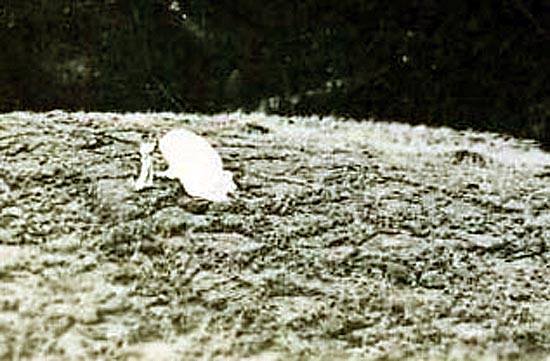 Enlargement of George Hopkins marooned on Devils Tower, 1941. About midnight the lights and sirens of the police cars announced the Durrance Party's arrival. The next morning, with Durrance leading the way, all nine resuers successfully scaled the rock. Durrance gave Hopkins a quick lesson in repelling. Thus Hopkins was brought down to greet a plethora of radio and newspaper reporters and newsreel cameras. When he came down, he commented: "I want a shave and a haircut."
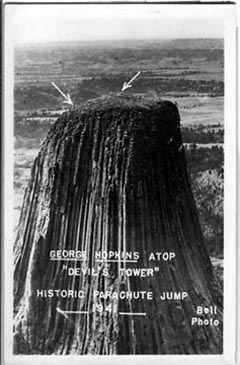 . . . . . .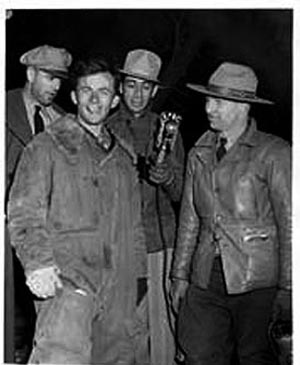 Left: illustration of where George Hopkins landed and where gear landed; Right: L. to R., Earl Brockelsby, George Hopkins, a KFBC radio reporter, and Newell Joyner. And precisely who was George Hopkins? Associated Press and United Press reports between October 3 and October 7 indicated that he was 29 (united Pess) or 30 (Associated Press) years old and "youngish looking;" that he was from San Antonio, Texas and that he former parachute instructor for the Royal Air Force and for Chiang Kei-Chek's forces. He according to the press reports had previously ferried bombers from New Foundland to Britain. Later reports had him as a part of the Flying Tigers flying over "the Hump" in Burma; that he was a Royal Air Force transport pilot; that he set records for the most jumps by an individual, 2,348, the longest freefall of 20,000 feet, and from the greatest height, 26,400 feet.
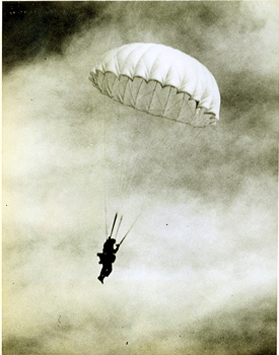 . . . . . .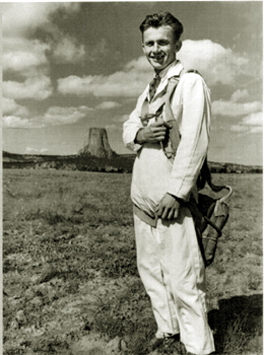 Left: George Hopkins parachuting at Rapid City; Right: Hopkins at Devils Tower. In Rapid City at the Junior Chamber of Commerce parachute exhibition, Hopkins attempted to best the existing record for the most parachute jumps in a single day. Unfortunately, a wind sprang up and he had to give up on the 14th jump. Later, he again attempted to break the record but on the third jump his chute streamed but did not open. He pulled the ripcord on his reserve chute but it tangled with the main chute. He was able ultimately to get it about one-third open. He landed and survived, bruised and bloody. See generally for above segment on George Hopkins: Jenkins, McDay,
White Death; Tragedy in an Avelanch Zone, Knopf, 2000; Titler, Dale: Wings of Adventure, Random House, 1972;
Dumas, Alan: "DAREDEVIL'S TOWER 1941 PARACHUTE JUMP ONTO WYOMING MONUMENT LANDS IN MODERN SCREENPLAY", Rocky Mountain News, October 18, 1998;
Poppilil, Alan:"A parachuting Daredevil Tuns The Eyes of a Nation to a Devilish Deed," Allegedly, Hopkins enlisted in the Army Air Corps. What became of him is generally unknown. A search of generally available records had failed to provide a definitive answer. There are simply too many individuals named "George Hopkins." On July 8, 1945, near Alexander, Texas, a P-51 crashed during an electical storm. The pilot, a Captain George Hopkins, had previously served as a P-38 fighter pilot in the South Pacific. He was too young, however, however to match the age given by the 1941 news reports. Capt. Hopkins was born on December 6, 1921. In 1977, Devils Tower again came to national attention when it was featured in the movie "Close Encounters of the Third Kind." Next Page: Black Hills continued, Aladdin, coal mining and logging.
|


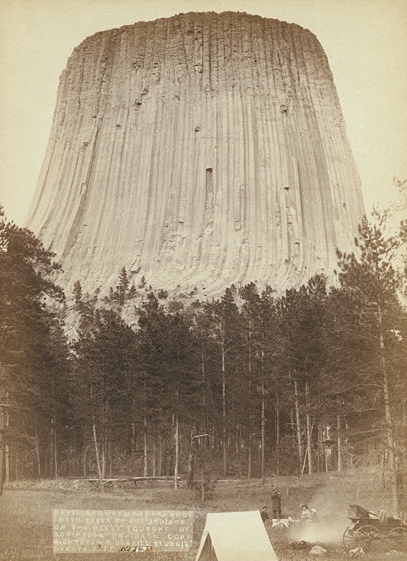 Devils Tower, Mateo Tepee, 1887, photo by John Grabill.