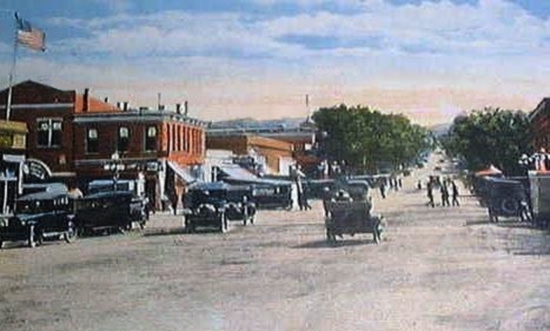
Center Street, Douglas, Wyoming, looking west toward 2nd.
The two-story building on the extreme left is the College Inn Bar located at 103 N. 2d Street is still in business and on the
National Register. Gambling was made illegal in 1902. The College Inn, nevertheless, maintained a
room on the second floor in which card games were conducted. The room was served by a
dumbwaiter for bringing drinks up from the bar below.
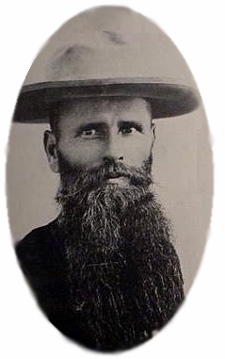
Doc Middleton
Doc Middleton, described by the Cheyenne Daily Sun as a"golden-toothed lover of other
folks' cattle and horseflesh," was reputed to have stolen 2,000 horses from ranchers and the Sioux in one
two-year period. Middleton, like Pike, came up from Texas.
Middleton, actually his middle name, supposedly recieved his nickname "Doc" as a result of his
skill in "doctoring" brands. Doc was reputedly associated with Kid Wade who ended this mortal
coil as the guest of
honor at a necktie party in Bassett, Neb.
Doc narrowly avoided the same fate in Sidney, Neb., when the sheriff permitted him
to escape. Ultimately, he was captured, placed on trial for horse stealing in
Cheyenne and was sentenced to five years.
Today, Doc Middleton is most famous for his participation in the great cowboy endurance
race of 1893 from Chadron, Nebraska, to Col. Wm. F. Cody's Wild West arena adjacent to
the Columbian Exposition in Chicago. In 1890, plans commenced for a World's Fair in Chicago to
celebrate the 400th anniversary of Columbus' discovery of the Americas. Col. Cody made an
application for a concession, but was turned down on the basis that his Wild West and Congress of
Rough Riders was incongruous with the theme of the fair. This did not stop Cody. He secured lands immediately adjacent
to the fair grounds and set up his own arena capable of seating an audience of
15,000. First, as a joke, and later seriously, plans were made for an endurance race from
Chadron to the Exposition with a first place prize of $200.00 and total prizes of $1000. Col. Cody agreed to contribute another
$500.00 if the race would end in his arena. Additional prizes were donated including a saddle from
Montgomery Ward and Co. and a gold-plated ivory handled revolver from the Colt Firearms Co. To prevent cheating,
a secret route with check stations was laid out.
Each rider was permitted two horses with the requirement that the rider must arrive in
Chicago on one of the original horses. Doc was sponsored by Wyoming and Sturgis, Dakota Terr., ranchman and horse breeder
J. D. "Jack" Hale, who provided Middleton with one of his best horses, Geronimo. Doc's second horse was Bay Jimmie. Other riders
included Josiah B. "Indestructable Joe" Gillespie (1849-1933), James H.
"Rattlesnake Pete" Stephens, and teenaged "Little Davy" Douglas. Rattleshake from Kansas showed up two days prior to the race. He was so called
because he used a string of rattlesnake tails as a hat band. Gillespie, also known as "Old Joe," was a stage driver and reputedly
a friend of Butch Cassidy. At the last minute another rider, former stagecoach driver and railroad
surveyor and land agent, John Berry entered. Chadronites cried foul; Berry had helped lay out the
secret route.
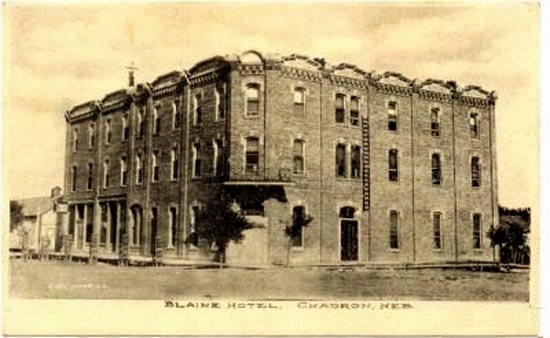
Blaine Hotel, Chadron, Nebraska, undated.
On June 13, the riders, a crowd estimated at more than 4,000, and a cornet band
gathered in front of the Blaine Hotel. The fire chief fired the gold-plated revolver and the nine were off.
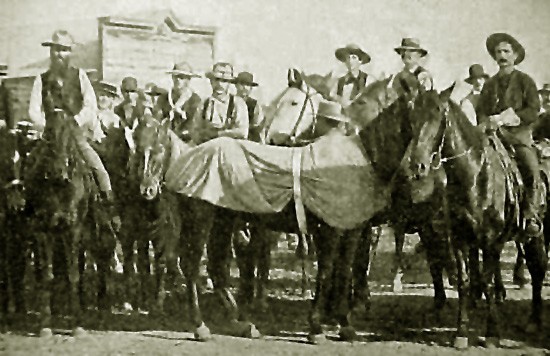
Riders at start of 1893 Endurance Race. Doc Middleton with beard on left.
Crossing the sand hills
of Nebraska, Little Davy became ill and dropped out. Berry missed the checkpoint at O'Neill, Nebraska, but provided an
affidavit that he had not cheated. Geronimo became lame, but Doc continued on Bay Jimmie. The eight remaining riders crossed the
Missouri at Sioux City. In Iowa, Rattlesnake Pete began coughing up blood and his first horse had to drop out. With a bottle of
whiskey, Rattlesnake Pete continued on his second horse General Grant. Across Iowa, toward Illinois the eight rode.
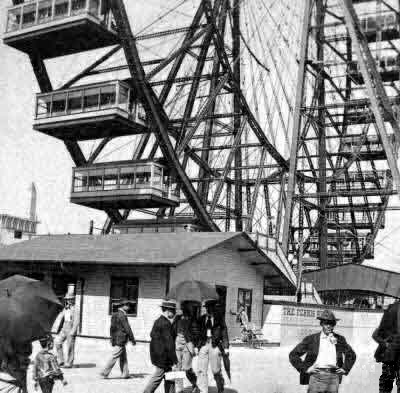 Ferris Wheel, Columbian Exposition, 1893 Ferris Wheel, Columbian Exposition, 1893
On the morning of June 27, word was received that the winning
rider was seen approaching the fair grounds. The rider's horse looked to be in good condition but mud splattered. The rider, however,
looked worse for the wear, for he had ridden 150 miles in the last 24 hours. In the arena,
Col. Cody resplendent in a white outfit decorated with silver, representatives of the Humane
Society, and a crowd estimated at 10,000 awaited. Beyond Col. Cody's arena, loomed the centerpiece of the
midway, G. W. G. Ferris' giant 320-ft. high steam-powered wheel, bearing 36 cars, each of which could accommodate 40 passengers and a lunch
counter. Above the fair grounds, a huge gas-filled tethered balloon was making its ascent into the heavens. The balloon permitted intrepid passengers to
ascend 1000 feet and view four states. Near the center of the fairgrounds was the Mining Hall in which was located the
Wyoming Pavillion. In the Pavillion, there were exhibits of petroluem, coal, and ferruginous rock from a mountain
north of Laramie City. The mountain would later be made famous as the
scene of a murder by a former Pinkerton agent. The rock assayed as high as 80 percent of metal. In
the Agricultural Hall, another Wyoming exhibit displayed grains grown with the help of irrigation.
Through the entrance to the arena the rider came. The entrance was flanked by images of
Christopher Columbus as the navigator of the oceans and Col. Cody as the navigator of the
plains. The two favorite riders were Doc. Middleton and "Old Joe" Gillespie. But the first
rider was neither. Instead to the surprise of the audience it was John Berry who pulled up in from of
Col. Cody. Over the next several days, the other riders came in. Doc dropped out in western Illinois with both horses
coming up lame. He was, therefore, last. Immediately, accusations of cheating arose.
Berry was declared the winner by Cody and received Cody's first prize and the
Montgomery Ward saddle. Old Joe was declared second-place winner by Cody. Berry was declared ineligible for the
Chadron prize, he having participated in the laying out of the route and it being believed that he and his horses rode
part of the route in a box car. Chadron declared Old Joe the winner and gave him the Chadron $200.00 first prize and the
gold-plated colt revolver. Rattlesnake Pete was fourth in Cody's determination and third by Chadron. Others, including
Doc were accused of taking the train for a portion of the trek. Thus, the scene broke up in a
fist fight refereed by the Humane Society.
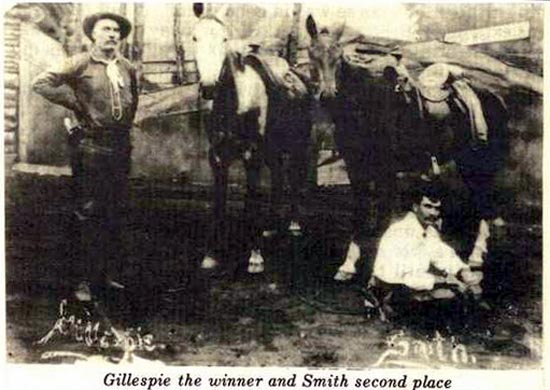
Winners Great Chadron Endurance Race .
The following day, at 10:42 Rattlesnake pulled in followed 13 minutes later by Joe Campbell. When Joe left Chadron he had no money.
As explained by the New York Sun, June 30, 1893, p. 5, "Cowboys All In:"
Campbell left Chadron with the rest and came all the way through on one horse. He had not a cent in his pockets when he started and didn't pick pu any on the way.
Instead, he lost a bet of $250 that he would not be the last one in the race. Campbell's Boomerang was in excellent condition, and so was
General Grant, "Rattlsnake's" animal.
In actuality, all of the animals were in good shape in sharp contrast to those of the German Army which the year earlier had done
an endurance race one-third the lengh of the Chicagto race. The German's lost some 20 horses. Rattlesnake moved back to Hutchinson, Kansas, and died in 1957.
If Berry cheated by taking the train, it was not the only time. The 1896 election in northwestern
Nebraska resulted in the following doggerel:
John Berry came bustling in out of the west,
For sheep or vote rustling the boldest and best;
The mavericks roaming on mountain and plain
Came rush through the gloaming on John Berry�s train.
Like showers of manna on Hebrews of old
Sheep hustlers for Hanna came in on our fold;
As crows in their flight would drop down in the rain
Came hoboes from Whitewood on John Berry�s train.
But northwest Nebraska rose up in her might
And buried those bogus votes deep out of sight;
Let freight rates go higher �gainst protest and pain
We pay for the fire in John Berry�s train.
Berry was the brother of George Berry. The two ran the Niobrara Transportation and Freight Company which provided
stage and freight service connecting to
the Fremont, Elkhorn & Missouri Valley Railway as it pushed across Nebraska and later Wyoming. One of the
lines the company ran was from Rawlins to Casper.
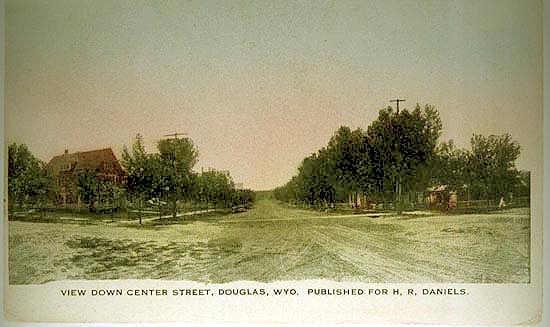
Douglas, Center Street, 1907, Photo by H. R. Daniels
James "Doc Middleton" Riley ended up in 1913 in Orin Junction where he
operated a "blind pig" in a tent. One night a fight between several of his
patrons broke out with a stabbing. Riley was arrested and thrown into the
Converse County jail where he died suppposedly of erysipelas, a painful hemolytic strepococcus inflamation
of the skin sometimes known as "St. Anthony's fire." A "blind pig" is an unlicensed saloon.
Various derivations, mostly aprocryphal, are given for the term: (a) a Mason jar was sometimes called a
"pig," thus, prohibition era speakeasies were known by the term as a result of serving
moonshine in the jars; (b) an illegal still was known as a "pig;" and (c) in areas in
which sale by the drink of alcohol was prohibited, "Museums" would purportedly exhibit
strange animals for which admission would be charged. The patrons would receive a
"complementary" drink. The animals, such as the "blind pig" or "blind tigar," would not
in fact exist. the term, "blind pig" dates back at least to the 1870's.
Sheriff Al Peyton arranged for Riley's funeral.
Gillespie moved to Dewey County, Oklahoma, where he was known as "Dad" Gillespie. He died in Fay, Oklahoma, in December
1933. Dewey County and Fay have been left behind in the dust of growth. Dewey County now has approximately
one-third the population it had in 1900. Fay was relocated once when it was by-passed by the
railroad. Electricity came in the 1920's, but until the 1940's, the electric plant ran only from sundown to 10:00 p.m. except
on Mondays when it ran an extra half-hour to permit washing.
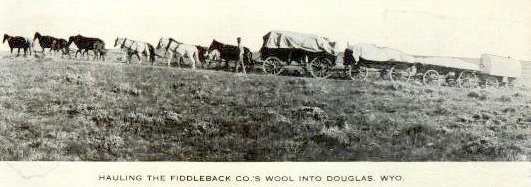
Hauling wool from the Fiddleback Ranch to Douglas
Below left, 3rd Street looking north, 1920's
The Fiddleback Ranch, north of Douglas on the Cheyenne, was owned by Ephrain Tillotson.
Tillotson,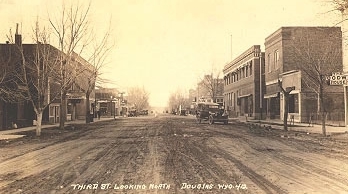 among other things donated the original
building for the Hospital
Association. The Association when it was formed, employed Amos Barber as its
physician at a salary of $100.00 per month and paid his moving expenses to Wyoming.
Contrary to some assertions, Dr. Barber did not come to the Territory
with the
military, although he subsequently did serve in the Southwest and in the Spanish-American War.
In 1889 the Association was discontinued and Dr. Barber went into private practice
in Douglas. With statehood, Dr. Barber became the first Secretary of State.
With the election of Gov. Francis E. Warren to the Senate, Dr. Barber became
Acting Governor and was so serving at the time of the Johnson County War.
Both the hospital and Dr. Barber are mentioned in Owen Wister's stories of
Wyoming, although he refers to Fetterman City as "Dry Bone." After
Tillotson's death at the turn of the century, the Fiddleback was sold to a corporation
headed by Roscoe Crary, a principal of Texaco. among other things donated the original
building for the Hospital
Association. The Association when it was formed, employed Amos Barber as its
physician at a salary of $100.00 per month and paid his moving expenses to Wyoming.
Contrary to some assertions, Dr. Barber did not come to the Territory
with the
military, although he subsequently did serve in the Southwest and in the Spanish-American War.
In 1889 the Association was discontinued and Dr. Barber went into private practice
in Douglas. With statehood, Dr. Barber became the first Secretary of State.
With the election of Gov. Francis E. Warren to the Senate, Dr. Barber became
Acting Governor and was so serving at the time of the Johnson County War.
Both the hospital and Dr. Barber are mentioned in Owen Wister's stories of
Wyoming, although he refers to Fetterman City as "Dry Bone." After
Tillotson's death at the turn of the century, the Fiddleback was sold to a corporation
headed by Roscoe Crary, a principal of Texaco.
Music this page based on the 1909 "Pony Boy" courtesy of Horse Creek Cowboy. If one replays it by clicking
"refresh" one might hear the town band at the beginning, the fire chief firing the gold plated revolver, and
toward the end a suggestion that Berry may have cheated by taking the train.
Pony Boy
Lyrics by Bobby Heath,
Music by Charley O'Donnell
Way out west, in a nest from the rest, dwelt the bestest little Bronco Boy
He could ride, he could glide o'er the prairies like an arrow.
Every maid in the glade was afraid he would trade his little heart away,
So each little peach made a nice little speech of love to him;
Pony Boy, Pony Boy, won't you be my Tony Boy?
Don't say no. Here we go off across the plains.
Marry me, carry me right away with you.
Giddy up, giddy up, giddy up, whoa! My Pony Boy.
Till one day, out that way, so they say, came to stay a fluffy ruffle girl.
She made eyes, she surprised, and he found his heart was lassoed.
When he thought he was caught, how he fought, but she taught this pony boy to love.
But he balked when she talked of a trip to New York, so she sang to him;
Pony Boy, Pony Boy, won't you be my Tony Boy?
Don't say no. Here we go off across the plains.
Marry me, carry me right away with you.
Giddy up, giddy up, giddy up, whoa! My Pony Boy.
Giddy up, giddy up, giddy up, whooooooa! My Pony Boy
Next Page, Douglas continued.
|