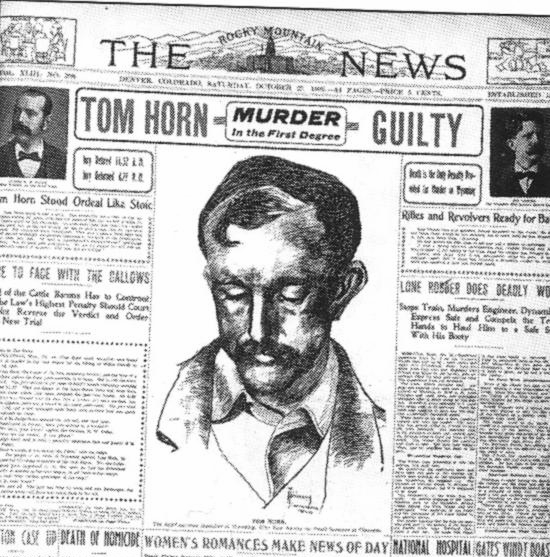
Rocky Mountain News Headline, Saturday, Oct. 25, 1902.
On October 23, 1902, after a two week trial, the jury of 11 whites and one black, Charles H. Tolson,
found Horn guilty on the sixth ballot. The jury was one which at least on first glance might be considered as being favorable to Horn:
|
H. W. Yoder, Ranchman, Goshen Hole
O.V. Seeburn, Ranchman, Goshen Hole
Charles Stamm, Ranchman, Wheatland Flats
T. R. Babbit, Ranchman, LaGrange
H. W. Thomas, Ranchman, LaGrange
G. W. Whiteman, Ranchman, Uva
Amos Sarbaugh, Foreman, Swan Land and Cattle Company
Homer Payne, Cowboy, Swan Land and Cattle Company
Frank F. Sinon, Foreman, White Ranch, Little Horse Creek
E. C. Metcalf, Blacksmith, Wheatland
Charles H. Tolson, Porter, Cheyenne
J. E. Barnes, Butcher, Cheyenne |
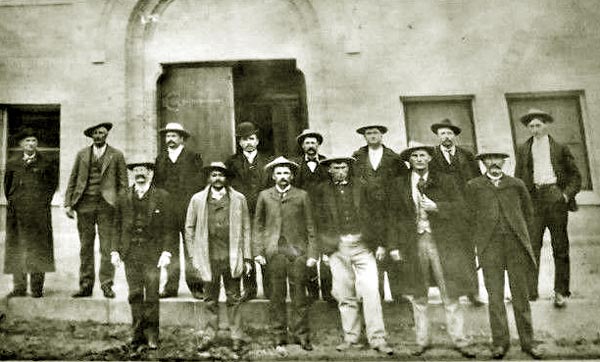
Horn Jury
At the end of the
fifth ballot, two jurors voted for acquittal.
The jury then examined all of the testimony. After re-examination, the two hold-out
jurors voted guilty. Each later made statements to the effect that
although they liked Horn, they had no choice but to find him guilty. Later,
Gwendolene Myrtle Kimmell, Horn's romantic interest as
portrayed in the movies, accused in a statement appended to Horn's autobiography
some of the jurors of being rustlers.
According to Larry Bell, "Tom Horn: his life & Legend", University of Oklahoma Press, (2014),Horn kept up his braggadocio whistling from his jail cell at parishioner passing by on their was to
Sunday morning mass "Goodbye, My Honey, I'm Gone.""
On appeal, Horn's lawyers argued, among other things, that had not the two hold-out jurors
been improperly influenced
by comments that they may have overheard while
dining, the jury would have remained deadlocked. The head waiter of the hotel testified that guests of the hotel were
discussing the case when the jury was present. The two baliffs, who sat at either end
of the table in the hotel dining room when the jurors were served, testified that
they heard no improper comments from other diners in the hotel. Tolson, who sat
directly opposite the two jurors, testified
in similar fashion.
In August 1903, while his appeal was pending, Horn with another inmate of the jail, Jim McCloud, attacked Deputy
Proctor, broke into the Sheriff's office and stole an automatic pistol. Leslie Snow came upon the scene
and gave the alarm. In the meantime Horn and McCloud made it out onto the street with
McCloud and Horn heading in opposite directions. Horn first headed east on 19th Street one block
to Capitol, the Courthouse being on the corner of 19th and Ferguson [now Carey]. Horn then headed
north on Capitol and then east on 20th being chased by a passerby, O. M. Eldrich. Eldrich fired at
Horn and Horn attempted to fire the automatic at Eldrich. Apparently Horn was
unfamiliar with the safety on the automatic and was unable to fire the gun. Pedestrians then
overpowered Horn and he was returned to the jail. See next photo.
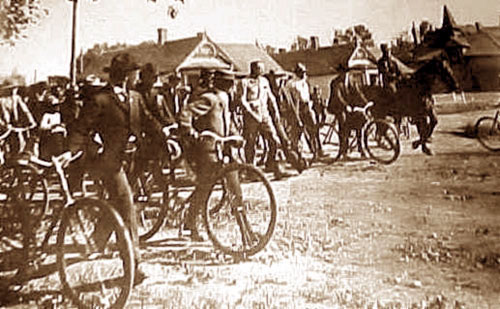
Tom Horn being escorted back to jail after escape attempt.
While awaiting the outcome of an appeal,
Horn spent his time braiding a rope, see photo below, and writing an autobiography. Additionally he busied himself
with correspondence. In March of 1902 he had complained to John Coble that except for Charlie
Irwin and Coble he had no visitors.
His appeal was denied on September 30, 1903. Following the denial of the appeal a flury of letter writing
resumed accusing those who testified of perjury. On October 31, Horn wrote Coble that one of his lawyer, Timothy Burke, has told him
he need affidavits proving he was no where near the Nickell homestead the day of the
murder. He was, he insisted at Alex Seller's ranch both that morning and at the end of the day. He
indicated to Coble that this could be confirmed by Dorrance Linscott and by Seller. Linscott did not respond to
Horn's letters and Horn did not know where Seller was. Writer's note: Seller's Ranch was at Toltec, North of Rock Creek about
60 miles as the crow flies from Iron Mountain. Soon an affidavit was produced in whch
Clarence D. Houck averred that Seller had admitted that Horn was there on the day in question.
Seller then came forward with an affidvait that the contents of the Houck
affidavit were untrue. By November Horn, seemed resigned to his fate. On
November 17 he wrote Coble:
Dear Johnnie:
Proctor told me that it was all over with me except
the applause part of the game.
You know they can't hurt a Christian, and as I am
prepared, it is all right.
I throuroughly appreceiate all you have done for me.
No one could have done
more. Kindly accept my thanks,
for if ever a man had a true friend, you have proven your-
self
one to me.
Remember me kindly to all my friends, if I have any
besides yourself.
|
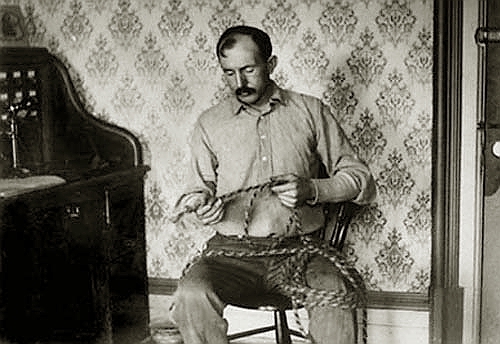
Horn weaving rope
As preparations for the execution neared, fears arose
that friends would attempt to break Horn out of jail. Thus, extraordinary precautions were
taken to prevent another escape. The Courthouse was surrounded by Companies A and E of the
Wyoming National Guard. Other prisoners were placed on a lower floor of the jail, leaving Horn along
on the top floor. A curtain was placed over the window in Horn's cell preventing him from seeing the
construction of the gallows below and, more importantly, precluding the exchange of signals between Horn and
his friends. Deputy sheriffs were at every window. As a result of the turmoil, after the Horn case
was over, all future executions were moved to the State Penitentiary.
At the same time there began a flurry of legal efforts to convince
Governor Chatterton to spare Horn from the gallows. At the end of October, affidavits were presented
to the governor intended to indicate that there was new evidence, including allegations that the
murder was committed by a double. Other affidavits were presented that witnesses had admitted that
they had perjured themselves or had been offered bribes for perjured testimony. The Laramie
Boomerang reported on November 4, quoting the Denver Post, that the legal efforts
were weakening Horn's case:
Gradually the inside facts relating to the affidavits presented to Gov. Chatterton Saturday in
behalf of Tom Horn, the condemned murderer, and the methods employed to secure them are becoming
known. The Frank Muloch Affidavit is regarded as being absolutely worthless and if it has had any bearing
on the case at all it has had a tendency to weaken Horn's plea. It is so plainly evident that there never was a double of
Horn, except the one manufactured in this case, that the affidavit is regarded as a sort of boomerang.
Affidavits in support of
executive clemency were presented to Governor Chatterton that the person in the Scandinavian Saloon was a double for
Horn, a case of mistaken identity. Mulock contended that it was only a "fellow claiming
to be Horn" who made the confession in the Saloon (emphasis in Mulock letter to J. W. Lacey, Oct. 5, 1903). Governor Chatterton dismissed the affidavits noting that the affidavits were inconsistent with
other affidavits presented by the defense relating to the conversations.
The efforts of Miss Kemmell to save Horn were also down played by the Boomerang. The
presentation of Miss Kemmell by Horn's attorneys was regarded as a "bad move" in "the opinion of every one who has
followed the case, and especially those who have seen the woman." Miss Kimmell contended that
Vic Miller killed Nickell.
The Boomerang report concluded:
Joe LaFors [sic], who trapped Tom Horn into making the confession that he
killed Willie Nickell, ridicules the affidavits presented to the
governor Saturday. He says they contain all kinds of misstatements and that
their sole purpose is to save a man from hanging who not only is
guilty of the foulest of crimes but was convicted fairly.
After a trial by affidavits in front of the governor including one which suggested (but did not say) that
LeFors had been bribed not to investigate Miller, Governor Chatterton rejected them noting that
the contents would not have been admissible in a court of law.
As the date set for execution drew near, the appeals to the governor became more impassioned.
Governor Chatterton received a letter wrtten from Denver's Albany Hotel threatening death if
he did not commute the sentence. On the evening of the 18th, National Guardsmen stopped by a threat to shoot,
a group of horsemen approaching the courthouse on Eddy Street. On the morning of the 19th, a friend of
Horn's was overheard commenting, "These little tin soldiers will get all the misery they want tonight."
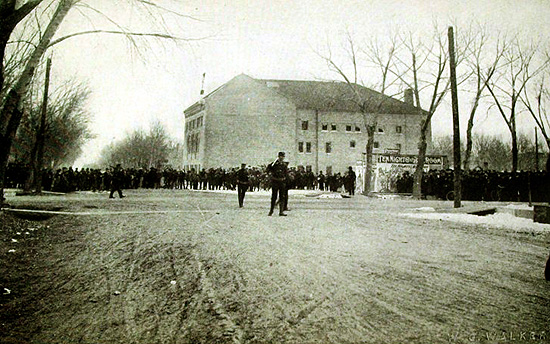
Crowds and soldiers on street near Courthouse.
On the afternoon and evening of November 19, Governor Chatterton turned down no fewer than
twelve appeals to delay the execution. Before 6:00 a.m. of the day set for the execution, the governor
was aroused from his bed with yet another appeal. He responded, "There is no use,
gentlemen. This execution will take place at the time set by the
law. I will not interfere in the case. This is final."
The invitations to the hanging were duly issued. The prosecution could invite twelve, Horn six. Kels Nickell was
denied an invitation. Roman Catholic and Episcopal priests visited with Horn, but Horn denied to
Charlie Irwin that he had gotten religion. Invitees reported to the rope barriers at the
courthouse at 7:00 a.m. On the roof, Sheriff Smalley's gatling gun stood guard. While waiting, one Denver Post reporter told the others
as to the number of executions he had attended. The executions were pass�, he said. They were
no more emotional that "the killing of a rat." Later, it was discovered that the
stone-hearted reporter for the Post cried during the hanging.
Music this page:
Good-Bye, My Honey, I'm Gone.
Copyright, 1885, by W. A. Evans & Bro.
I had a girl, and her name was Isabella,
She ran away with another colored feller,
Chorus.
Good-bye, my honey, I'm gone,
Good-bye, my honey, I'm gone;
And I couldn't stay no longer;
Good-bye, my honey, I'm gone.
One day in de middle of de month ob Januyear,
I rolled my dearie in my arms for to soothe her
But her heart was with another,
And she wouldn't let me love her;
Good-bye, my honey, I'm gone.
Chorus.
Good-bye, my honey, I'm gone,
Good-bye, my honey, I'm gone;
And her heart was with another,
And she wouldn't let me love her;
Good-bye, my honey, I'm gone.
I thought dis girl was de nicest little daisy,
'Till a dude came along from de roller rink so crazy;
And I hollered for a copper.
But he said, he couldn't stop her;
Good-bye. my honey, I'm gone.
Chorus.
Good-bye, my honey, I'm gone,
Good-bye. my honey, I'm gone;
And I hollered for a copper.
But he said, he couldn't stop her;
Good-bye, my honey, I'm gone.
I had a girl and she was a little lily,
Freddy came along and knocked her very silly;
And I hollered for a copper.
But he wouldn't run to stop her;
Good-bye. my honey, I'm gone.
Chorus.
Good-bye, my honey, I'm gone.
Good-bye, my honey, I'm gone;
And I hollered for a copper.
But he wouldn't run to stop her;
Good-bye, my honey, I'm gone.
I forgot for to tell you her name was Mary Walker,
she wore de pants till she couldn't wear 'em shorter;
And I hollered for a copper.
But If said, he couldn't stop her;
Good-bye, my honey. I'm gone.
Chorus.
Good-bye, my honey. I'm gone,
Good-bye. my honey, I'm gone;
And I hollered for a copper,
But he said, he couldn't stop her;
Good-bye, my honey, I'm gone.
This funny little girl was a dandy little runner,
Her name was Belva Lockwood, but the White Home was a stunner,
And I hollered for a copper,
Bur. he said, he couldn't stop her;
Good-bye. my honey, I'm gone.
Chorus.
Good-bye, my honey, I'm gone,
Good-bye. my honey, I'm gone;
And I hollered for a copper,
But he said, he couldn't stop
I know a man and he tried to coin a dollar.
His name is Uncle Sam. and he ought to get a collar,
For it wasn't worth a dollar.
And the ninety cents was holler;
Good-bye, my children, I'm done.
Chorus.
Good-bye, my children, I'm done.
Good-bye, ray children, I'm done;
For It wasn't worth a dollar.
And ninety cents was holler;
Good-bye, my children, I'm done.
Next Page: The Hanging and the aftermath.
|