 . . . . 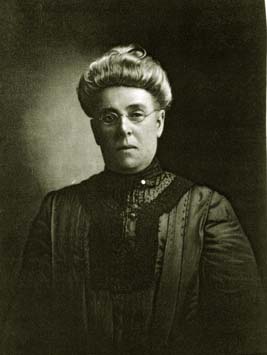
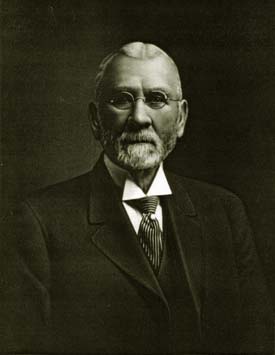
Edward and Jane Ivinson.
Edward Ivinson (1830-1928) is recognized as Laramie's leading philanthropist having donated the bell tower to St. Matthew's
Cathedral, Ivinson Hospital, the Ivinson home for aged ladies and the World War I monument. He born in the Danish Virgin Islands (now the American Virgin Islands) where his
father Thomas J. Ivinson, originally from Cumrew, England, was the manager of a sugar plantation. The younger Ivinson was one of
five children. The 1846 St. Crois census indicates that Ivinson's father was a widower and managed the
St. Croix River Estate plantation. Following the death of Edward's mother Sarah, Thomas Ivinson commenced another family with a
Curzian "free-woman" by whom Thomas father several children. About 1838 at the age of eight, Young Ivinson was sent away to England apparently to his grandfather. Sometime following its founding in
1840, young Invinson was enrolled in the Croft House Acadamy for boys. The acadamy was located in Brantley, about seven miles
from Cumrew. The proprietor and head master of the acadamy, Joseph Coulthard, advertised that he provided a commercial education. He advertised that
"Pupils are prepared for the Universities, for special Examinations and pursuits, and for Professional, Mercantile. Agricultural, and general practical life."
The school was not cheap. Tuition was 35 to 40 guineas with terms for boarders, equal today to about �2,400 - �3,000. It is likely that the headmaster influenced Ivinson's interest in
philanthropy. Follwing the death of Coulthard, a public subscription was raised for a window in the parish church dedicated to the
head master. Later, a Brampton poet, Peter Burn, wrote of Coulthard:
He shall not die. The man, who gave
His life in labour for our good,
Still speaks a language, understood,
When generations pass the grave.
The worker rests. He scattered seed
Upon the waters of the mind:
We, in this summer land shall find,
Bread that shall nerve for noble deed.
A leader he! To fairer lands
Me led the wavering, doubting soul:
Himself possessor of the goal,
He waits to greet his faithful bands.
Our teacher lives. The grateful heart
Shall mark the spot where he has been,
To keep his memory ever green,
Shall seek the aid of mighty art.
Coulthard will live. When we shall sleep,
And strangers tread our busy street,
Soul-stirring words shall he repeat,
Although his lips in silence keep.
Ivinson was in the commercial programme. Upon completion of his
education at Croft House, Edward Ivinson was apprenticed in the dry goods trade in Brampton.
In 1847 at age 17, Ivinson briefly returned briefly to the Danish Virgin Islands.
The same year, 1847, Edward Ivinson's father became manager of the
Cinnamon Bay Estate sugar plantation on a "share and share alike" basis with William Dawson and Clement Skelton. It appears that
Dawson and Skelton put in the funds and the older Ivinson put in his expertise as plantation manager. The investment proved not to be a good one.
The Danish Virgin Islands plantation system was dependent upon slave labor. Although slaves had been emancipated in the British Virgin Islands in 1834, the practice
continued in the Danish possessions. In 1848, there was a slave insurrection which resulted in all
slaves in the Danish Virgin Islands being freed. Five years later, a cholera epidemic hit the plantation. By 1855, when Thomas Ivinson bought out his surviving partner,
the value of the two-thirds interest in the plantation had declined to $3,000. By the time of
Thomas Ivinson's death in the summer of 1857, the plantation was essentially not worth what what owed on it.
Writer's note: some Wyoming sources, apparently relying on I.S. Bartlett's History of Wyoming, Vol. II, S. J. Clarke Publishing, Chicago, 1918, p. 358, contend
that Thomsas Ivinson died in 1850. For general information concerning Thomas Ivinson in St. Croix, the Cinnamon Bay estate, and the
cholera epidemic, see Knight, David, Cholera Epidemic of 1853-1854, Vol. X St. John Histocial Society, No. 7, April 2010.
Young Ivinson did not stay long in the Virgin Islands. By 1852, Ivinson had moved to New York where he
secured employment with a British, colonial and foreign weekly gazette, The Albion. He then moved to a women's dry good store, Lord and Taylor. On April 12, 1854, in Jersey City,
Ivinson married a British immigrant, Jane Wood.
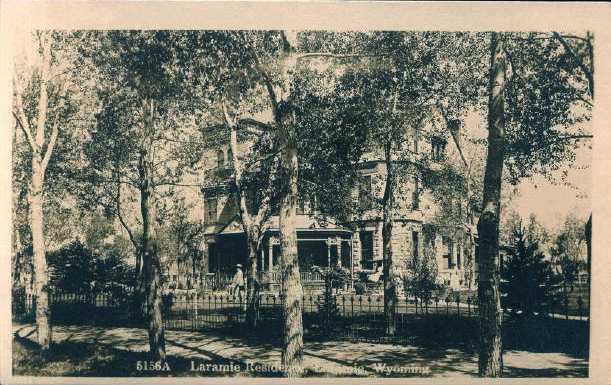
Ivinson Residence, 603 Ivinson Ave., 1910.
Note horse and carriage in driveway and Mr. Ivinson in yard.
In 1857, the Ivinsons move to Indiana and was employed as a paymaster for the Evansville & Crawforsville Railroad. Shortly thereafter Edward joined his brother John in the Iron foundry business
which was then supplying the Union Army.
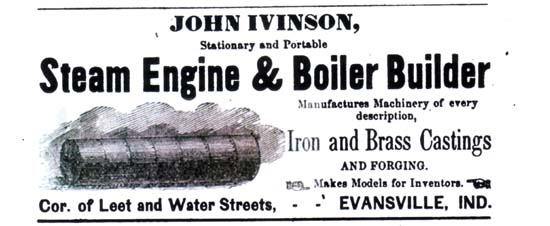
Advertisement for Ivinson Foundary, 1860.
By 1867, the Ivinsons were in Memphis. The City directory indicates that Ivinson and Gilbert were doing business
at 284 Main Street. In September, cholera and yellow fever struck the city. By December the Official Register indicated that some 259 persons had died of
the yellow fever. Some estimates indicated that as many as 600 to 1,000 died from the yellow fever and
the cholera. And yet again the Ivinsons picked up
stakes and moved onward. Ivinson borrowed funds for the purpose of establishing a general store in California.
He purchased goods for the new store and headed
west. Unfortunately, the railroad had not yet progressed beyond Tie Siding, south of Laramie.
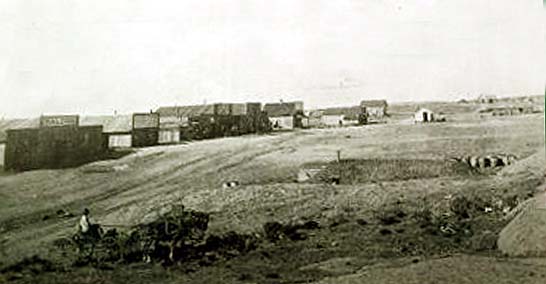
Tie Siding, 1890's, photo by J. E. Stimson
Tie Siding was aptly named. It was a supply point for railraod ties for
the Union Pacific. There he arranged a contract to provide railroad ties to
the Union Pacific.
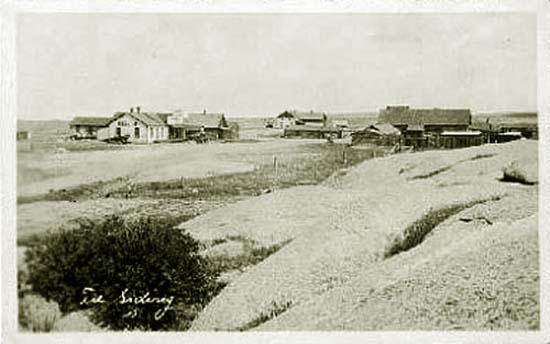
Tie Siding, approx. 1920, photo by Henning Svenson
Henry T. Williams in his 1876 The Pacific Tourist, Williams'
Illustrated Guide to Pacific R.R., California, and Pleasure Resorts across the Continent described
Tie Siding:
Tie-Siding, -- 555.2 miles from Omaha; elevation, 7985 feet. This is a
telegraph station, with side tracks for the accommodation of the numberous cars which are
loaded with ties, fencepoles and wood. Vast quantities are hauled from the
mountains in the vicinity of the Diamond Peaks to this siding. There are a
few houses, and the inevitable saloon -- houses occupied mostly by woodchopers and
teamsters -- while the saloons generally take the most of their money. A short
distance from this station two soldiers of an Iowa cavalry regiment were
killed by Indians at the overland stage station, in 1865. The pine board and mound
which marks their resting place will soon disappear, and there will be
nothing left to mark the spot where they fell. Near Tie-Siding are extensive ranches occupied by sheep during the summer.
Indeed, from the above photo and Williams' description, little has changed. On the west side of
U.S. 287, there remains the inevitable combination general store, saloon, and post office. On the
east side of the highway, on a side road, are several houses.
Ivinson determined that Laramie City showed great potential for growth and therefore
decided that he would establish his new general store there. Thus, Ivinson
arrived in Laramie on the first passenger train in 1868. The following year, he served on a committee which
brought the territorial prison to Laramie and in 1870 purchased the local bank located on the corner of
Third and what is now Ivinson. The bank later became part of the First National Bank of Laramie of which Ivinson became
President.
As a banker he financed the construction of Laramie's first courthouse located on the site
of the present one. In 1892, Ivinson commenced the construction of his home depicted in the next
series of photos.
The house was designed by architect Walter E. Ware and was constructed by Frank
Cook at a cost of $40,000. The home was equipped with the most modern amenities including
electricity. Ware subsequently moved to Salt Lake City where he became one of
Utah's most reknown architects designing, among other things, the Salt Lake City 1st Presbyterian
Church, the 1st Church of the Christ Scientist, the Westminster College
Payne Gymnasium, the University Club Building, and the Utah State Fair's the
Horticulture Building and the Mining and Manufacturing Building.
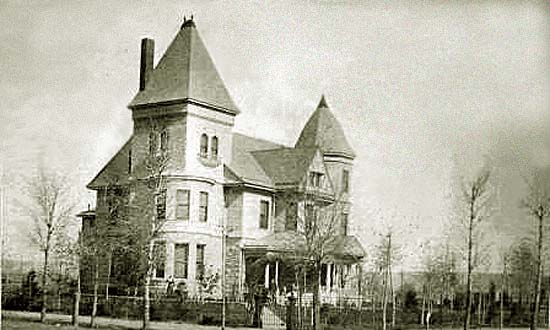
Ivinson Residence, undated
In 1892, Ivinson was nominated on the 10th ballot by the Republican Party for governor but
in the general election was defeated by John Eugene Osborne, a Democrat from
Rawlins. It was not the year to be on the ballot as a Republican. The country was in the midst of
a financial panic blamed on the Republicans. Osborne is now more noted as being the one who skinned Big Nose George Parrott, had his hide tanned and turned
into a medical bag and a pair of shoes, see Rawlins, which Osborne would wear on special occasions. The rest of Big Nose's remains were kept in a whiskey barrel
in Osborne's medical office until disposed of in a landfill. The shoes are now in the Carbon County Museum.
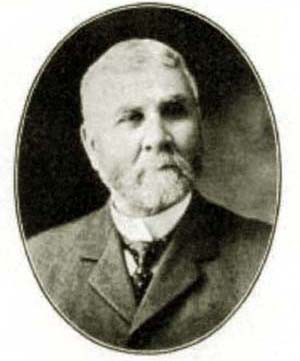 . . . . . .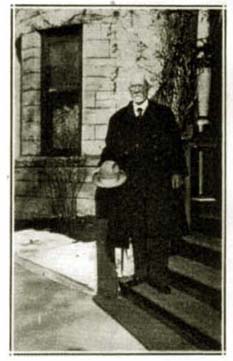
Left, Edward Ivinson, approx. 1902, age 72; Right, Edward Ivinson, approx. 1919, age 90.
Following his defeat, Ivinson came up smelling like the proverbial roses. As discussed with regard to Cheyenne, in 1892 shortly before his San Diego bank failed D.D. Dare departed
San Diego for parts unknown. In the summer on 1893, six Los Angeles banks closed, precipitating a run on the
San Diego Banks. Ivinson had established a winter home in San Diego and was already doing banking as Edward Ivinson and Compay, in Ensenada, Lower California,
seventy miles south of the border.
Ivinson took advantage of the panic and purchased a controlling interest in the newly oganized
Merchants National Bank, one of two San Diego banks to survive the panic. Eventually, he acquired full ownership.
Thus, he had an
interest in two banks, the Merchants National Bank as well as the First National Bank of Laramie. In 1904, Ivinson
sold his interest in the Merchants National Bank and returned to Laramie.
In 1915, Ivinson's wife of 61 years, Jane, died. In her memory he constructed the Ivinson Hospital. In
1921, he donated the house to the Episcopal Church for use as a girl's boarding school. As will be observed on other
pages, schools were instituted with the first settlements in the 1850's. Jane Ivinson was one of the
first teachers in Laramie. Additionally, she was responsible for organizing the Rebekahs, the women's counterpart to the
Odd Fellows of which Edward Ivinson was a member. Ivinson served in all of the chairs of the
Odd Fellows Lodge in Laramie.
The first legislature provided for the
auditor to be the territorial superintendent of public instruction and
made provision for uniform texts. Provision was made for school districts and certification of
teachers. In 1874, teachers' institutes were begun and by 1882 all teachers were
required to attend at territorial expense. In 1886, Cheyenne adopted a two-track system of high school eduation, college
preparatory track and a three year "business" track. The latter omitted Latin and some science.
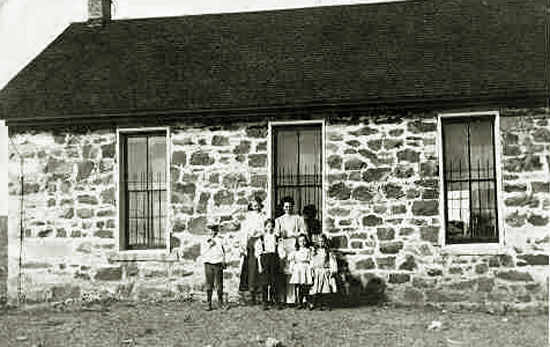 > >
Granite Canyon School, approx. 1900
Mandatory school attendance for students between the ages of 6 and 18 was instituted in
1873, although because of practical difficulties this may not have been
strictly enforced as to older students.
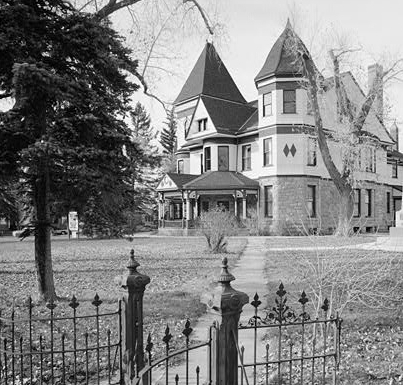
Ivanson Mansion
In rural areas, local schools, frequently only one or two rooms with one
teacher, would
go only through the 8th grade, although occasionally some high school programs would
be offered in the smaller schools. Conditions in the one room schools, heated only by a wood burning
stove, could in the winter be somewhat trying. In some schools, as an example,
penmanship was taught in the afternoon, so as to give the ink in the inkwells an opportunity to thaw.
High schools existed only in the major cities. As late as 1895 there were only
five high schools in the state. As a result of the distances involved, students from
rural ranches and outlying areas would, in order to attend high school,
board with relatives in cities in which high schools existed. Although, school buses had come into use by the 1920's, in some rural areas, in
the winter, teams and wagons remained in use as late as the 1950's. Thus, until the advent of
good roads and school buses, Ivinson's contribution made a high school education available when it
might otherwise have been impossible. The house is now the Laramie Plains Museum.
In 1918 at the age of 88, Ivinson was elected mayor of Laramie for a two year term. In 1922 at the age of 92, Ivinson married Augusta Haley, the widow of Ora Haley.
Ora Haley owned the Haley Livestock
and Trading Co., headquartered in Maybell, Colorado and was a major shareholder in the First National Bank of Laramie and had
served as Vice-President. Haley is sometimes regarded as the
last of the "Cattle Kings." The marriage, however, did not last long, ending in
divorce with Augusta being restored to the Haley name.. Thereafter, Ivinson wintered in Denver staying at the Brown's Palace Hotel or
the Shirley Savoy. In summers he stayed in the Connor Hotel on Third Street. Upon Ivinson's death in
1928, he left money for the construction of the
Ivinson Home for Aged Ladies at the corner of 20th and Grand. In addition to his other contributions to
Laramie, he provided funds for the tower and chimes in St. Matthew's Cathedral and the
World War Monument.
By 1970, the Ivinson house lay in disrepair. The ironwork fece was broken in places, some of the
windows of the house were boarded up. The grounds were overgrown. There was a danger that the house would be razed. In 1972, the Laramie Plains Museum acquired the proper and began its
restoration. The museum moved into the house in 1973.
Next page, Laramie continued.
|