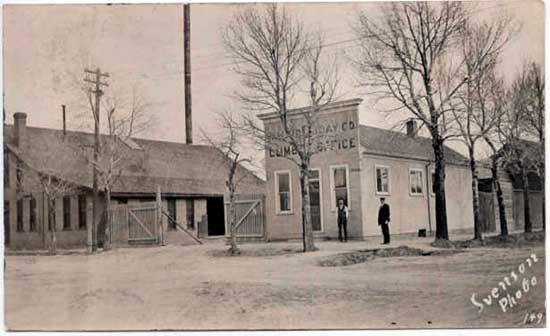
Holliday Lumber Company, Photo by Henning Svenson
William Helmus Holliday (1843-1925) came Colorado in 1865 at age 22 and worked for
a freighting company. In 1867, he was employed by a timber company at Sherman which he was
able to buy with his brother Jethro Holliday and William R. Williams. The
company provided the lumber for much of the construction of Greeley, Colo.
Within two years he was able to buy out his brother and Williams and moved to Laramie.
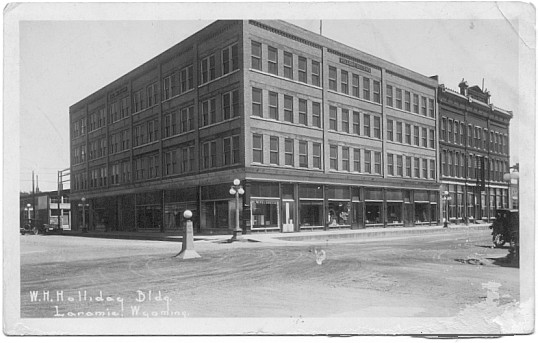
W. H. Holliday Company, corner of 2nd Street and Garfield, looking southeast, photo by Henning Svenson.
In 1886, the W. H. Holliday Co. was incorporated. The building
depicted cost $30,000 to construct. Ultimately, the business grew to occupy the entire block
between 2nd and 3rd and between Garfield and Custer. Holliday was active in Democratic Party
politics and served in the Territorial Legislature and was the Democratic candidate for
Congress and ran for governor in 1894. The building burned on April 14, 1948.
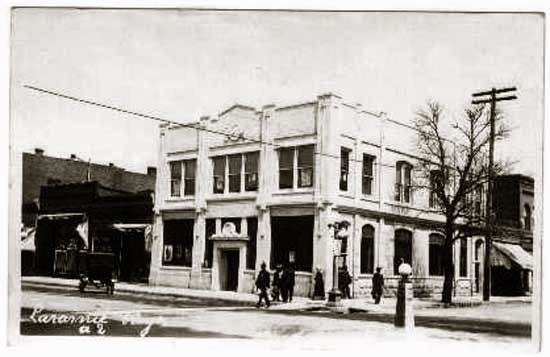
Albany National Bank of Laramie, 2nd Street, approx. 1920, photo by H.
Svenson
The Albany County National Bank was chartered in 1887 as the "Albany County National Bank of Laramie City and
changed its name to the "Albany National Bank of Laramie" in 1918. Additional views of the Bank
may be seen in the views of 2nd street below.

Front Street (now 1st Street), looking south, photo by H. Svenson
Svenson came to the United States from Germany in
1903 and joined his brother John Henning in Omaha in 1905. In 1905, he
opened a photography studio in Laramie. In addition to studio photographs he
made a number of photos in the 1920's documenting Laramie and its area.
The studio is still in business, operated by the fourth generation of the
same family. The American Heritage Center at the University of Wyoming maintains
over 20,000 negatives of photographs taken by the family. In addition to
photography, Svenson was a beekeeper, gardener and raised Belgian hares.
Additional Svenson photos are on the Laramie I,
Laramie II, Sherman, and
Lincoln Highway pages.

Second Street, approx. 1920, photo by H. Svenson
2nd Street, photo by H. Svenson
Located on Second Street, north of Ivenson Aveune was the Empress Theatre, Laramie's first movie palace.
During the days of silent movies, the theare featured its own orchestra to provide additional
thrills to the action upon the screen.

Empress Theatre, Second Street, undated.
The theatre was constructed in 1912 and opened in 1913. In 1938, it temporarily closed for
remodeling and reopened in 1939 at the Fox Theatre with the front facade redone in an
art-deco style.

Fox Theater, Second Street, 2005. Photo by Geoff Dobson
The Fox has fallen on hard times. It closed in 1975. Its roof is in a state of partial collapse and
the building is occupied only pigeons with the droppings so extensive that those going into the
building are required to wear hazardous material suits.

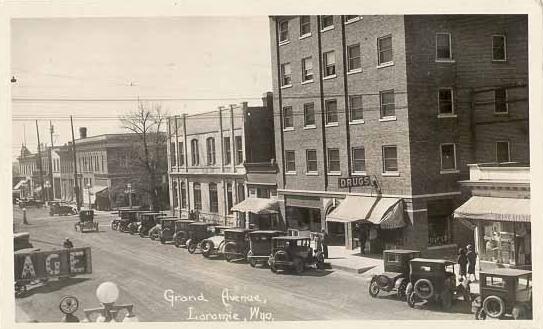
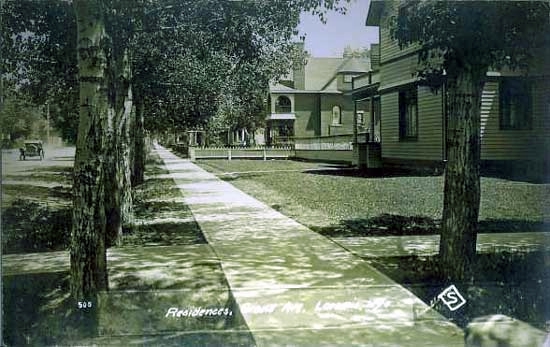
Grand Avenue, looking toward intersection with 2nd Street, approx. 1920, photo by H. Svenson
A review of the 1880 census for Laramie indicates that there were at least three such facilities on
Front Street, a white facility owned by Lizzie Palmer and two mulatto facilities. Additionally,
the census also reflected that were three soiled doves on 3rd Street. The census is unusual in that it
clearly shows the professions of the various doves. The entry for Lizzie Palmer shows
occupation as "Keeping House of Ill Fame." Normally, in most towns the census merely reflects the
inmates of such establishments as "keeping house," "actresses," or "boarders." Thus, in the 1870 census for
Cheyenne, the famous madam Ida Hamilton is shown as a "housekeeper" and the remaining residents of
the house (excepting the cook) are shown as "dressmakers." However, the Cheyenne census for 1880
was also an exception. There,
although Ida Hamilton is shown as "keeping house," no doubt is left as to the
profession of the remaining seven female inmates of Hamilton's establishment.
It has been contended that Laramie tolerated
the existence of the facilities as a revenue raising measure by collecting fines of $7.00 and $7.50. There
were repeated arrests and fines for Sophia Riccard a resident of 3rd Street, but any belief that the
City fathers were merely using the situation to raise money is speculation. Just as likely is that
there was a difficulty in obtaining convictions or adequate fines under the territorial laws.
In 1873, Cheyenne's famous madam, Ida Hamilton, as an example, was prosecuted in the District Court for
Laramie County and found guilty of "keeping and maintaining a lewd house,
for the practice of fornication." She was sentenced to four months in the Laramie County Jail by the district judge.
On appeal, the case was reversed on the basis that Hamilton was entitled to have the
sentence determined by the jury. Hamilton continued to operate her house. In 1879, one of the
clients attempted to murder one of the inmates, Ida Snow, by choking her. Snow's screams aroused
others in the house and her assailant Edward Malone was shot to death by Charles Boulton. The death of
Malone was found by the jury to be justifiable homicide. Mrs.
Snow recovered from her injuries and as shown by the 1880 census was soon back at work. Snow is, perhaps, an example of the
difficulties of widowhood in the 19th Century. Snow, an Irish immigrant, was widowed by age 27 and was,
thus, apparently forced, far from home, into a life of degradation and shame, to die "unknelled, uncoffined, and unknown." [Lord Byron,
Childe Harold, Canto iv, stanza 179.]
Certainly other cities elsewhere did use the keeping of bawdy houses as an oppotunity to enhance municipal revenues.
Thus, notwithstanding that a Texas law made illegal the keeping of bawdy houses, San Antonio, the
home of Fannie Porter, hostess to members of the Wild Bunch, actually issued licenses for keeping of
such facilities. Ultimately, the Texas courts held that the ordinance providing for
licensure was itself illegal. One madam after finding out that
the City licensing ordinance was invalid, sued to get back her
$500.00 licensing fee.

Grand Avenue, 1918.
Next page: Cheyenne.
|