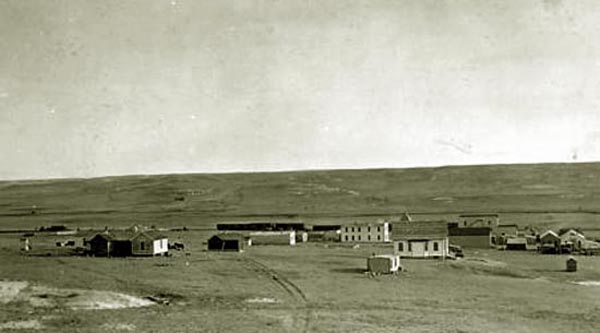
Van Tassell, undated.
Prior to the coming of the
motor car, small towns abounded. The towns would frequently consist of a church, a general store, post office, saloon, and a
Grange, Odd Fellows, or like Van Tassell a Woodman's Hall. Throughout rural America such towns would be strung along railroad tracks or a stage line on an average of
about ten to fifteen miles apart, a convenient distance for isolated homesteaders to hitch up and ride to
town for church, lodge meetings, and supplies. Such were Node and Van Tassell to the east of Lusk and
Manville, Keeline, and Shawnee to Lusk's west. On Sunday afternoons, a baseball game might also attract teams
from neighboring towns.
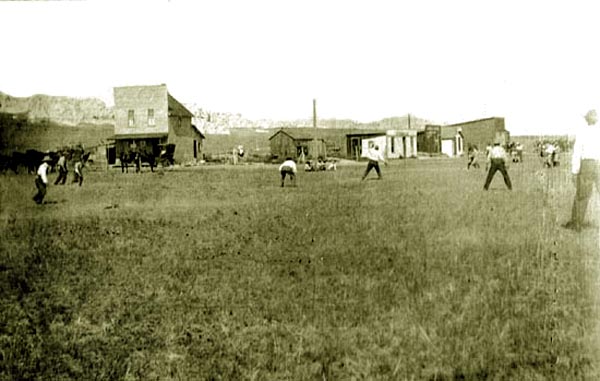
Sunday afternoon game, Van Tassell vs Harrison, Neb., approx. 1914.
Sunday baseball was illegal in Nebraska, so the Harrison 9 had to come to Van Tassell. Harrison was led by its star pitcher and
Clerk of Court, Arch Davis and star catcher "Happy" Davis. The lineup for Van Tassell was Pitcher, Geiger; Catcher, Derrick;
Left base, Boone; 2nd base, Daniels; 3rd base, Pickrel; short stop, Roberts; left field, Clingman; center field, Siegman, and
right field Hammond. Umpire was Wilhermandorfer from Harrison. On one Sunday game, Van Tassell won 10-2 with
Harrison's only runs being in the 8th inning.
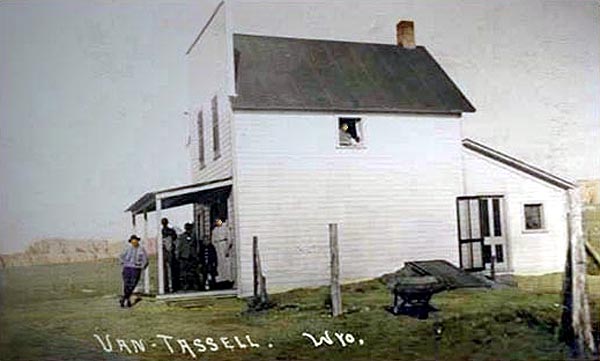
Scene at Van Tassell, approx 1917
Van Tassell was founded when the Fremont,
Elkhorn and Missouri Valley Railroad arrived in 1886. The town was named after Ranchman Van Rensselaer Schuyler ("R.S.") Van Tassell, photo lower on
page.
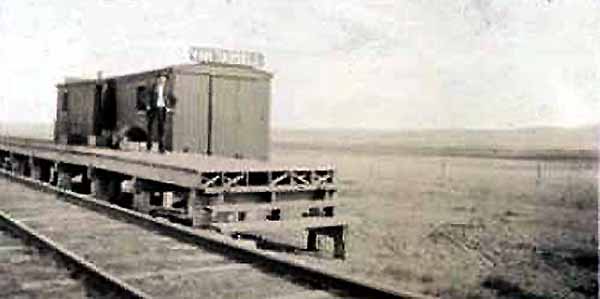
Passenger Depot, Van Tassell, Wyoming, undated
The use of a box car as a railway depot was not unique to Van Tassell. The Railroad also
used a box car as the depot in Keeline to the west of Lusk. At the opposite end of the state, the Union Pacific used
three box cars on a siding as the railway station for Granger. In Granger, the center car housed the ticket and baggage office. Another car
constituted the freight station and the third was the passenger waiting room, divided into
Ladies' and Gentlemen's waiting lounges. The two waiting areas were divided by a chalk line drawn on the floor. Smoking was
permitted on one side of the chalk line in the Gentlemen's Lounge but prohibited on the Ladies'side of the line.
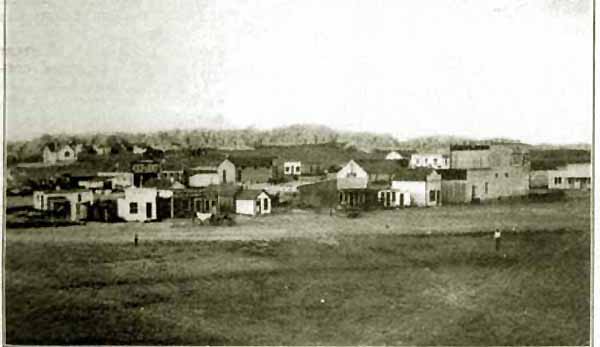
Van Tassell, 1919
As later discussed, in the early years of the 20th Century there began the promotion of "dry farming." Dry farming was generally not
profitable on small homesteads of 160 acres since it required that land remain fallow every other year. As a
result in 1909 Congress passed the "Enlarged Homestead Act of 1909. With promotion of the availability of
land suitable for dry farming in eastern Wyoming there began a land rush for homesteads
in the small towns strung along the Chichago, Burlington and Quincy.
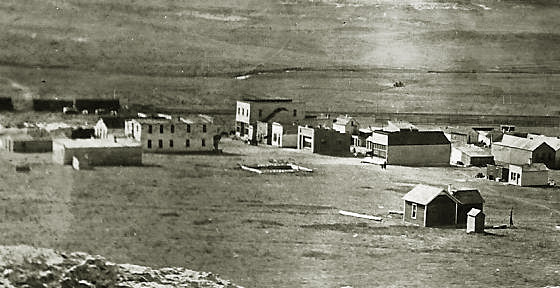
Van Tassell, 1914
Van Tassell was incorporated in 1916 and rapidly became a main shipping point for
Goshen and Niobrara Counties and at one time had a newspaper, the Van Tassell Pioneer replaced by
the Van Tassell Booster. The business community consists of two stores, two churches, an electric
plant, the Kuester Hotel, three cafes, Cunningham's pool hall, Adams & Killings Reo automobile dealership and a city jail.
Cunningham's advertised, among other things,
"Mick's Drinks of All Kinds." "Cliff Hanger" serials were shown in the
Woodman Hall.
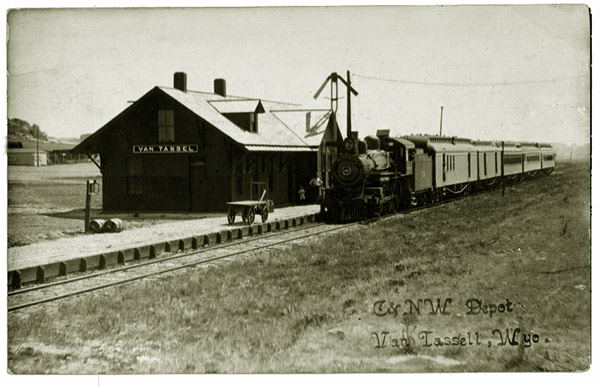
Railway depot, Van Tassell, 1914.
(Note the sign on the depot spelling Van Tassell with one "L.")
With growth, the town was able to support a respectable railway depot. Prior to
1922 the road between the state line westward to Orin Junction was "unimproved." Thus,
to a great extent prior to the improvement of the road even local transportation to Lusk or
Harrison was by train or horse and wagon.
The town was also home to
Ferdinand Branstetter Post No. 1 of the American Legion, the first post chartered in the
United States. The charter is now on display in the Stage Coach Museum in Lusk.
Other charters in addition to Van Tassell were issued on the same day for Washington, D. C.,, Denver, Colo.,
and St. Louis, Mo. The post in Washington, originally known as the John J. Pershing Post No. 1 and now known as the George Washington Post No. 1 is
recognized as the first post since its charter was signed first. Ferdinand Branstetter Post No. 1., however,
claims to be the first post in that it convened its organizational meeting approximately an hour before Washington.
Branstetter, originally from Nebraska, was one of the first
residents of the area to be killed in World War I.
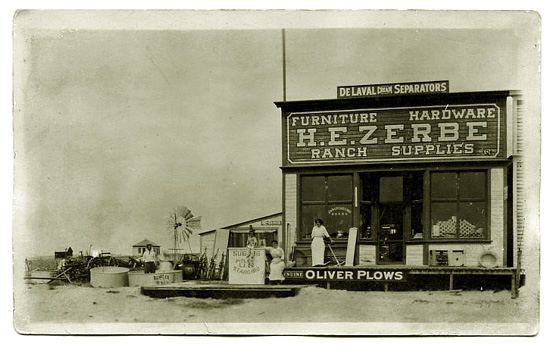
Harvey Zerbe's Hardware Store, Van Tassell, Wyoming, approx.
1912.
Harvey E. Zerbe (1881-1975) opened the store in 1912. The store closed in the 1930's. He was also a plumber and steam fitter.
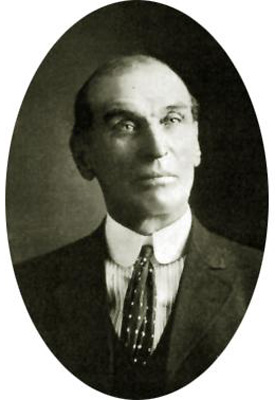 R. S. Van Tassell R. S. Van Tassell
The Booster was a typical weekly newspaper
of the time with advertisements and social items and minutes of the town council meetings on the first page and
syndicated contents on the inside pages. Beginning in the 1920's, following construction of what is now
US Highway 20, business was conducted in nearby Harrison, Neb. or in Lusk. The bloom was off of
dry farming. The town slowly declined reached a
nadir in the 1990's of a population of 8. As of the 2000 census the town's population is 18. The Town has a modern town hall and
community center.
The area presently encompassed
by Niobrara County, however, did not begin to be settled until the 1870's with the
establishment of the Sage Creek Cantonment near the old Hat Creek Road Ranch north of the
Hat Creek Breaks north of present day Lusk. Some settlement occurred, of course, south of Lusk in Goshen County near
Rawhide Buttes.
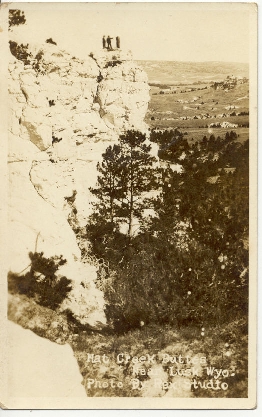
Hat Creek Butte, north of Lusk
The Hat Creek Breaks, a line of hills are, like Rawhide Buttes, an extension of a geologic formation
known as the Pine Ridge Escarpment which divides the Great Plains from the rest of the
state. It was from the Breaks that early intreped travellers on
the Black Hills Stage first felt that they were really in the Black Hills. The Black
Hills received their name as a result of the ponderosa pine which from a distance seemed
black when seen in contract to the lighter chalky sedimentary rocks. Rawhide Creek was first
described by Rufus B. Sage in his description of his early 1840's trip through
the area:
This creek traces its course over a broad sandy bed, through a wide valley of rich clayey loam,
slightly timbered and luxuriant in grasses. Towards its head it is shut in upon both sides by high pine hills; but,
in passing on, these mural confines are exchanged for the prairies, and the
creek finally debouches into the Platte.
North of the Breaks on Sage Creek was the Hat Creek Station. As
noted on a previous page, there were two Hat Creek Stations, the newer one slightly
to the west of the old is still in existence. Hat Creek, itself, is in
Nebraska, but through error, Capt. Egan in establishing the fort, thought he was on
Hat Creek. The name stuck. Further to the north, near present day Mule Creek Junction and just south of the present day
Weston County line, was the Robbers' Roost Road Ranch. The Robbers' Roost Station was a
long, low, crude building with a sod roof. See photo on Deadwood Stage page.
Next Page: Jay Em and Node.
|