|
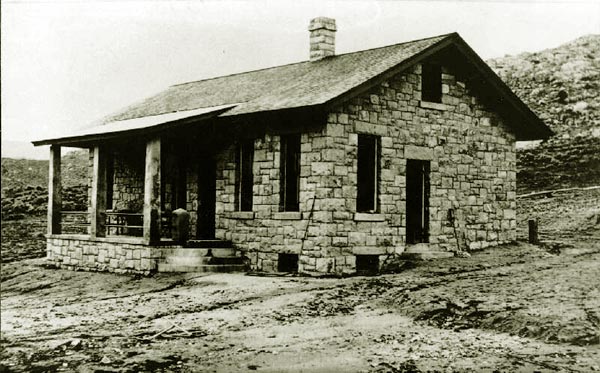
Dam Keepers House, Pathfinder Dam, 1906
Portions of the North Platte are among the most modified of the rivers of the west. Seven dams create reservoirs
along its course, the Seminoe, photo below, and Kortes dams upstream from the Pathfinder Reservoir and the Alcova,
Gray Reef, Glendo and Guernsey downstream.
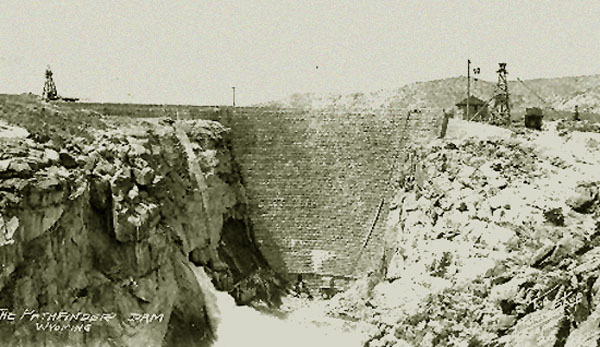
Pathfinder Dam, 1922
The oldest of the dams is the Pathfinder located about 45 miles
southwest of Casper at the confluence with the Sweetwater. The dam, one of the first constructed by the
Reclamation Service, was started in 1905 and completed in 1909. Difficulties were experienced in construction including even obtaining
a contractor. The first bidder, Bradbury & O'Gara of Denver withdrew their bid after reviewing
local conditions. The next bidder N.S. Sherman of Oklahoma City did not have the financial
ability to carry out the project. Ultimately, the contract was awarded to Geddis and Seerie Stone Co. of Denver for $428,000.
With cost overruns, however, the project cost climbed to $626,523.52. Other projects
undertaken by the firm included the Colorado State House, the Brown Palace Hotel, the
Omaha Post Office and the Cheesman Dam which provided water for Denver. The diversion tunnel carrying the
river around the dam site and ultimately serving as the outlet for the reservoir was
constructed by Kilpatrick Brothers and Collins Contracting Company.
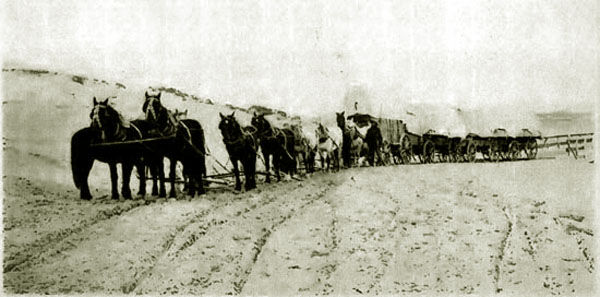
Freight wagons hauling supplies to Pathfinder Dam.
Difficulties of construction on the Pathfinder Dam included merely getting materials to the site. Concrete had to be brought by freighter
from Casper. There it cost an average of $2.68 a barrel. Transportation to the dam
site cost an additional $3.00 a barrel and took anywhere from three days to over
two months to traverse the distance from Casper.
All kinds of freighters were used to bring the materials to the
dam, from a 22-horse team drawing five wagons carrying 31,000 pounds of cement to a two-horse
sheep wagon.
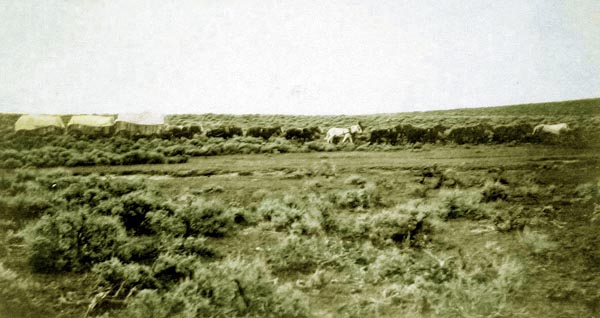
Freight wagons hauling cement to Pathfinder Dam, 1907.
The site lacked coal for the steam engines powering the machinery. Kilpatrick Brothers had used
all local timber as fuel for their machinery. Thus, cord wood
was cut in the Pedro Mountains ten miles to the south and hauled to the site. The difficulties
of transportation were such that at the conclusion of construction much of the
equipment was abandoned as not being worth the cost to get it back to Denver.
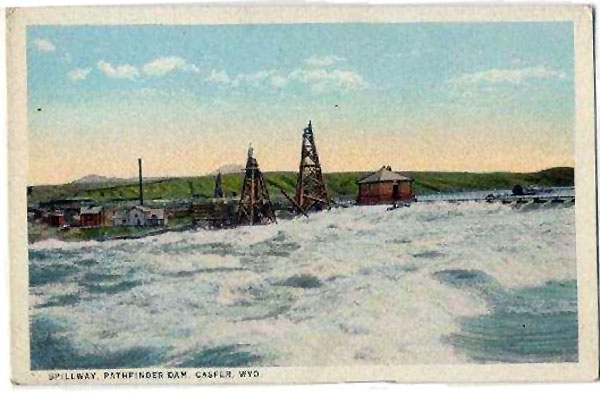
Pathfinder Spillway approx. 1920
The weather was of little help in the construction of the Pathfinder. Initial excavation to bedrock was
delayed while crews cut through ice as much as three feet thick in temperatures as low as
-29 F., followed in the spring by flooding. Thus, the first stones of the masonry
structure were not laid until August of 1906. Indeed, the weather had its final revenge
in 1909. During the last month of construction the weather again took its toll, alternating
between cold, rain and wind.
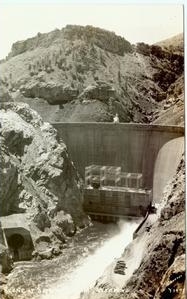 Seminoe Dam, constructed 1936-1939
The Pathfinder Dam originally held promise for irrigation. However, in 1912, the State Engineer,
A. J. Parshall, complained that although the
original intent of the project was to provide irrigation for 700,000 acres, most of which was to be
in Wyoming, the vast majority of the
area actually irrigated was in Nebraska. He continued by noting that, excluding some 17,000 acres belonging to
the North Platte Canal and Colonization Company, only 4,000 acres had been reclaimed in the
state, "a very small area to reclaim after submerging 22,000 acres * * * * [a large part of
which] was improved and irrigated land * * *."
The Seminoe Dam, 31 miles northeast of Rawlins, was constructed between 1936 and 1939. The
reservoir provides hydro-electric power and water for
irrigation, with water being released as necessary to the Pathfinder downstream. As with the
Pathfinder, weather still provides problems. Freeze-thaw has caused cracking in
the concrete structure requiring refurbishment and monitoring. Access to the
power plant is on occassion obstructed by rockslides in the narrow canyon also requiring
maintainance and extra expense.
The name "Seminoe" is an
Anglicizing of Cimineau. The Seminoe Mountains and
Reservoir are named after Basil Cimineau LaJeunesse,
a French-Louisianan guide who accompanied each of the three Fremont
expeditions including the 1843 expedition along the Platte and Sweetwater.
LaJeunesse was killed by Klamath Indians in May, 1846, near Klamath Lake,
Oregon. The name was applied first to the area by LaJeunesse's brother, Charles LaJeunesse.
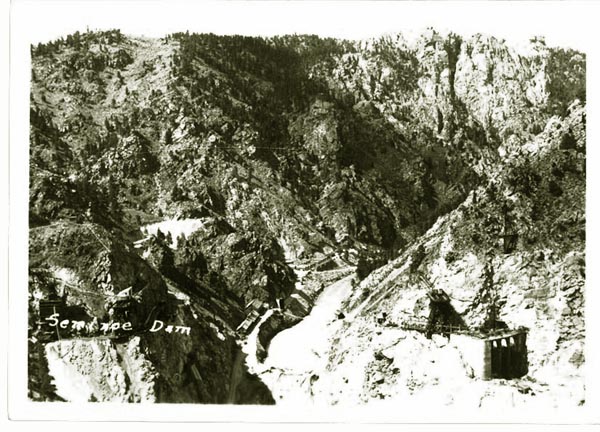
Seminoe Dam under construction, 1936.
Next Page, Bessemer.
|